Trump’s Hormuz Map Turns a Shipping Crisis Into a Sovereignty Contest
President Donald Trump has escalated the psychological war over the Strait of Hormuz by posting a map labeling the waterway as “new” US territory, days after declaring that America had “total control” of the strategic chokepoint. ABC News confirmed the social-media post on Tuesday.
The map does not change international law.
But strategically, it reveals how far the conflict has moved beyond freedom of navigation.
Washington and Tehran are no longer arguing only over whether commercial ships can pass safely. They are competing over who possesses the authority to define the rules of passage through the strait.
Trump insists Hormuz is open, the mines have been removed and the US Navy controls maritime access. Tehran says the opposite: the strait remains effectively closed until Washington lifts its blockade on Iranian ports, eases sanctions, releases frozen assets and ends military pressure.
Reuters reported Tuesday that the June interim arrangement has now expired without a replacement and that Iran has adopted an increasingly offensive posture.
The reality at sea is closer to Iran’s description than Trump’s rhetoric.
Commercial traffic remains dramatically below prewar levels. Reuters has reported that normal traffic of roughly 130 ships per day has fallen to only a fraction of that number, while crude flows through Hormuz have collapsed from around 18 million barrels per day to roughly 2 million.
That means America may possess overwhelming naval superiority without yet possessing something equally important: commercial confidence.
Tankers do not care which government claims “total control.” They care whether their crews can transit without being struck.
That distinction was underlined again Tuesday when the UK Maritime Trade Operations center reported that a tanker in the Strait of Hormuz had been struck by an unknown projectile, damaging its engine room and causing a crew casualty. UKMTO has documented repeated projectile attacks in the waterway throughout the conflict.
This is why Trump’s territorial rhetoric is strategically risky.
If treated merely as provocation, Tehran can ridicule it. Iranian officials have already dismissed the idea of American sovereignty over Hormuz as a “delusion.”
But if Washington begins behaving as though military control creates political ownership, it risks transforming an already dangerous navigation dispute into a direct sovereignty confrontation with Iran and potentially Oman.
Iran’s response is equally dangerous.
Tehran argues that ships cannot cross without its approval and continues using Hormuz as leverage to demand sanctions relief and an end to the US blockade. Iranian negotiator Mohammad Bagher Ghalibaf said Tuesday that the strait would remain shut until Washington fulfills those conditions.
Neither side therefore recognizes the other’s authority.
That is the definition of an unstable military standoff.
The diplomatic picture is almost as confused. Trump says there are “no talks or conversations” underway or scheduled. Yet other US officials have described continuing contacts with different parts of the Iranian establishment, highlighting the extraordinary disconnect between public messaging and private diplomacy. Reuters reported the same contradiction on Tuesday.
For markets, however, the message is increasingly clear.
The conflict is becoming prolonged.
Brent crude closed Tuesday at about $91 a barrel, its highest level in three weeks, as hopes of an immediate US-Iran settlement faded.
WARYATV ASSESSMENT
Trump’s map should be understood as coercive signaling, not a legal acquisition of territory.
But the symbolism matters.
America is saying: we have the naval power to decide who moves through Hormuz.
Iran is answering: geography gives us the power to make that control prohibitively expensive.
Both statements contain part of the truth.
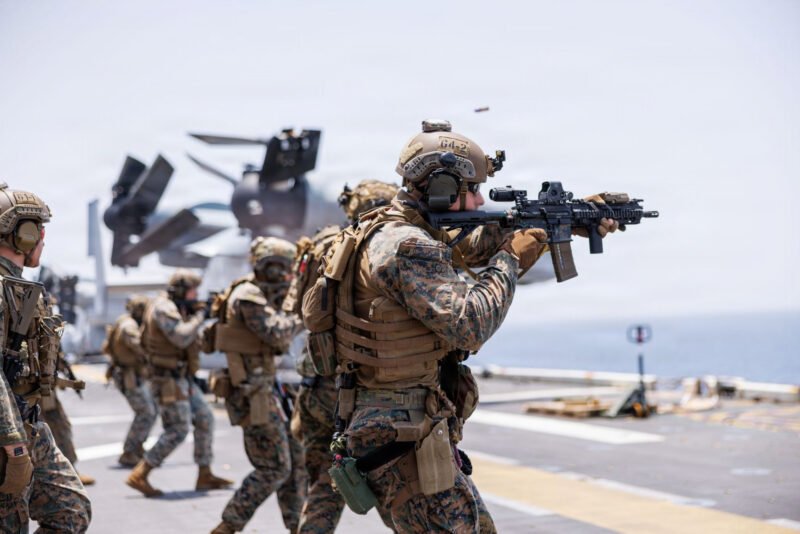
The United States can dominate the conventional maritime battlefield and maintain its blockade for a prolonged period. Defense Secretary Pete Hegseth has said Washington can sustain it indefinitely through naval rotations.
Iran, however, does not need to defeat the US Navy.
It needs to keep enough missiles, mines and maritime uncertainty alive that commercial shipping remains afraid to return.
That is why the real battle for Hormuz will not be decided by whose flag appears on a social-media map.
It will be decided when tankers return in numbers approaching normal traffic without military escorts, emergency alerts or fear of attack.
Until that happens, neither Washington nor Tehran truly controls Hormuz.
They are fighting over it.