While the world watched missiles, a bigger game was unfolding—quiet moves by China and Russia that could reshape global power.
In the early days of the U.S.-Israel war with Iran, American intelligence agencies reached a stark conclusion: the conflict was never just about Iran. It risked becoming a proxy contest among the world’s major powers.
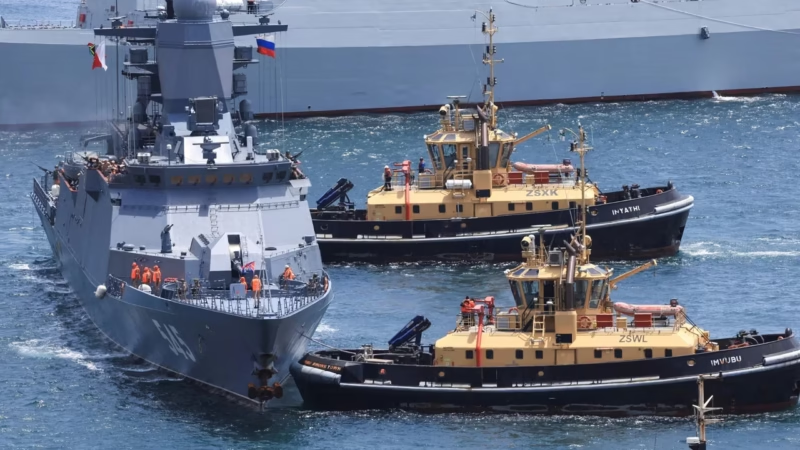
According to a report by CBS News, analysts at the Defense Intelligence Agency assessed that both China and Russia were actively exploring ways to support Tehran—signaling a potential shift toward a broader geopolitical confrontation.
The findings point to a two-track response from Washington’s rivals. Moscow, officials say, had already crossed a threshold by sharing battlefield intelligence with Iran, including insights on U.S. military positions in the Middle East. Beijing, meanwhile, appeared to be weighing a more calculated, longer-term move: supplying advanced radar systems that could strengthen Iran’s air defenses.
At the center of that concern were X-band radar systems—technology capable of tracking low-flying drones and cruise missiles with high precision. If delivered, such systems could significantly blunt U.S. and Israeli air superiority, complicating future strikes and extending Iran’s defensive resilience.
It remains unclear whether China ultimately followed through. But the mere consideration has raised alarms in Washington, not because of immediate battlefield impact, but because of what it suggests: a quiet convergence of interests among powers seeking to counter U.S. dominance without direct confrontation.
This is not a formal alliance. There is no treaty binding Beijing, Moscow, and Tehran. Instead, officials describe a looser alignment—one defined by opportunism. Iran does not need to win militarily; it only needs to endure. For its partners, prolonging the conflict—or raising its cost for Washington—can be strategically sufficient.
The timing is also telling. As the war strained U.S. resources and exposed divisions with allies, both China and Russia appeared to test how far they could go without triggering escalation. Intelligence sharing, potential technology transfers, and diplomatic backing all fall short of direct intervention, but collectively they shift the balance.
The episode underscores a broader reality now shaping global security: modern conflicts rarely stay contained. Even when fighting is localized, the strategic contest quickly expands—into intelligence, technology, and influence.
The battlefield may be in the Middle East, but the real competition stretches far beyond it.