After a Week of War, Tehran’s Arsenal Appears Crippled — but the Regime Remains Standing.
Iran’s missiles shook the region. Now its military machine may never be the same.
Only a week into the war, the imbalance in military power is already reshaping the strategic map of the Middle East. Iran’s long-built arsenal — once presented as an existential threat to its neighbors — appears severely degraded, even as the regime in Tehran remains intact.
Military assessments circulating in regional capitals suggest that much of Iran’s offensive infrastructure — missile depots, drone facilities, command centers and logistics networks — has been significantly damaged. While Tehran continues to project defiance, the scale and speed of the strikes have exposed the vulnerability of a system that spent decades building deterrence through volume and reach.
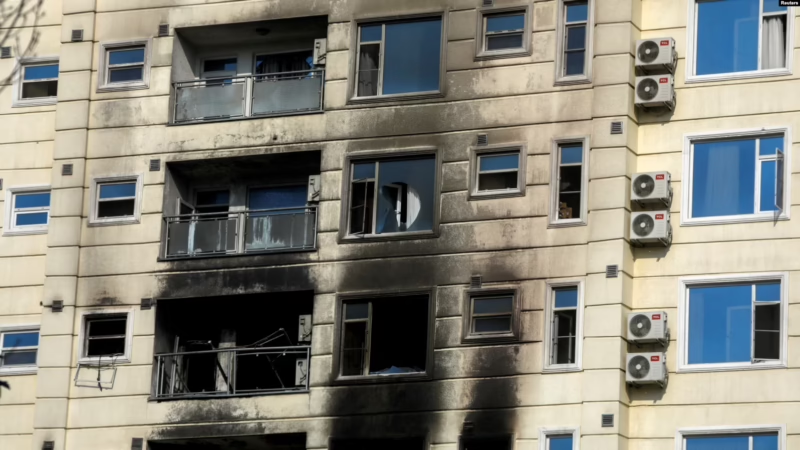
The conflict began on February 28, when U.S. and Israeli forces launched coordinated attacks that killed Supreme Leader Ali Khamenei and targeted key military assets. Iran responded with missile and drone barrages across the Gulf, striking more than ten countries. Though officials in Tehran framed the attacks as directed at military targets, several civilian sites — airports, ports and residential areas — were also hit.
For years, Iran’s strategy was clear: accumulate enough destructive capacity to deter intervention and dominate regional calculations, potentially under the shield of a future nuclear deterrent. That calculus now appears disrupted. Analysts increasingly describe the dismantling of Iran’s “weapons empire” as a strategic turning point — one that could neutralize its ability to project overwhelming force for years.
Yet history offers caution. After Iraq’s defeat in Kuwait in 1991, Saddam Hussein’s regime survived another 12 years despite military devastation and sanctions — a scenario often recalled as the “Safwan tent” precedent. A weakened but intact regime can endure, rebuild and recalibrate.
There are few signs that Iran’s governing structure is collapsing from within. The Islamic Revolutionary Guard Corps, or IRGC, remains cohesive. No large-scale defections have emerged. No unified opposition force has demonstrated the capacity to replace the system. While some speculate about transformation from within, meaningful change would likely require fractures inside the security establishment — and those are not yet visible.
A full-scale ground invasion to impose regime change, as occurred in Iraq in 2003, appears unlikely. The political appetite and military resources required would be enormous. That leaves Washington facing a narrower set of options: accept a weakened but functioning system, or attempt to shape whatever leadership emerges from within it.
If current trends continue, Iran’s capacity to threaten its neighbors with overwhelming military force may be sharply reduced by the war’s end. Whether that ushers in a more restrained Iran — or simply a wounded power waiting to rebuild — will define the next chapter.
The arsenal may be collapsing. The regime, for now, is not.