No Exit, No Plan—Trump’s War Speech Raises More Questions Than Answers.
As rockets lifted NASA’s Artemis II mission toward the moon, attention inside the White House turned sharply back to Earth—and to a war with no defined end.
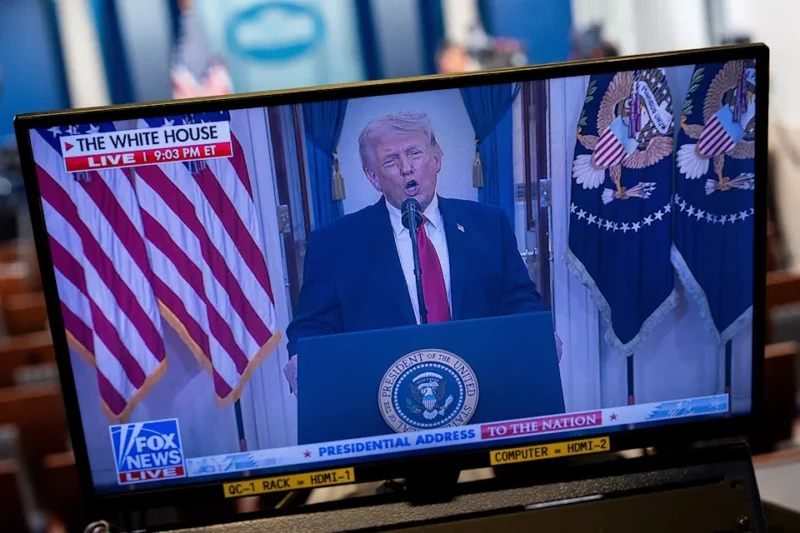
In a primetime address, Donald Trump sought to explain the rationale behind the expanding conflict with Iran. Instead, he delivered a message heavy on resolve but light on detail. The central takeaway was not what he said, but what he did not: no timeline, no clear endgame, and no updated strategy.
The omission matters. At a moment when the war is becoming a defining feature of his presidency, Trump offered reassurance without specificity. He insisted that Iran’s nuclear ambitions remain an “intolerable threat” and framed the campaign—branded “Operation Epic Fury”—as essential to global security. Yet he did not explain how recent strikes have altered Iran’s capabilities, nor how success will ultimately be measured.
By the third layer of the address, the broader pattern becomes clear. This is a war being justified in principle but managed in ambiguity.
Trump emphasized that “core strategic objectives are nearing completion,” even as he signaled further strikes in the coming weeks. The tension between those two claims—progress and escalation—underscores the absence of a defined endpoint.
There were subtle shifts. Trump dropped earlier references to active negotiations with Iran, a notable departure after days of suggesting diplomatic channels were open.
He also avoided renewed attacks on NATO allies, softening rhetoric that had threatened to widen political divisions. And while he ruled out, implicitly, a ground invasion, he offered no alternative pathway to secure critical objectives such as Iran’s enriched uranium or the stability of the Strait of Hormuz.
The result is a strategy defined less by clear milestones than by flexibility—some would say improvisation. Military pressure continues to build, with thousands of additional U.S. troops moving into the region. Yet diplomatic efforts remain largely absent from public view, and the administration has not outlined a framework for de-escalation.
At home, the political and economic stakes are rising. Trump acknowledged concerns over fuel prices, calling them temporary, but offered no concrete measures to cushion the impact. Markets have reacted sharply to shifting signals from Washington, and the cost of energy is already climbing.
There are gray areas in the administration’s case. U.S. intelligence assessments prior to the war indicated Iran had not yet initiated a weapons program, though it had positioned itself closer to that capability. Trump’s assertion that threats have been largely neutralized sits uneasily alongside continued military operations.
The speech also highlighted a deeper institutional shift. Trump’s decision to launch and expand the war without clear congressional backing—and his unprecedented appearance at a Supreme Court hearing earlier the same day—points to a broader consolidation of executive authority during wartime.
Still, for supporters, the message was consistent: strength, speed, and a promise of decisive results. For critics, it reinforced concerns about a conflict advancing without clear boundaries.
The strategic question now is not whether the United States can sustain the campaign—it is whether it knows where it is heading. Wars defined by open-ended objectives tend to evolve on their own terms, shaped as much by reaction as by design.
And in that space between intention and outcome, the risk is not just prolonged conflict—but a gradual shift into a war whose conclusion becomes harder to define than its beginning.