Israel’s Mossad has escalated its psychological warfare campaign against the Iranian regime, claiming to know the identity of Tehran’s newly appointed top war commander—an individual whose name Iranian authorities refuse to reveal, citing security concerns.
In a pointed message Tuesday on its Persian-language X (formerly Twitter) account, the intelligence service wrote:
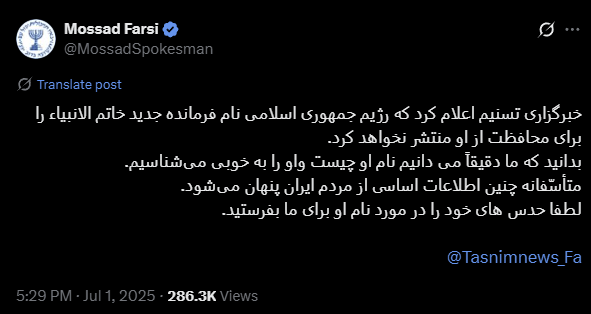
“We know exactly who he is and know him well. Unfortunately, such basic information is hidden from the Iranian people. Please send us your guesses about his name.”
The tweet directly referenced a Tasnim News Agency report earlier the same day, which stated that the identity of the new commander of Iran’s Khatam al-Anbiya Central Headquarters would remain classified due to the assassinations of the last two commanders—believed to have been carried out by Israeli airstrikes.
The Shadow Commander No One Can Name
Iranian state media has offered no name, no photo, and no details about the man who now controls one of the most critical command posts in Iran’s military hierarchy. This comes just weeks after Maj.-Gen. Ali Shadmani, the last commander of Khatam al-Anbiya, was killed alongside another top IRGC official in a suspected Israeli strike.
Mossad’s taunt throws a spotlight on what critics call a widening gap between the regime and its people. While Iranian officials keep the public in the dark “for security,” Israel’s intelligence service claims to have penetrated the veil of secrecy with ease—and is flaunting it.
Psychological Ops in the Digital Age
The tweet is part of a broader Farsi-language influence campaign launched by the Mossad in recent weeks. Previous posts have:
Mocked senior Iranian officials for secretly following the account.
Offered VPN guidance to Iranian users.
Warned users not to engage with the account to avoid surveillance by Iranian intelligence.
The tone is provocative, taunting, and at times deeply personal—clearly aimed at undermining the regime’s credibility and creating friction between its leadership and the public.
A Direct Hit at Khamenei’s Narrative
Earlier in the day, the same account claimed that Supreme Leader Ayatollah Ali Khamenei had “surrendered” and approved backchannel negotiations with both the United States and Israel—a dramatic departure from his usual hardline stance. Mossad described this as “the beginning of the end of the Islamic Republic” and declared: “The countdown has begun.”
Khamenei, 86, last appeared on state TV on June 26, insisting that Iran would “never surrender.” The contrast between his public defiance and Mossad’s claims of secret negotiations is clearly part of the information war playing out online.
Behind the Curtain of a Secret War
The Khatam al-Anbiya Central Headquarters is the nerve center of Iran’s strategic military planning. Its leadership is critical, particularly amid the aftermath of joint Israeli-American strikes that hit multiple Iranian nuclear and military targets last month.
That Iran now feels compelled to hide the identity of its top commander speaks volumes about its internal vulnerabilities. That Mossad is using this secrecy as a digital weapon shows how modern intelligence wars are being fought—not just with drones and missiles, but with tweets and narrative control.
Bottom Line
Mossad’s message is clear: “We see you.” Tehran’s refusal to name its war commander only adds weight to Israel’s campaign to frame the Islamic Republic as crumbling, paranoid, and penetrable. For the Iranian public—many of whom rely on VPNs and encrypted apps to access uncensored information—the battle for truth and trust has moved online.
Whether this campaign will shift public opinion or further destabilize Iran’s internal power structure remains to be seen. But one thing is certain: the war for hearts and minds inside Iran is fully underway.