As bombs fall and lives are torn apart on both sides of the Israel-Lebanon border, the world is holding its breath. Today, in a race against time, the U.S., France, and eight global powers made an urgent plea: a 21-day ceasefire. This is not just another political maneuver—it’s a desperate attempt to pull both countries back from the brink of an all-out regional catastrophe.
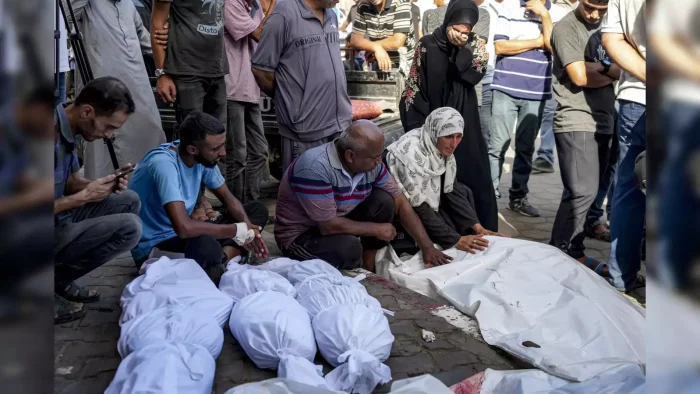
With Israel’s warplanes bombarding Lebanon and Hezbollah launching missiles in retaliation, the air is thick with fear, anger, and uncertainty. In just three days, over 615 lives have been lost in Lebanon, and more than 2,000 wounded, many of them innocent civilians. Hospitals are overwhelmed, homes destroyed, and entire families displaced.
The joint statement from the U.S., European Union, and major global players couldn’t be clearer: “This conflict is intolerable.” As the violence escalates, the risk of a broader regional conflict grows terrifyingly real. The stakes have never been higher.
France’s Foreign Minister is already on his way to Beirut, spearheading last-ditch diplomatic efforts. This isn’t just about words—it’s about preventing an explosion of violence that could drag the entire region into a nightmare of war.
As bombs rain down, so do the pleas for peace. U.N. Secretary-General Antonio Guterres took the global stage with an emotional appeal: “Stop the killing. Step back from the brink.” His message to the world? If this conflict spirals out of control, we’re not just looking at another battle. We’re staring down the barrel of an all-out catastrophe.
But in the midst of this diplomatic whirlwind, Israel’s military isn’t backing down. Its army chief has bluntly warned that his troops should prepare for a ground invasion of Lebanon, a terrifying possibility that could plunge the region into a war even bloodier than we’ve seen.
In a brazen escalation, Hezbollah fired a missile aimed at Israel’s Mossad headquarters near Tel Aviv, rattling nerves across the region. Israel intercepted the missile, but the message was clear—this war is heating up, and the next phase could be even deadlier.
As Israeli fighter jets pummel Hezbollah targets and rockets rain down on northern Israel, ordinary civilians on both sides are left to wonder—when will this end? In Lebanon, Prime Minister Najib Mikati is pleading with the world to act, condemning Israel’s strikes that are leaving women and children dead in what he calls “the world’s full view.”
Back in Washington, U.S. military officials are trying to keep hope alive. Despite the ominous signs, they insist there’s still time for diplomacy. But even as they push for de-escalation, the fear that one wrong move could ignite an unstoppable war remains at the forefront of everyone’s minds.
President Joe Biden didn’t mince words in a recent interview: “An all-out war is possible,” he said, warning that while the door to peace is still open, time is running out fast.
As diplomatic leaders meet in the halls of power, the real cost of this conflict is being paid in blood by the people of Lebanon and Israel. Families torn apart, children separated from parents, and entire communities reduced to rubble. Since October 8, 70,000 people have fled northern Israel alone.
In Lebanon, the death toll climbs by the hour. Roads are flooded with refugees, fleeing homes that may no longer exist when they return. Hospitals are stretched beyond capacity, while the United Nations refugee agency is sounding the alarm, calling the situation in Lebanon “a humanitarian nightmare.”
Behind the chaos lies a dangerous alliance. Hezbollah’s rockets are flying in solidarity with Hamas, whose October 7 attack on Israel ignited this inferno. Since then, Hezbollah has fired nearly 9,000 rockets at Israel, while Israel has responded with relentless airstrikes. And looming in the shadows is Iran, a powerful backer of both Hezbollah and Hamas, whose foreign minister has made a chilling statement: “Iran will not remain indifferent in case of a full-scale war in Lebanon.”
The next few days are critical. The global powers are pushing for peace, but the drums of war are growing louder. Will diplomacy pull us back from the edge, or will the Middle East be plunged into a full-scale regional war that could reshape the world as we know it?
As the situation unfolds, one thing is certain—the world is watching. And as we hold our collective breath, the question remains: how much longer can this last before everything changes?