In his inaugural address as NATO Secretary-General, Mark Rutte pledged to bolster Western support for Ukraine, reaffirming the alliance’s commitment to Ukrainian sovereignty. Rutte, who assumed office on Tuesday, vowed to navigate NATO through an era marked by war in Europe and geopolitical tensions while expressing confidence in his ability to work with any future U.S. administration, regardless of the outcome of the upcoming American presidential election.
“There can be no lasting security in Europe without a strong, independent Ukraine,” Rutte said in his first remarks from NATO headquarters. He reiterated a 2008 commitment made by NATO leadership that Ukraine’s rightful place is within the alliance, a goal that remains aspirational amid Russia’s ongoing war of aggression.
Rutte’s comments come as Russian forces press their offensive in eastern Ukraine, testing the limits of Ukraine’s military resources. While Ukrainian troops have made gains, including limited success in Russia’s Kursk region, they remain outnumbered and face mounting casualties. Despite the grim reality on the ground, Rutte emphasized that supporting Ukraine is a necessary investment in European stability. “The cost of supporting Ukraine is far, far lower than the cost we would face if we allow Putin to get his way,” he said.
Though NATO’s support for Ukraine remains strong, full membership for the war-torn country appears remote. Major member states, including the United States and Germany, are hesitant to bring Ukraine into the fold while active conflict persists. Rutte declined to offer a timeline for Ukraine’s potential accession, acknowledging the complexities of the situation.
However, he pointedly criticized China for its ongoing support of Russia, stating that Beijing’s alignment with Moscow has enabled the prolongation of Europe’s largest conflict since World War II. “China has become a decisive enabler of Russia’s war in Ukraine,” Rutte remarked. “This cannot continue without consequences for China’s interests and reputation.”
U.S. Election Looms Over NATO’s Future
With just weeks until the U.S. presidential election, Rutte underscored the importance of the trans-Atlantic bond between the United States, Canada, and Europe. A change in U.S. leadership could dramatically reshape NATO’s dynamics. Surveys indicate a tight race, which could see the return of Donald Trump, whose previous administration frequently criticized NATO allies over defense spending and called into question America’s commitment to the alliance.
NATO faced existential questions during Trump’s tenure as smaller member nations feared the U.S. might withdraw from the mutual defense pledge that underpins the organization’s mission. Still, Rutte expressed confidence that he could work with either U.S. candidate. “I know both candidates very well,” he said. While praising Trump for pushing NATO allies to increase defense spending and taking a tough stance on China, Rutte also lauded Vice President Kamala Harris as a “highly respected leader” with a “fantastic record.”
When asked about Trump’s potential impact on NATO’s future, Rutte sidestepped speculation, saying only that both candidates “understand that, in the end, the trans-Atlantic relationship is crucial, not just for Europe.”
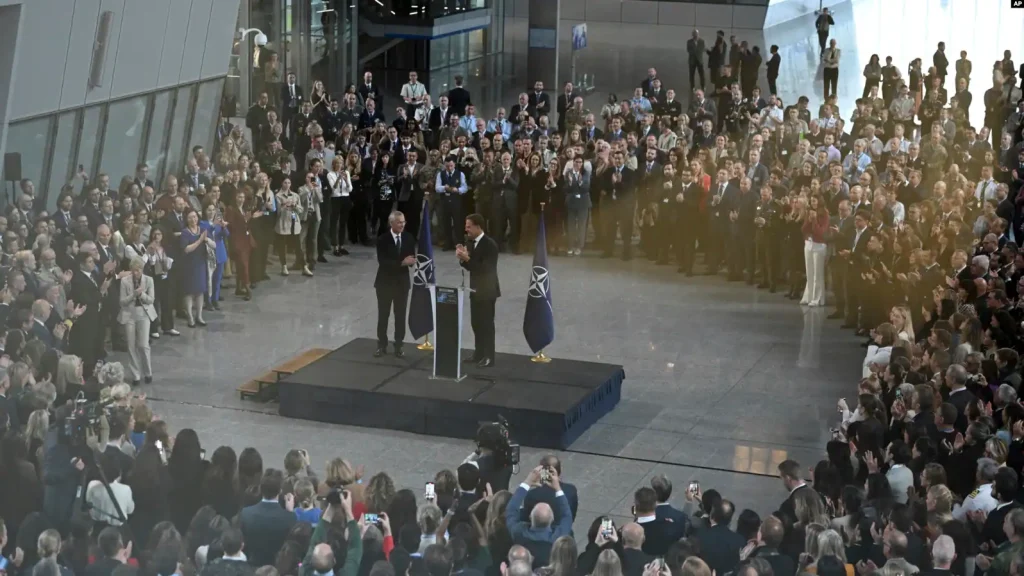
During his first day in office, Rutte joined his predecessor, Jens Stoltenberg, in a symbolic ceremony at NATO headquarters in Brussels. The two leaders laid a wreath honoring fallen military personnel before the flags of NATO’s 32 member states. Stoltenberg, visibly moved, praised Rutte’s leadership credentials, noting his experience as prime minister of the Netherlands for 14 years and his ability to navigate coalition governments. “Mark has the perfect background to become a great secretary-general,” Stoltenberg said.
Rutte outlined several key priorities for his term, including increasing defense spending among member states and expanding NATO’s partnerships with countries in Asia and the Middle East. He also underscored the need for NATO to adapt to an increasingly complex global security environment, where threats range from cyberattacks to rising authoritarianism.
As Rutte embarks on his new role, he inherits an alliance strengthened under Stoltenberg’s leadership. Since Stoltenberg took office in 2014—just as Russia annexed Crimea—NATO has ramped up its defense posture, a shift that Rutte aims to continue. Stoltenberg’s tenure, second only to Dutch diplomat Joseph Luns, who served for 12 years, leaves a lasting legacy of reinforced NATO unity amid growing global tensions.
The ceremony concluded with Stoltenberg passing a Viking gavel to Rutte, a symbol of the alliance’s continuity and strength. As Rutte settles into his new role, he faces the monumental task of steering NATO through uncertain times while ensuring it remains the cornerstone of trans-Atlantic security.
With the war in Ukraine showing no signs of abating and the U.S. election poised to reshape the global landscape, Rutte’s ability to unify NATO’s 32 members and navigate shifting political currents will be crucial in the months ahead. “I cannot wait to get to work,” he said, poised to begin a term that will likely define NATO’s future course.