Kenya’s President William Ruto has cancelled more than $2.5 billion in contracts with India’s Adani Group after the company’s founder, Gautam Adani, was indicted in the United States on charges of bribery. The decision, announced during Ruto’s state of the nation address on Thursday, represents a significant blow to the conglomerate’s international expansion and comes amid growing scrutiny of its global operations.
Cancelled Contracts
Two major deals with Adani Group were terminated:
- Airport Development: A nearly $2 billion agreement to construct a second runway and upgrade the passenger terminal at Nairobi’s Jomo Kenyatta International Airport (JKIA) in exchange for a 30-year lease.
- Energy Infrastructure: A $736 million public-private partnership signed last month for the construction of power transmission lines.
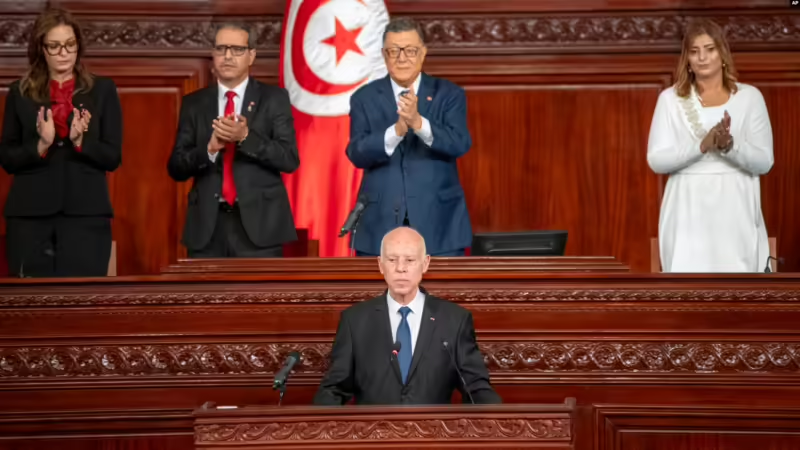
Ruto directed agencies within the Ministries of Transport and Energy to immediately halt the procurement processes. He attributed the cancellations to “new information provided by investigative agencies and partner nations,” a veiled reference to the U.S. indictment.
The announcement drew applause from lawmakers in parliament and resonated with a public increasingly critical of the deals, which many viewed as opaque and lacking in accountability.
Adani Group Allegations and Denials
The U.S. indictment accuses Gautam Adani and seven co-defendants of paying approximately $265 million in bribes to Indian government officials to secure lucrative contracts. These allegations add to existing controversies surrounding the Adani Group, including a 2023 report by short-seller Hindenburg Research, which accused the company of improper governance practices and financial irregularities—claims the Adani Group has consistently denied.
In a statement responding to the U.S. charges, the Adani Group dismissed the allegations as baseless and pledged to pursue “all possible legal recourse.”
Criticism and Protests in Kenya
The Adani Group’s deals in Kenya have faced mounting opposition, particularly the airport project, which was proposed in March under a procedure bypassing competitive bidding. It only became public knowledge through a social media leak in July, sparking public outcry.
In September, a Kenyan court temporarily blocked the airport deal following a lawsuit that argued it failed to provide value for money to taxpayers. Despite the controversies, senior government officials, including Ruto, defended the agreements until recently. Energy Minister Opiyo Wandayi, for instance, told senators hours before the president’s announcement that the power transmission deal would proceed as no corruption had been detected in its awarding.
Legal Implications
Legal experts suggest that the Adani Group may challenge the cancellations through arbitration, particularly concerning the power transmission contract, which had already been signed.
“Any dispute resolution framework is likely to lean toward the state, considering the fact that the deal has been cancelled on the basis of integrity issues,” said George Kamau, a Kenyan lawyer specializing in public procurement.
A Shift in Kenya’s Approach
Ruto’s decision reflects a broader move to distance his administration from controversial deals and bolster Kenya’s reputation for governance. It also highlights the impact of international collaboration on combating corruption. By citing “information from partner nations,” Kenya signals its readiness to align with global standards on accountability, a step likely to resonate with the international community.
The cancellations come at a time when Kenya is grappling with rising public debt and pressure to improve infrastructure. While the termination of these high-profile deals may reassure critics of Adani’s practices, they also raise questions about the country’s strategy to attract foreign investment and develop critical infrastructure.
For the Adani Group, the fallout represents a growing challenge to its global ambitions as scrutiny intensifies over its business practices.