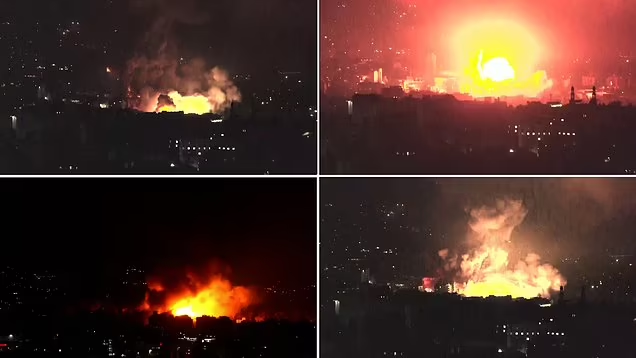
From Lübeck to Today: How Strategic Bombing Reshaped War—and Echoes in Modern Conflicts.
From wooden cities to digital warfare—the logic of war hasn’t changed, only the tools.
In March 1942, the British Royal Air Force made a calculated decision that would redefine modern warfare: it chose the historic German city of Lübeck not for its military value, but for its vulnerability.
The city’s medieval structure—dense, flammable, and largely built from timber—made it an ideal target for incendiary bombing. Over the night of March 28–29, British bombers dropped hundreds of tons of explosives, including tens of thousands of incendiary devices.
The result was devastating: a firestorm that destroyed nearly a third of the city, killed hundreds, and displaced thousands.
It was not just an attack. It was a message.
Britain’s strategy marked a shift from targeting military infrastructure to targeting morale. By striking culturally significant cities, London aimed to demonstrate that Germany itself was no longer insulated from the war.
The objective was psychological as much as physical: to erode public confidence and force political reconsideration in Berlin.
The response from Adolf Hitler was immediate and revealing. Enraged, he ordered the Baedeker Blitz—retaliatory strikes against British cities such as Bath and York, chosen not for industrial importance but for their cultural heritage. War had entered a new phase, where symbolism and identity became targets alongside armies and factories.
Yet the outcome exposed a critical miscalculation.
Despite the destruction, British morale did not collapse. Instead, the bombings hardened public resolve, reinforcing a pattern that would repeat throughout the war: strategic bombing inflicted immense damage, but rarely achieved decisive political surrender on its own.
That lesson still resonates today.
Modern conflicts—from the Middle East to Eastern Europe—continue to echo this logic. Civilian infrastructure, energy systems, and symbolic sites are often targeted not only to degrade capabilities, but to send signals, shape narratives, and influence political will.
What has changed is not the intent, but the method.
Where Lübeck burned under incendiary bombs, today’s wars deploy precision strikes, drones, cyberattacks, and economic pressure. Yet the underlying calculation remains familiar: that by increasing the cost of war for societies, leaders can force strategic concessions.
History suggests otherwise.
The bombing of Lübeck—and the retaliatory campaigns it triggered—demonstrated that societies under attack often adapt rather than collapse. Instead of breaking morale, such strategies can entrench resistance and prolong conflict.
Eighty-four years later, the firestorm over Lübeck stands as more than a historical episode.
It is a reminder that wars are not only fought on battlefields—but in cities, in minds, and in the fragile line between pressure and resilience.