Drones were supposed to change everything. They did—but not in the way armies expected.
The search for a decisive weapon—one that ends wars quickly and cheaply—has shaped military thinking for centuries. From gunpowder to nuclear arms, each technological leap promised a shortcut to victory.
Yet one month into the war involving Iran, a familiar reality is reasserting itself: new weapons rarely deliver clean endings. Instead, they reshape the battlefield—and often prolong the fight.
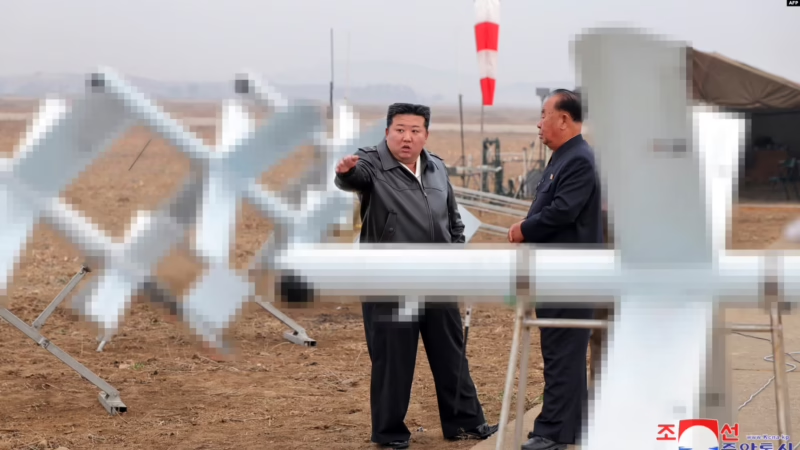
Drones are the latest example of this paradox. Their appeal is obvious. They are relatively cheap, widely accessible and capable of delivering both surveillance and precision strikes in real time.
In conflicts like the war in Ukraine, and now across the Middle East, unmanned systems have become central to military operations. They allow weaker actors to punch above their weight, while enabling stronger powers to extend their reach without risking pilots or expensive platforms.
But this “democratization” of firepower carries a cost. Because drones are affordable and easy to produce—even with off-the-shelf components—they lower the threshold for sustained conflict.
A single cruise missile can cost millions; a loitering drone may cost tens of thousands. The result is not decisive victory, but endurance warfare—where both sides can keep fighting longer than expected.
Iran has embraced this logic. Despite heavy airstrikes, it continues to deploy waves of drones across the region, targeting infrastructure and threatening maritime routes like the Strait of Hormuz.
These systems may lack the sophistication of advanced missiles, but they compensate with volume, flexibility and psychological impact. The constant presence of drones—often heard before they are seen—creates a persistent climate of fear among civilian populations.
This psychological dimension is as important as the physical damage. Warfare is no longer confined to front lines; it is experienced in cities, ports and even digital spaces. The line between military and civilian targets becomes increasingly blurred, amplifying both disruption and uncertainty.
Yet drones are not a magic solution. Their rise has exposed a deeper imbalance: defending against cheap weapons is often far more expensive than deploying them. Interceptors, radar systems and advanced defenses strain resources, creating an unsustainable equation.
As former U.S. commander David Petraeus has argued, no military can indefinitely counter low-cost threats with high-cost responses.
The next phase is already taking shape. Militaries are racing to develop cheaper countermeasures—electronic jamming, laser defenses and AI-driven detection systems. But history suggests this cycle will continue: innovation followed by adaptation, advantage followed by erosion.
What emerges is a sobering conclusion. Technology changes how wars are fought, but not the fundamental nature of war itself. There is no single breakthrough that guarantees victory. Instead, each new tool expands the battlefield, deepens the complexity and often extends the conflict.
The age of drones has arrived. But rather than ending wars, it is making them harder to finish—and easier to sustain.