Bab el-Mandeb Threat Raises Global Trade Fears as Iran Expands Leverage.
As tensions over the Strait of Hormuz continue, a second, equally critical chokepoint is entering the spotlight—and with it, a far more dangerous global scenario.
The Bab el-Mandeb Strait, linking the Red Sea to the Gulf of Aden, is emerging as Iran’s next potential pressure point. Iranian officials have openly signaled that if the conflict escalates, disruption could extend beyond Hormuz—effectively putting two of the world’s most vital trade arteries at risk.
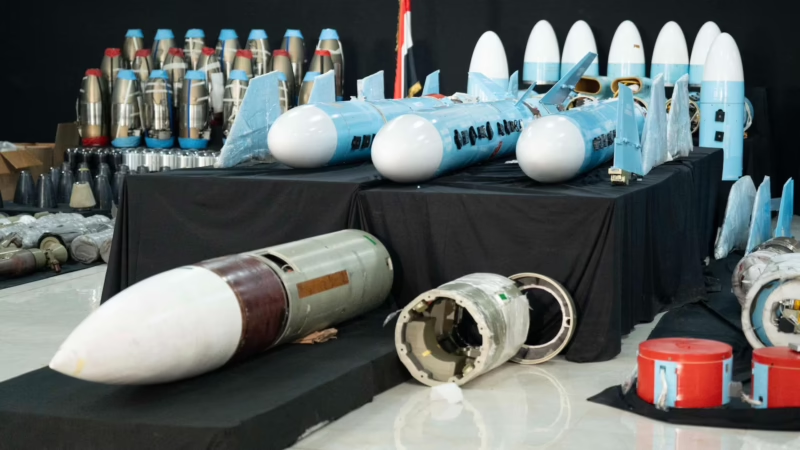
This is not theoretical. The Bab el-Mandeb already sits within a volatile security environment, with Yemen’s Iran-aligned Houthi forces having disrupted shipping since 2023. Missile and drone attacks forced major companies, including Maersk, to reroute vessels, reshaping global trade patterns and driving up costs.
The strategic significance is immense. At its narrowest, the strait is just 18 miles wide, yet it carries millions of barrels of oil daily alongside critical goods—from food to industrial materials. It is also a key alternative route for Gulf energy exports diverted from Hormuz during crises.
What makes the current moment especially dangerous is the potential for overlap.
Iran does not maintain direct military control near Bab el-Mandeb. Instead, its leverage flows through regional proxies, particularly the Houthis. While not fully controlled by Tehran, they remain aligned enough that increased Iranian pressure could translate into intensified attacks or even temporary closure of the waterway.
If that happens, the impact would be immediate and compounding.
The disruption of Hormuz alone has already pushed oil prices sharply higher and strained global supply chains. A simultaneous threat to Bab el-Mandeb would amplify those effects—restricting both Gulf exports and Red Sea transit routes, effectively squeezing global trade from two directions.
Energy markets would not be the only casualty. Shipping insurance costs would surge, rerouting would increase transit times, and developing economies—already vulnerable—would face rising food and fuel prices.
Even without a full closure, the mere threat is enough to disrupt flows. As seen in previous Houthi campaigns, uncertainty alone can deter shipping, reducing traffic and tightening supply without a single decisive strike.
This is the new reality of modern conflict: chokepoints as weapons.
For global powers, the challenge is no longer limited to reopening one strait—it is preventing a cascading disruption across interconnected maritime routes. For regional players, particularly Gulf states, the stakes are even higher, as alternative export pathways become critical to economic survival.
The ceasefire may have slowed the crisis, but it has also expanded its geography.
And if Bab el-Mandeb becomes the next front, the world will not be dealing with a regional disruption—but a systemic shock to global trade itself.