Exclusive Strategic Analysis
Why do states often face greater resistance immediately after achieving a diplomatic breakthrough?
One of the most profound miscalculations in contemporary statecraft is the belief that diplomatic recognition is a finish line. For an aspiring or re-emerging state, securing a major diplomatic breakthrough is frequently treated as the ultimate shield—a structural transition that locks in sovereignty and permanently reduces external vulnerability.
Yet structural intelligence assessments reveal a far more volatile reality: diplomatic breakthroughs rarely freeze geopolitical competition; more often, they accelerate it.
This phenomenon defines the Recognition-Retaliation Cycle, a recurring pattern in international politics where a sudden leap in a state’s institutional legitimacy dramatically intensifies the threat calculus of its competitors.
When a political entity successfully crosses the threshold from an ignored anomaly to a recognized strategic actor, it forces regional adversaries to recalibrate their long-term interests, almost always triggering an immediate wave of asymmetrical pushback.
This paradox exists because formal recognition fundamentally alters the distribution of regional power. Before a major diplomatic shift occurs, an unacknowledged territory can often be contained through quiet diplomatic isolation or political neglect.
However, the moment that entity gains formal legitimacy, new security alliances, or a recognized voice in the international architecture, it creates clear strategic winners and losers.
Competitors who perceive themselves as losing ground feel an urgent imperative to act before the newly recognized state can institutionalize its gains.
The resulting cycle moves rapidly from regional anxiety to coordinated political pressure, aggressive information operations, and ultimately, targeted economic or proxy warfare designed to slow or reverse the state’s momentum.
Historical patterns confirm that this vulnerability is an inherent feature of global geopolitical realignment rather than an isolated anomaly.
When Western nations extended recognition to Kosovo, it did not pacify the region; instead, it intensified aggressive international lobbying campaigns, diplomatic blockades, and deep gray-zone opposition from Belgrade and Moscow.
In South Sudan, the triumph of internationally backed sovereignty almost immediately exposed the young state to fierce regional competition for internal influence, fragmenting its security environment.
Similarly, every expansion of Taiwan’s unofficial diplomatic network or high-level international engagement triggers an immediate, highly predictable escalatory response from Beijing, manifesting in intensified military posturing, economic leverage, and the systematic poaching of its remaining formal allies.
Even Ukraine’s post-2014 trajectory proves the rule: as Kyiv formalized its integration with Western political and security architectures, it faced an escalating campaign of cyber warfare, economic coercion, and direct military intervention aimed explicitly at fracturing that alignment before it could fully solidify.
Applying this macro-level framework reveals that recent developments in the Horn of Africa conform precisely to this global pattern.
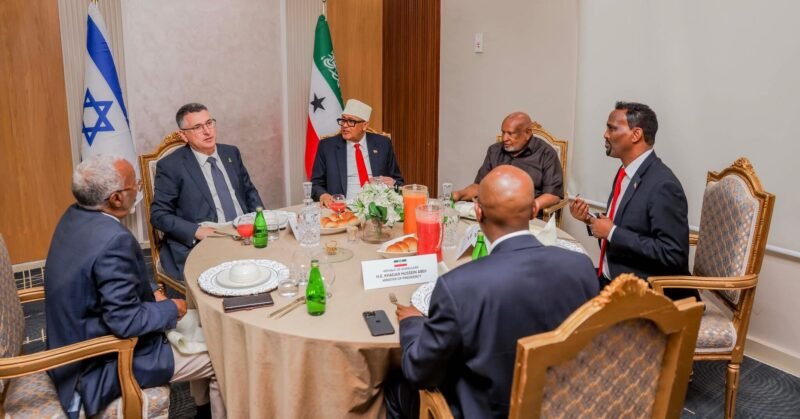
The formal recognition of Somaliland by Israel—followed by the highly synchronized establishment of its first official embassy in Jerusalem—represents a classic catalyst for structural recalculation.
By formalizing ties with a major United Nations member state, Somaliland has moved from the periphery of international law directly into the center of the Red Sea security architecture.
This breakthrough does far more than validate decades of de facto self-governance in Hargeisa; it signals a profound shift in maritime, security, and intelligence alignment across from the critical Bab al-Mandeb Strait.
Predictably, this sudden leap in prominence has generated an immediate regional and international counter-reaction.
The resulting friction is not a series of disconnected, coincidental events, but rather the cumulative pressure of independent actors responding to the exact same structural shock.
For competitors whose regional strategies rely on a centralized or fragmented Horn of Africa, a recognized, strategically aligned Somaliland threatens the geopolitical status quo.
The pushback observed across diplomatic forums, synchronized information campaigns, and sudden security re-alignments aligns perfectly with pattern-based analysis: multiple external actors, acting out of individual self-interest rather than a centralized conspiracy, are exerting pressure across multiple domains to challenge the durability of Hargeisa’s new diplomatic reality.
For strategic planners, navigating this cycle requires shifting focus away from single-event advocacy and toward comprehensive domain monitoring. The longevity of a diplomatic breakthrough depends entirely on a state’s ability to withstand the immediate, inevitable backlash.
Strategic collection priorities must focus heavily on a clear set of indicators: escalations in sophisticated cyber operations targeting state infrastructure, coordinated diplomatic offensives aimed at dissuading other nations from following suit, and targeted attempts to exploit domestic political narratives during sensitive election cycles.
Recognition is not a passive shield; it is an active lightning rod.
The ultimate challenge for a state emerging from isolation is recognizing that diplomatic success does not diminish the storm—it simply changes the rules of the game.
Will Domestic Political Warfare Hand a Victory to Mogadishu and Beijing?
Is Hostile Foreign Funding Driving KAAH’s Anti-Israel Crusade?