Muslim identity is becoming a 2026 U.S. midterm campaign issue. Republicans say they are confronting extremism and sharia law. Critics say an entire religious community is being turned into an electoral threat. The November vote may show whether that strategy still works in a country where Muslim political power is growing.
WASHINGTON — Muslim identity is becoming an increasingly visible issue in the 2026 U.S. midterm elections, as Republican candidates link debates over Islam, extremism and religious law to national security and Democratic politics.
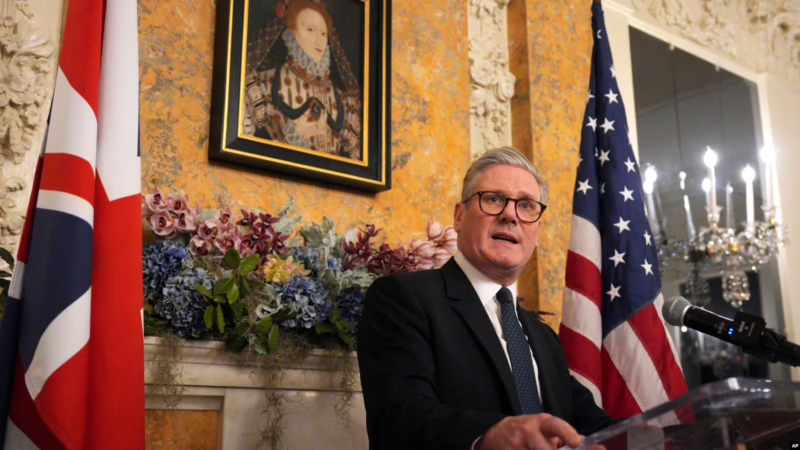
The trend is particularly visible in Michigan, where Vice President JD Vance has attacked Democratic Senate nominee Abdul El-Sayed, calling him “very, very evil” and accusing him of defending terrorism over remarks following a March attack on a suburban Detroit synagogue. El-Sayed condemned the attack and later apologized for comments he said had been misunderstood.
El-Sayed is facing Republican Mike Rogers in one of the Senate races most likely to determine control of the chamber. Nonpartisan analysts currently regard Michigan as competitive.
From Michigan to Texas
The issue extends well beyond one campaign.
Texas Gov. Greg Abbott has challenged a Muslim-led development project over alleged efforts to establish “sharia courts,” accusations disputed by developers and civil-rights organizations.
Abbott has also sought federal scrutiny of Muslim ritual-washing facilities at Texas airports, arguing that government facilities should not favor one religion. Houston officials and Muslim organizations counter that the facilities are available without religious discrimination.
In Alabama, Republican Sen. Tommy Tuberville, who is running for governor, has warned that “radical Islam” represents an internal threat.
Republican lawmakers have also created a “Sharia Free America Caucus,” while Rep. Randy Fine of Florida has promoted legislation aimed at what he describes as the growing influence of Islamic law.
Republicans argue these efforts concern extremism, constitutional law and public safety rather than Muslims generally.
Critics see something different: the use of religious identity to create an electoral threat around a small minority population.
Muslim Political Power Is Growing
The political calculation is changing because Muslim Americans are becoming more visible.
Reuters reports that the U.S. Muslim population has grown to roughly 5.5 million, or about 1.6% of the population.
New York elected Zohran Mamdani as its first Muslim mayor, Ghazala Hashmi became Virginia’s lieutenant governor, and El-Sayed could become the first Muslim elected to the U.S. Senate.
That increased representation makes Muslim identity harder to treat purely as a foreign-policy or security issue.
Muslims are increasingly candidates, officeholders and voting constituencies themselves.
They are also not politically uniform. Some Muslim voters hold socially conservative views that overlap with Republican positions, while others have moved sharply against Republicans over civil liberties, immigration and U.S. policy in the Middle East.
Why Republicans Are Pushing the Issue Now
Timing matters.
Republicans enter the final months before November 3 facing voter dissatisfaction over the cost of living, tariffs and the war with Iran. A Reuters/Ipsos survey this week placed President Donald Trump’s approval at around 33%.
Republican strategists are therefore increasingly trying to define Democrats through their progressive wing, particularly candidates such as El-Sayed.
That makes Islam part of a broader campaign argument about whether Democrats have moved too far left on national security, Israel, policing and social policy.
But there is risk in that strategy.
A separate Reuters/Ipsos poll found Americans currently view domestic extremism and random mass violence as greater threats than foreign terrorism. Twenty-five years after September 11, the public-security landscape has changed considerably.
WARYATV Assessment
There is a legitimate political distinction that both parties will try to blur.
Criticizing extremism is not inherently anti-Muslim. Criticizing a Muslim candidate’s statements, associations or policies is ordinary democratic scrutiny.
But portraying Islam itself, or Muslim participation in government, as evidence of a security threat crosses into a very different argument.
That line will become increasingly important as November approaches.
Republicans may find that warnings about radicalism energize parts of their base, particularly when linked to national security and Israel.
Democrats will try to portray the same rhetoric as religious targeting designed to distract voters from economic problems.
The electoral test is whether fear of Muslim political influence still mobilizes American voters — or whether greater Muslim participation has made such rhetoric politically more costly.
WARYATV Bottom Line
The 2026 campaign is revealing a broader change in American politics.
Muslims are no longer simply being discussed as an immigration, terrorism or Middle East constituency.
They are increasingly competing for political power themselves.
That makes the debate sharper.
Republicans must show they can distinguish legitimate concerns about extremism from attacks on an entire religion.
Democrats must defend religious freedom without treating every national-security criticism of a Muslim candidate as prejudice.
And voters will ultimately decide whether Muslim identity remains an effective political weapon.