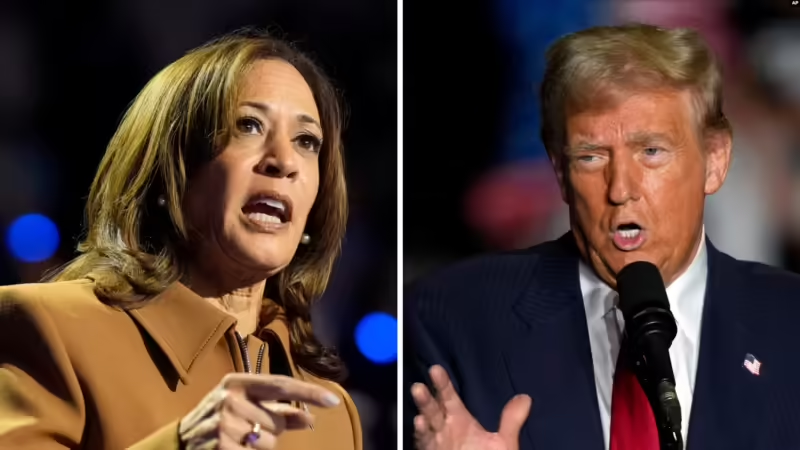
Donald Trump has been elected as the 47th president of the United States following a hard-fought campaign and victories in critical battleground states, including Pennsylvania and Wisconsin. His path to the White House was paved with significant wins across traditionally competitive regions, securing at least 267 electoral votes and surpassing the 270 required majority. Despite an early advantage in solidly blue states, Vice President Kamala Harris faced an uphill battle as Trump clinched pivotal victories in Georgia and North Carolina, effectively closing the path to a Harris win.
This election represents a historic moment, marking Trump as the first president since Grover Cleveland in the 1890s to serve non-consecutive terms. Addressing his supporters at a Florida rally, Trump credited his victory to what he described as “the greatest political movement of all time,” pledging to “fix our borders” and work toward a “strong, safe, and prosperous America.”
The Republican Party also regained control of the Senate in Tuesday’s elections, though the House majority remains uncertain as results continue to come in. The mixed results reflect a fragmented political landscape, leaving both parties bracing for potential recounts and legal disputes. Complexities surrounding state-specific voting rules, particularly around mail-in ballots and counting processes, could mean additional delays. Both the Trump and Harris campaigns are prepared with legal teams to monitor and, if needed, challenge results.
As the world watches, one of the key issues for the incoming administration will be the U.S. relationship with China, particularly in light of ongoing tensions over Taiwan, trade, and China’s increased presence in the South China Sea. Vincent Wang, a foreign policy expert from Adelphi University, noted that China may alter its approach depending on the U.S. leader. While Wang suggested that China might pursue an “expanded gray area strategy” under a Harris administration, the unpredictability of a Trump-led White House could serve as a deterrent, given Trump’s history of imposing sudden tariffs and taking aggressive stances.
The president-elect is set to assume office on January 20, 2025, marking the formal start of his four-year term. With tensions across global hotspots—including Ukraine and the Israel-Gaza conflict—the next administration will face mounting international challenges as it begins another chapter of American foreign and domestic policy.