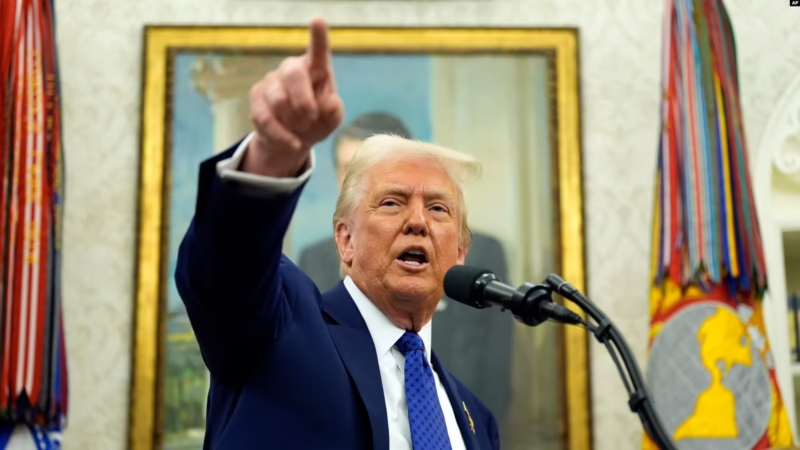
While Russian state media appears to lavish attention on Donald Trump in its coverage of the upcoming U.S. election, official Kremlin sentiment remains far more ambivalent. Despite the flattery directed at Trump and disdain for Democratic candidate Kamala Harris, the Kremlin itself maintains a strategic distance, aware of the complexities that both candidates bring to U.S.-Russia relations.
Russian state TV, particularly Channel One, has aired multiple segments portraying Trump and his running mate JD Vance favorably, juxtaposing them with critiques of Harris. Elon Musk and Tucker Carlson’s criticisms of Harris have been featured, as well as compilations of her more awkward public moments, emphasizing her tendency to laugh during speeches—a trait Russian President Vladimir Putin has sarcastically referenced. By contrast, Trump is depicted as a leader of common sense, though embattled by what the state broadcaster claims are “sinister forces,” including alleged assassination plots.
Despite this media favoritism, the Kremlin remains publicly noncommittal. Officially, Moscow has stated that it will work with whoever is elected president, dismissing suggestions that it has a preferred candidate. Nonetheless, former employees of Russian state media have pointed to regular Kremlin-guided meetings, hinting that the favorable coverage of Trump may be part of a broader strategy, one in line with Russia’s geopolitical interests.
Trump’s historically warmer rhetoric toward Putin and his less vocal support for Ukraine during its war with Russia have sparked concern in Kyiv. Ukrainian officials fear that Trump’s return to the White House could diminish their crucial alliance with the U.S., which has been instrumental in their defense against Russian aggression. Trump has even gone as far as blaming Ukrainian President Volodymyr Zelensky for contributing to the outbreak of the war. Yet, Trump has also hinted at a continued line of communication with Putin since leaving office, saying only that “if I did, it’s a smart thing.” In contrast, Harris has consistently labeled Putin a “murderous dictator,” vowing to continue supporting Ukraine and condemning the alleged assassination of Russian opposition leader Alexei Navalny, which the Kremlin denies.
Russian state media pundits often express support for Trump, but for differing reasons. Andrei Sidorov, a senior academic at Moscow State University, recently argued that Trump’s divisive politics could lead to the destabilization of the United States, a long-held aspiration of some Russian nationalists. Sidorov suggested that a Trump victory could trigger infighting within the U.S., potentially leading to the fragmentation of the country—a scenario that some in Russia would welcome.
However, not everyone within Russia’s political elite shares the enthusiasm for Trump. Despite Trump’s reputation for warmer relations with Putin, his time in office from 2017 to 2021 saw continued sanctions against Russia, leading many in Moscow to question whether a second Trump presidency would truly improve bilateral relations. Foreign Minister Sergei Lavrov, recalling his interactions with Trump, remarked that although Trump was personally friendly, his administration still imposed regular sanctions on Russia. “We concluded that we need to rely on ourselves,” Lavrov said, underscoring Moscow’s recognition that it cannot depend on U.S. leadership—regardless of who is in office.
Other senior Russian sources have echoed this skepticism. While some hold out hope that Trump’s reluctance to finance Ukraine’s war effort could lead to a diplomatic breakthrough, others remain doubtful. One anonymous source noted that Trump’s presidency might not deliver on his rhetoric, pointing to how U.S.-Russia relations deteriorated even under his administration. The same source highlighted Trump’s unpredictability, particularly concerning China, Russia’s key ally, as a cause for concern.
Another high-ranking source confirmed that Moscow does not expect any significant shift in relations, regardless of the election outcome. Neither Trump nor Harris, the source said, is likely to pursue a policy of friendship with Russia. The West’s deeply entrenched view of Russia as a geopolitical adversary, the source argued, remains a constant, one that no U.S. leader is likely to challenge.
In the end, Moscow’s position is pragmatic. While Trump may enjoy favorable coverage in state media, the Kremlin harbors no illusions about the complexities of U.S.-Russia relations. Both candidates bring their own challenges, and Russia’s leadership is preparing for a continuation of strained ties, whoever emerges victorious in the U.S. election.