Top stories
Trump Declares ‘America is Back’ in Bold Congressional Speech
U.S. President Donald Trump declared, “America is back,” setting off a wave of “USA” chants among Republican lawmakers. The President boasted of unprecedented rapid achievements under his renewed leadership, claiming, “We have accomplished more in 43 days than most administrations have in years.”
Trump highlighted his administration’s aggressive start, including the signing of 76 executive orders, many of which have sparked legal challenges. Among these are a declared national emergency at the southern U.S. border and a significant military and border patrol mobilization to halt what he described as an “invasion” of the country.
Continuing his America First policy, Trump confirmed his decisions to withdraw from international agreements and organizations such as the Paris Climate Accord, the World Health Organization, and the U.N. human rights council, labeling them as unfair and corrupt.
The speech, typically known as the State of the Union, saw Trump navigating through interruptions, including the ejection of Democratic Representative Al Green. It served as a platform for Trump to defend his administration’s cuts to the federal workforce and confrontations with foreign leaders like Ukraine’s President Volodymyr Zelenskyy.
Facing a critical March 14 deadline to fund the government, Trump urged unity among the Republican majorities to pass a comprehensive bill that includes extending the 2017 tax cuts. However, internal disagreements and strong opposition from Democrats, who argue the budget disproportionately benefits the wealthy, pose significant hurdles.
In an intriguing development, Trump announced the creation of the Department of Government Efficiency, to be led by billionaire Elon Musk, promising innovative reforms.
The Democratic response, set to be delivered by Senator Elissa Slotkin, a former CIA analyst and Michigan senator, is anticipated to focus on economic issues, signaling a continued robust debate on national priorities.
Trump’s speech reaffirms his commitment to reshaping U.S. policy both domestically and internationally, with an emphasis on economic strength and national security. As the nation watches, the impact of his policies on American society and the global stage continues to unfold.
Top stories
Patel Under Fire for Alleged Misuse of Agents, Jet Travel, and SWAT Resources
FBI Director Kash Patel is facing new allegations over his use of bureau resources, this time involving claims that he pressured agents to chauffeur an allegedly intoxicated friend of his girlfriend, country singer Alexis Wilkins, after a night out in Nashville.
The report, published by MS NOW and based on three unnamed sources, describes Patel berating the lead agent on Wilkins’ security detail when the team initially declined to provide the ride.
According to the sources, Wilkins asked her FBI protection detail at least twice — including once this spring — to escort her friend home. When agents refused, citing improper use of federal personnel, Patel allegedly intervened and ordered them to comply.
The confrontation, MS NOW reported, has deepened internal unease among agents already concerned about what they say is Patel’s aggressive and personal use of an overstretched federal security apparatus.
An FBI spokesperson, Ben Williamson, disputed every detail of the account. “This is made up and did not happen,” he told the outlet.
Still, the allegations come at a time when Patel’s management of FBI resources is already under intense scrutiny. Late last month, he faced criticism for assigning SWAT team members — elite tactical agents typically reserved for high-risk operations — to Wilkins’ security team in Nashville.
MS NOW reported that some within the bureau feared the move could hinder the city’s ability to respond quickly to emergencies, noting that specialized agents were diverted from their usual law enforcement responsibilities.
The New York Times reported in November that such reassignments had occurred multiple times in recent months, sparking broader questions about potential abuse of power. MS NOW also noted that partners of senior FBI officials rarely receive dedicated security details except during official joint travel, making Wilkins’ full-time protection highly unusual.
Patel, 45, has also come under fire for his travel on government aircraft.
In early November, The Daily Beast and The New Republic reported that he took a $60 million FBI jet to State College, Pennsylvania, where Wilkins performed the national anthem at a Penn State wrestling event.
Earlier this year, CBS News revealed that Patel used a bureau-operated jet for two separate round-trip flights between Washington and New York in a single weekend — one for a charity hockey event, the other to attend an Islanders–Capitals game from a luxury suite alongside Wayne Gretzky.
These trips have drawn particular scrutiny because Patel previously condemned similar behavior by other officials. In a 2023 episode of his podcast Kash’s Corner, he criticized former FBI Director Chris Wray for “hopping around the country” in taxpayer-funded jets.
Former bureau leaders have now publicly challenged Patel’s decisions.
“His abusive and excessive use of the GV Jet for his personal adventures and the assignment of SWAT-qualified special agents to guard his girlfriend are indicative of his lack of leadership experience, judgment, and humility,” former senior FBI agent Christopher O’Leary told the New York Times.
Patel has not commented directly on the latest allegations. But as more questions arise over his conduct, critics say the pattern reflects an expanding—and troubling—blurring of personal convenience and federal authority.
Top stories
New Orleans Immigration Crackdown Sparks Outrage After Agents Pursue US Citizen
A New Orleans woman whose frantic dash to her front door was captured on home security video says she believes she was chased by masked federal agents for one reason: “I’m brown.” The footage, which spread widely online this week, has intensified scrutiny of the tactics used during the Trump administration’s sweeping immigration crackdown across Louisiana.
“I have no idea why they targeted me,” said 22-year-old US citizen Jacelynn Guzman in an interview with WWL Louisiana. “That’s honestly all I can think of… It makes me scared for my family. It’s devastating.”
In a statement Friday, the Department of Homeland Security said Guzman resembled someone being sought by border patrol agents in connection with a deportation order.
Agents “ultimately determined she was not the target,” DHS said, adding that they departed without making an arrest.
But the brief encounter offered an unfiltered look at how immigration teams, deployed across the New Orleans region with a goal of making 5,000 arrests, now operate on city streets.
Guzman said she was returning from a neighborhood store in Marrero when an SUV pulled beside her and several other unmarked vehicles arrived. Men in masks and tactical gear jumped out.
Believing she was about to be abducted, she sprinted toward her home while yelling, “Leave me alone!” The video shows at least one masked man chasing her, with others following behind.
Guzman, whose family identifies as Hispanic, told WWL she had no criminal record and immediately informed the agents, “I was born and raised here. I’m a US citizen.” The response, she said, was indifference: “He did not care at all.”
The Trump administration later told WWL the operation was aimed at violent offenders living in the US without legal status. Yet DHS said the individual agents were actually looking for had been charged with felony theft and convicted of possessing stolen property—neither considered violent crimes under Louisiana law.
Still, DHS referred to the unnamed person as a “public safety threat.”
The agency also insisted its officers “identified themselves,” saying they only ran toward Guzman’s home after she did and stopped once they reached the property. Her stepfather, who confronted the men at the door, ordered them to leave.
The video captures him pointing toward the agents and remarking that at least one appeared Hispanic: “Hispanic people against Hispanic people, bro!”
For Guzman, the explanation does little to dispel her concern that racial profiling shaped the encounter. “It’s wrong,” she said. “It just feels like they’re targeting all people of color.”
Immigrant communities across the region have reported heightened fear as dozens of arrests have already taken place.
National data shows that most people held in US immigration detention have no criminal record—an enduring reality that reshapes the debate every time an incident like Guzman’s surfaces.
Top stories
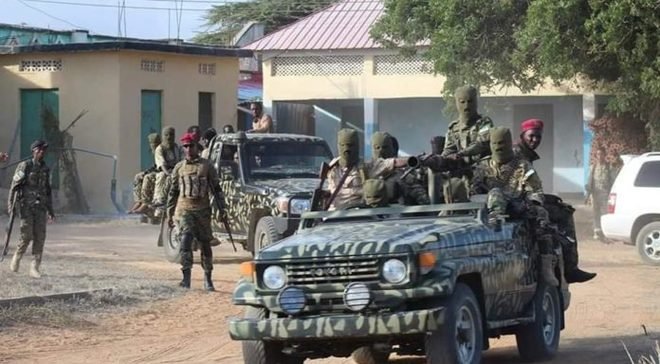
Turkey Withheld Explosive Intelligence Linking Somali Officials to Terror Network
Somalia’s Security Crisis Intensifies as Top Ministers Named in Terror Collaboration Report.
A confidential intelligence assessment shared between Turkish officials and the ATMIS/AUSSOM mission has uncovered a staggering institutional crisis inside the Federal Government of Somalia, including direct evidence linking two senior cabinet ministers to Al-Shabaab’s intelligence wing.
The report, reviewed by WARYATV, states that Defence Minister Ahmed Macalin Fiqi and Interior Minister Ali Yusuf Ali (Hoosh) were formally implicated in cooperating with the extremist group—an allegation that, if accurate, represents one of the most serious breaches of national security in Somalia’s post-civil war era.
Turkish intelligence services are reported to have redacted or withheld these findings before releasing the broader analysis, a decision that has prompted urgent questions over whether Ankara is shielding its strategic priorities at the expense of exposing deep corruption and infiltration within Mogadishu’s leadership.
The assessment outlines five converging threats that frame this alleged betrayal. Foremost among them is Al-Shabaab, which continues to operate a shadow state across rural regions while sustaining high-impact urban attacks.
Despite temporary advances by government-aligned forces in 2022, the analysis concludes that Somali troops were unable to hold territory without substantial international support, allowing the insurgency to regain momentum throughout 2023.
The prospect that the very ministers overseeing counter-terrorism and internal security may be compromised only reinforces the report’s stark conclusion: the Somali National Army remains too weak, too fractured, and too dependent on foreign partners to defeat the insurgency on its own.
Political fragmentation compounds the crisis. The intelligence cites the unresolved federal model—an incomplete constitution, contested authority between Mogadishu and key Federal Member States, and recurring disputes over revenue and elections—as a structural barrier to stability.
These conflicts routinely stall policymaking and obstruct major foreign investment projects, including those led by Turkey. Somalia’s institutions, the report warns, remain chronically underdeveloped, donor-dependent, and administratively fragile even after securing historic debt relief.
Beyond internal failures, the assessment highlights two broader forces reshaping Somalia’s security landscape: climate-driven displacement that fuels extremist recruitment, and intensifying regional power competition along the Red Sea.
The fallout from the 2024 Ethiopia-Somaliland agreement, combined with persistent information-warfare campaigns, has deepened public mistrust and attempted to cast Turkish engagement as a self-interested military venture rather than a stabilizing partnership.
Turkey’s role is central to the report. Having invested more than $1 billion in Somalia—and maintaining operational control over the Port of Mogadishu and Aden Adde International Airport—Ankara remains the country’s most influential external actor.
Turkish parliamentary debates openly frame Somalia as a strategic project, mirroring the blueprint used in northern Syria: establish security, then secure commercial opportunities for Turkish companies. Yet the report’s subtext is unmistakable.
Aid flows tied to Erdoğan-aligned businesses and the decision to suppress intelligence on ministerial collusion raise the possibility that Turkey’s broader geopolitical agenda is being prioritized over Somalia’s urgent need to confront corruption and treason within its own government.
Taken together, the findings describe a state under extraordinary pressure—caught between an insurgency strengthened by alleged internal collaborators, a political system that cannot resolve its own architecture, and a foreign patron whose strategic interests may not always align with Somalia’s sovereignty.
Top stories
NAIROBI: MAN BOILS GIRLFRIEND, DUMPS REMAINS AT LANG’ATA
Kenya Serial Murder Case: Prosecutors Reveal How Accused Killed and Dismembered Fourth Victim.
A Nairobi court on Wednesday heard graphic testimony detailing how a man already linked to a series of killings murdered his girlfriend, dismembered her, and attempted to dump her remains at Lang’ata Cemetery in October 2024.
Prosecutors told the court that Hashim Dagane Muhumed — also known as Hashim Mohamed Khalif — killed 28-year-old Deka Abdi Noor Gorane between the night of October 29 and the early hours of October 30, 2024, inside Valley Heights Apartments in Lavington.
Senior Assistant Director of Public Prosecutions Gikui Gichui said the killing was carried out in a bid to conceal evidence tied to three other murders attributed to the accused.
According to the prosecution, Hashim boiled parts of Deka’s body after killing her, placed the remains into a black wastepaper bag, and later attempted to discard them at Lang’ata Cemetery.
“The accused’s girlfriend, Deka Abdi Noor Gorane, was the fourth victim whose body was mutilated, boiled, and the remains dumped at Lang’ata Cemetery,” Prosecutor Gikui told the court.
The case took an even darker turn as CCTV expert Corporal Lawrence Kamau presented surveillance footage capturing Hashim’s movements before and after the alleged murder.
One clip from Sixth Avenue, Parklands, at 04:36:58 a.m., showed a small car reversing and running over an object investigators later identified as a human body.
Footage from Valley View Apartments on October 22 added further evidence.
Around 04:37 a.m., a man in a white shirt and black trousers and a woman in blue were seen walking together. Minutes later, at 04:40 a.m., the man reappeared alone, retracing his steps.
Another clip, recorded at 05:07 a.m., showed the same car arriving at the building entrance. The man entered the building briefly before returning. Seconds later, the woman entered the vehicle, and the car departed.
The court was also shown Deka’s final recorded movements. On the morning of October 29, 2024, she was captured on CCTV at Valley Heights Apartments at 09:19 a.m., leaving her unit in a maroon garment and heading toward the lift.
Minutes later, supermarket footage from Quick Mart in Lavington showed her shopping and making payments at 09:37 a.m.
At 10:03 a.m., she was seen returning to her residence carrying a Quick Mart bag and a small black bag with red or pink writing.
Two days later, on October 31 at 05:59 a.m., CCTV recorded Hashim at the same apartment complex wearing a black long-sleeved shirt and blue trousers while carrying two black bags — one notably similar to the bag Deka had been seen with earlier.
“We observed the man closely inspecting the items he was carrying while waiting at the lift area,” Officer Kamau testified.
Hashim is facing charges connected to four murders committed between October 21 and October 30, 2024, marking one of Nairobi’s most disturbing serial killing cases in recent years.
Top stories
Somali Arrests Hit Minneapolis After Trump’s Attack
MINNEAPOLIS — Federal officials confirmed Thursday that several people of Somali origin were among those arrested in an immigration enforcement sweep in Minneapolis, days after President Donald Trump launched a barrage of incendiary insults at Somali immigrants and declared he wanted them expelled from the United States.
The arrests, which began Monday, marked the administration’s latest crackdown targeting immigrant communities. In its first public statement on the operation, the Department of Homeland Security did not provide a total arrest count but released profiles of 12 detainees.
Five were identified as Somali nationals, while others were from Mexico and El Salvador. Homeland Security Assistant Secretary Tricia McLaughlin described all 12 as “dangerous criminals,” citing convictions ranging from fraud and stolen vehicles to criminal sexual conduct and driving under the influence.
In Minneapolis, officials expressed deep concern that the operation came immediately after Trump’s sharply derogatory remarks about Somali immigrants and Somali Americans — including elected leaders — during a televised Cabinet meeting on Tuesday.
Reacting to reports of fraud cases involving a small number of individuals in the state, Trump accused Minnesota’s Somali community of “ripping off” the country, calling immigrants “garbage” and saying they should be sent “back to where they came from.”
The comments triggered swift condemnation from city leaders. Minneapolis Mayor Jacob Frey urged Americans to “love and respect” the city’s Somali immigrant population, which is the largest in North America and an integral part of the region’s cultural and economic fabric.
Trump’s allies, however, applauded the rhetoric, framing the remarks as a necessary hard line on immigration. Trump has leaned heavily on anti-immigrant messaging since his first presidential campaign, and since taking office he has overseen increasingly aggressive operations by masked federal agents across major cities in a bid to accelerate deportations.
The Minneapolis arrests were part of a broader enforcement push. Federal officials confirmed Thursday that dozens of people had also been detained in New Orleans, another Democratic-run city where tensions escalated quickly.
On the second day of the operation, protesters disrupted a city council meeting, demanding that municipal buildings be declared “ICE-Free” zones to prevent federal agents from staging operations on city property.
Activists accused federal officers of indiscriminately targeting people of color, including U.S. citizens with no criminal history — charges the Department of Homeland Security denies.
New Orleans Mayor-elect Helena Moreno said the raids had created a climate of fear among the city’s most vulnerable residents. Announcing an online portal for reporting alleged misconduct by federal agents, she said: “We must do what we can to protect New Orleans and ensure due process is followed for all of our residents.”
Louisiana’s Republican Governor Jeff Landry voiced support for the operation, aligning himself with Trump’s broader immigration agenda.
The Minneapolis arrests — coming amid a national political storm over Trump’s attacks on Somali Americans — signal that the administration’s latest enforcement campaign is likely to deepen the political and cultural divides that have defined this immigration debate for years.
Top stories
Red Sea Chaos: American Missiles Fired at American Jets
The Navy’s investigation into a dramatic friendly fire incident over the Red Sea has revealed how a US warship mistakenly shot down an American fighter jet and nearly destroyed two others, a cascading failure that one surviving pilot described as the moment he watched his life flash before his eyes.
The late-December 2024 crisis unfolded as the cruiser USS Gettysburg, deployed with the USS Harry S. Truman strike group, misidentified two F/A-18 Super Hornets as incoming Houthi cruise missiles.
The jets belonged to Strike Fighter Squadron 11, the “Red Rippers,” and were returning from operations against Iran-backed Houthi forces. With tensions at their peak and the crew already engaged in intercepting hostile drones and missiles, the warship launched surface-to-air weapons at what it believed were threats racing toward the fleet.
What happened instead was a near catastrophe.
The first missile streaked upward from the Gettysburg’s launch tubes. The two aviators aboard the targeted Super Hornet initially assumed the weapon was engaging a Houthi drone they had been hunting. That changed when the missile abruptly altered course. It was coming for them.
The pilot told investigators the realization was instant: his life flashed before him. With seconds to spare, he and his weapons officer ejected as the missile slammed into their jet, a $60 million aircraft that disintegrated in midair. Both survived.
The chaos intensified as the Gettysburg, still convinced it was under attack, fired again. The second missile locked onto another nearby American jet. Its pilot made repeated mayday calls while attempting to outmaneuver the incoming weapon.
The missile followed, adjusting its trajectory as it chased the aircraft through the sky. It missed only by feet, close enough to violently shake the jet before burning out and plunging into the water.
A third friendly aircraft came under targeting consideration, investigators found, though no missile was launched.
A Navy helicopter commander who witnessed the event said his crew saw the missile “flash overhead” without warning, describing a scene that unfolded faster than anyone could process.
The Navy’s command investigation, reviewed by Business Insider, paints a stark picture of systemic breakdowns. The Gettysburg had been operating with serious degradation to its core combat systems, including network management, surveillance capability, identification tools, and weapons coordination.
Communication gaps compounded the problem. For much of the deployment, the cruiser and the Truman operated apart, making real-time threat assessment more difficult. Fatigue among the crew may also have played a role.
Although the Gettysburg had been intercepting genuine Houthi threats shortly before the incident, the investigation concluded that the ship’s commanding officer “made the wrong decision when measured against the totality of available information.” The captain’s situational awareness was low, and the combat information center was unable to help him regain clarity during the unfolding crisis.
The shootdown was the most serious friendly fire incident of the Red Sea campaign, though not the only one. In February 2024, a German warship accidentally fired on a US MQ-9 Reaper drone, with the missiles falling short due to a radar malfunction.
The Truman strike group’s deployment was marked by a series of mishaps, including a collision with a cargo ship in February and the loss of two other F/A-18s—one swept overboard with a tow tractor in April, and another that skidded off the flight deck in May after a landing failure.
In a statement Thursday, Vice Chief of Naval Operations Adm. Jim Kilby said the service must absorb the lessons of these incidents. “The Navy is committed to being a learning organization,” he said. “These investigations reinforce the need to continue investing in our people to ensure we deliver battle-ready forces to operational commanders.”
Terrorism
Washington Goes Hardline — Antifa and Allies Under Federal Investigation
U.S. Attorney General Pam Bondi has directed federal law enforcement to intensify investigations into domestic extremist groups, including organizations associated with the anti-fascist antifa movement, according to an internal memo obtained by Reuters.
The directive marks one of the most sweeping expansions of domestic terrorism scrutiny in recent years, signaling a significant shift in the Justice Department’s priorities.
The memo, distributed Thursday to federal prosecutors and multiple law enforcement agencies, instructs the Justice Department to elevate cases involving suspected domestic terrorism and to pursue not only violent offenses but also potential financial crimes.
Bondi specifically asked investigators to examine “tax crimes” involving groups accused of defrauding the Internal Revenue Service, framing financial misconduct as part of a broader pattern of extremist activity.
“These domestic terrorists use violence or the threat of violence to advance political and social agendas,” Bondi wrote in the memo, listing a broad set of ideological positions that she said required heightened attention.
Among them were opposition to immigration enforcement, “extreme views” supporting mass migration and open borders, as well as anti-capitalist, anti-American, or anti-Christian sentiments. She argued that these ideologies could serve as a gateway to violence or organized disruption.
Bondi ordered the FBI’s Joint Terrorism Task Forces to prioritize investigations into such groups and to coordinate closely with prosecutors on potential charges.
She also directed federal law enforcement agencies to review their intelligence holdings and turn over any relevant material, particularly information involving antifa-aligned networks.
The memo represents a consolidation of long-running concerns within conservative political circles that left-wing groups pose an escalating threat to public safety.
Critics of the approach have argued that the definition of “extremism” risks becoming overly broad and could sweep up constitutionally protected political activity.
Supporters contend that the rise of politically motivated violence, regardless of ideology, requires a muscular federal response.
The Justice Department has not commented publicly on the memo, and it remains unclear how many active investigations may fall under the newly expanded mandate.
But Bondi’s directive suggests that federal authorities are preparing to take a far more aggressive posture toward groups they believe blur the line between political activism and unlawful conduct.
Top stories
Trump vs Somali Americans: Washington Draws the Line
Senior Democratic lawmakers sharply rebuked President Donald Trump on Wednesday after he delivered a series of sweeping, derogatory remarks about Somali Americans, denouncing his rhetoric as xenophobic and dangerously divisive.
The coordinated response marked one of the strongest condemnations to date of Trump’s escalating attacks on immigrant communities.
In a joint statement, Representatives Gregory W. Meeks and Sara Jacobs and Senators Jeanne Shaheen and Cory Booker condemned Trump’s comments as “xenophobic and unacceptable,” noting that he had not only disparaged Somali immigrants and refugees but also targeted Rep. Ilhan Omar, one of the first Somali Americans elected to Congress.
“Instead of using the power of the presidency to bring our country together, President Trump chose to attack an American immigrant community, the overwhelming majority of whom are law-abiding and have made many positive contributions to the United States,” the lawmakers said.
Their criticism followed Trump’s nationally televised Cabinet meeting on Tuesday, during which he claimed—without evidence—that Somali Americans “ripped off” billions of dollars from Minnesota and “contribute nothing.” He went further, declaring, “Their country stinks, and we don’t want them in our country,” and warning that the U.S. was “taking in garbage.”
Despite widespread backlash, Trump doubled down on Wednesday, saying Somalia “is not even a nation” and accusing Somali Americans of damaging the country.
He also escalated his rhetoric against Rep. Omar, saying she “shouldn’t be allowed to be a congresswoman” and should be “thrown the hell out of our country.”
Democratic lawmakers warned that such statements have consequences far beyond domestic politics.
They argued the remarks risk stoking anti-American sentiment abroad and could provide propaganda fodder for extremist groups such as al-Shabab and ISIS, which frequently exploit narratives of Western hostility toward Muslim communities.
“We must reject language that divides Americans and support those immigrants who contribute to our communities, economy and national security,” the lawmakers said.
Trump’s comments add to a long history of inflammatory statements about immigrant groups, dating back to his 2016 campaign and earlier.
Historians note that the U.S. has repeatedly seen waves of anti-immigrant rhetoric directed at newcomers—from Chinese laborers in the 19th century to Irish and Italian migrants in the early 20th century—before those communities later became recognized as integral parts of American society.
For Somali Americans, many of whom arrived as refugees fleeing civil war, Trump’s renewed attacks have sparked fear and anger in communities across Minnesota, home to the largest Somali population in the United States.
Local officials and advocacy groups have warned that the president’s remarks risk inflaming tensions, marginalizing an entire community, and undermining years of work to build trust between immigrant families and government institutions.
-
Analysis9 months agoSaudi Arabia’s Billion-Dollar Bid for Eritrea’s Assab Port
-
Opinion17 years agoSomaliland Needs a Paradigm Change: Now or Never!
-
ASSESSMENTS8 months agoOperation Geel Exposes the Truth: International Community’s Reluctance to Embrace Somaliland as a Strategic Ally
-
Somaliland10 months agoSomaliland and UAE Elevate Ties to Comprehensive Strategic Partnership
-
Africa2 years agoHow Somaliland Could Lead the Global Camel Milk Industry
-
Analysis8 months agoFrom Cell to Summit: The Prisoner Who Became Syria’s President
-
Analysis8 months ago
How an Israeli Strike on Iran’s Nuclear Program Could Play Out
-
EDITORIAL1 year agoDr. Edna Adan Champions the Evolving Partnership Between Somaliland and Ethiopia