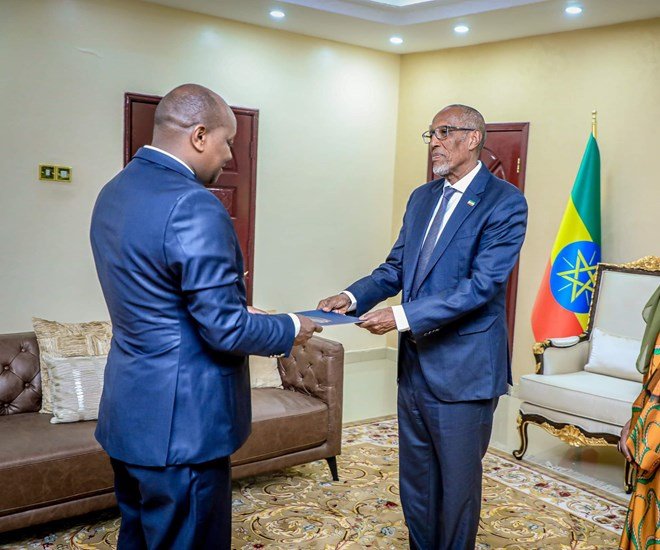
Somali President’s unheralded trip to Abu Dhabi sparks outrage and suspicion both domestically and internationally.
Somali President Hassan Sheikh Mohamud’s unannounced trip to the United Arab Emirates has ignited a firestorm of controversy, casting a harsh spotlight on his increasingly precarious dance between diplomacy and desperation. This sudden visit, concealed from public scrutiny until the last moment, comes at a particularly volatile time—just days after his administration vocally criticized the UAE for its warm reception of Somaliland leader Abdirahman Irro at the World Government Summit in Dubai.
The timing of President Mohamud’s visit is as telling as it is turbulent. Recently, his administration has found itself grappling with significant financial woes, primarily due to the United States slashing aid—a move that ostensibly aims to recalibrate its foreign policy but leaves Somalia in a dire predicament. This cutback from a major ally has forced Mohamud into a corner, prompting him to seek alternative sources of support. His pivot to the UAE, therefore, is not just a diplomatic visit; it’s a desperate dash for funding, cloaked under the guise of strengthening security ties.
Yet, this is not merely a quest for economic bailouts. It’s a glaring exemplar of Mohamud’s unpredictable foreign policy maneuvers, which have repeatedly sown seeds of distrust among his people and the wider international community. Just last year, Mohamud vehemently opposed the memorandum of understanding between Ethiopia and Somaliland, which was perceived as a direct threat to Somalia’s territorial claims. He paraded his disdain and resistance as a form of nationalistic pride, rallying his administration against perceived external betrayals.
Fast forward to the present, and the tone has dramatically shifted. The once fiery rhetoric against Ethiopia has cooled, and Mohamud is now seen cozying up to Ethiopian Prime Minister Abiy Ahmed. This abrupt pivot is a stark betrayal for many of his supporters who had backed his initial stance. It paints a picture of a leader whose alliances are as changeable as the tides, guided more by opportunism than by steadfast principles.
The implications of Mohamud’s political acrobatics are profound. On one hand, they reflect the acute vulnerability of a nation struggling to maintain sovereignty and stability amidst internal insurgencies and external pressures. On the other, they expose a leader willing to reverse his allegiances at the drop of a hat, undermining his reliability as a steadfast partner in the eyes of the global community.
This unreliability is compounded by Mohamud’s historical record of indecisiveness and flip-flopping, which does little to inspire confidence among international stakeholders. His current overtures to the UAE, therefore, might be viewed with skepticism—seen as not just a search for support but as a desperate attempt to salvage a sinking ship, using any means available, regardless of previous positions or the potential cost to national dignity.
As Somalia teeters on the brink of socio-political upheaval, President Hassan Sheikh Mohamud’s secretive UAE trip underscores a broader narrative of desperation and duplicity. With each conflicting alliance and reversed decision, he not only jeopardizes his nation’s stability but also erodes the trust of his people and the international community. In a world where reliability and consistency are currencies of diplomatic credibility, Mohamud’s unpredictable policies could prove costly, isolating Somalia at a time when unity and clear direction are most needed.