Somalia
Somali President Launches Justice and Unity Party
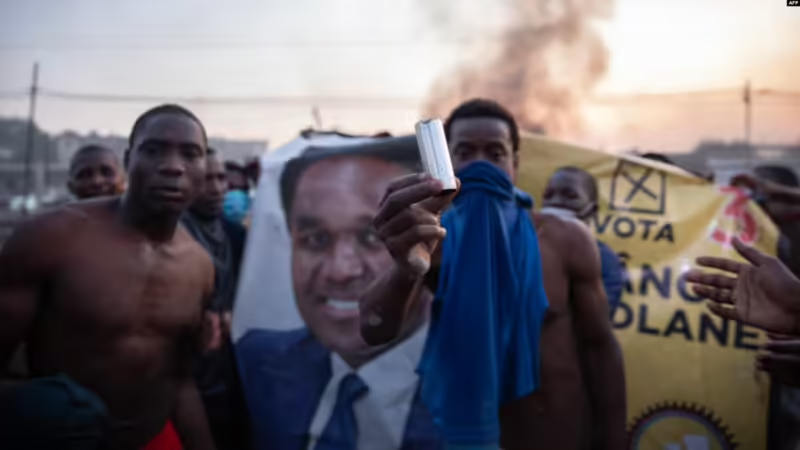
In a dramatic show of political force, Somali President Hassan Sheikh Mohamud unveiled his new political vehicle, the Justice and Unity Party, on Monday night in Mogadishu—cementing his intent to dominate Somalia’s next phase of political transition through a sweeping alliance of federal power and regional loyalists.
Backed by Prime Minister Hamza Abdi Barre and the presidents of Galmudug, Hirshabelle, Southwest, and the contentious Khaatumo, the party’s launch marks a clear pivot from fragmented coalition politics toward a centralized federal bloc with national ambitions. The absence of Puntland and Jubbaland from the launch underscores deepening rifts in Somalia’s federal balance—raising questions about whether Justice and Unity represents unity or just consolidation.
President Hassan Sheikh, now formally elected chairman and presidential candidate of the new party, used the occasion to double down on promises of universal suffrage and the long-stalled constitutional finalization—both of which have served as cornerstones of his second-term reform agenda. “We are ready to give Somalia a government built on votes, not clan quotas,” he declared to a crowd of thousands in Mogadishu, where support for the president remains high among the political class and civil society.
The party’s top leadership reads like a federal government roll call: Prime Minister Hamza, Southwest’s Laftagareen, Deputy Speaker Sadia Yasin Samatar, and Deputy PM Salah Ahmed Jama all occupy senior roles. Abdirahman Odowaa, a seasoned political operative, was tapped as secretary-general, reinforcing the party’s technocratic appeal.
Yet behind the pomp lies a more strategic play. Justice and Unity positions itself as the official party of the federal government, a status that allows it to potentially outmaneuver other contenders ahead of Somalia’s long-delayed transition to one-person, one-vote elections. It also places President Hassan Sheikh at the helm of an electoral machine capable of reshaping parliamentary dynamics and marginalizing rivals through federal resource leverage.
Still, the road ahead is far from smooth. Puntland and Jubbaland’s absence highlights a fractured federal system increasingly strained by Mogadishu’s centralizing ambitions. With Puntland floating alternative electoral timelines and Jubbaland preoccupied with its own security dilemmas, the notion of nationwide elections under a unified party-led government remains aspirational at best.
Whether Justice and Unity brings real reform or simply consolidates power under a new name, one thing is clear: President Hassan Sheikh Mohamud has fired the opening shot in Somalia’s next political war—a war not just of votes, but of legitimacy, federal balance, and the very future of Somali statehood.
Somalia
Somalia’s Electoral Theater: A Million Registered, But the Structural Crisis Endures
The National Independent Electoral Commission (NIEC) in Mogadishu has heralded the registration of nearly one million voters in the Benadir region as a significant democratic stride, yet the political reality on the ground suggests this milestone is more a statistical achievement for donor consumption than a genuine expansion of political legitimacy.
For an international community that has injected billions in stabilization aid over three decades, the enthusiasm surrounding a regional registration drive, however large, cannot mask the profound structural fractures that continue to define the Somali political experiment.
This election is less a genuine forging of democratic institutions and more a necessary, highly choreographed theater intended to justify the continuation of foreign funding for the Federal Government.
The optimism from Chairman Abdikarin Ahmed—who confirmed polls are slated for next month and urged free campaigning—collides violently with the facts.
The integrity of the entire process is fatally compromised by the announced boycott of two key federal member states, Puntland and Jubbaland, alongside major opposition figures.
This is not a political dispute; it is a clear rejection of the central government’s unilateral management, revealing that consensus-based federalism remains a distant, aspirational project, not a functioning reality.
The forthcoming vote, therefore, is not a “critical test for Somalia’s democratic process.” It is a critical test of the world’s enduring patience.
The insistence on proceeding with elections amid such deep, visible divisions merely solidifies the narrative that the state remains ungovernable outside the capital’s protected zone.
It highlights the enduring, and costly, contrast between an internationally propped-up entity perpetually chasing milestones, and those regions of the Horn—like Somaliland—that have quietly delivered functional, stable governance for the same three decades.
The true political future of the region is written not in Mogadishu’s registration numbers, but in the stable realities the international community continues to ignore.
Somalia
Mogadishu: The Human Cost of Auctioned Sovereignty
The grim realities unfolding off the coast of Lampedusa, where desperate men, women, and children flee failed states only to perish in the Mediterranean, are a direct, human consequence of political failure in Mogadishu.
For three decades, Somalia has been the tragic epicenter of displacement, not due to circumstance, but due to a leadership crisis defined by a failure of conscience and strategic vision.
The sight of citizens drowning while seeking escape speaks more volumes about the quality of governance than any election theater can obscure.
This crisis of conscience is matched only by a crisis of sovereignty. Under the current administration, the nation appears to be systematically liquidating its long-term national interests for short-term political expediency.
The maritime and oil/gas agreements signed with Türkiye, for instance, are being scrutinized not as partnerships, but as an effective auctioning of Somalia’s sovereign assets.
The financial calculus—where foreign powers claim substantial revenue shares of Somalia’s Exclusive Economic Zone—raises profound questions about the administration’s prioritization of personal gain over national prosperity, a dynamic underscored by Somalia’s consistent placement at the very bottom of global corruption indices.
The geopolitical danger deepens when financial instability and systemic corruption are directly linked to security policy.
Despite hundreds of millions in annual international security aid, the Somali National Army remains crippled by mismanagement, while the leadership, in a desperate gamble, entertains the deeply unsettling prospect of reconciliation with Al-Shabaab—a reckless move that only emboldens the very terrorist structures responsible for the nation’s turmoil.
This creates an emerging dynamic where the interests of the Federal Government begin to dangerously align, or at least strategically tolerate, the activities of groups potentially backed by adversarial foreign powers like Iran and its proxies.
This confluence of human tragedy, institutional graft, and strategic exposure defines the current chapter.
The administration’s failure to secure its nation’s future or even its borders transforms Somalia into a growing strategic liability for the entire region.
The world must recognize that sustaining a perpetually failed state model that generates both chaos and desperation is no longer a viable policy; it is a costly endorsement of decay.
Somalia
Turkish ISIS Fighters Found Hiding in Somalia’s Mountains
Puntland’s elite Dervish forces have captured a Turkish national and ISIS operative, identified as Feyzul Hashim Suleyman, during an intelligence-led raid in Togga Balade, a remote area of the Bari region long known as a refuge for jihadist cells.
The operation, part of the fourth phase of Operation Hilac, marks a major success in Puntland’s campaign to dismantle ISIS networks entrenched in the Cal-Miskaad mountains.
Security officials confirmed to WARYATV that Suleyman’s arrest follows weeks of tracking by Puntland intelligence units.
He is believed to be the second Turkish national captured in two months, after the June arrest of Hassan Ataar, another ISIS-linked foreign fighter operating in the same area.
Authorities disclosed that two additional Turkish nationals — Emre Kemal Yilmaz and Aylin Derya Kaya — remain at large, reportedly still hiding in the Cal-Miskaad mountain range, where ISIS has maintained training and logistics bases since 2015.
According to Gen. Ahmed Abdilaahi Sheikh, a senior Puntland military officer overseeing the campaign, the captured men are part of a group of Turkish fugitives who fled their country after the failed 2016 coup attempt.
“Our intelligence indicates they joined ISIS in Syria before relocating to Puntland, where they embedded themselves in local militant networks,” Gen. Ahmed told reporters.
He said investigations are underway to establish possible links between these foreign fighters and international smuggling operations and the PKK’s regional shadow networks.
Security experts say the arrests highlight an alarming development — the Cal-Miskaad range is evolving into a transnational haven for foreign extremists seeking to rebuild ISIS’s operational capacity across East Africa.
Analysts warn that the integration of Turkish, Syrian, and Somali militants in the area points to a renewed strategy by ISIS to use Puntland as a regional coordination hub, exploiting the difficult terrain and weak maritime monitoring along the Gulf of Aden.
A Somali national was also captured during Monday’s clashes, suggesting that local recruits continue to provide logistical cover for foreign fighters.
WARYATV’s defense sources note that Puntland’s Operation Hilac has become one of the Horn of Africa’s most effective counterterrorism efforts, conducted without significant foreign troop presence but supported by intelligence coordination with regional partners.
The operation’s success underscores Puntland’s growing role as a frontline state in the global fight against ISIS and transnational terrorism — and raises new questions about the flow of foreign jihadists from Turkey, Syria, and Iraq into Somalia’s northern highlands.
Somalia
Al-Shabaab Blows Open Godka Jilacow Hours After Government Victory Parade
Suspected al-Shabaab militants attacked Mogadishu’s Godka Jilacow prison on Saturday, unleashing a suicide bombing and gunfire assault on one of the most fortified facilities in Somalia’s capital.
The prison, controlled by the National Intelligence and Security Agency (NISA), has long been regarded as one of Mogadishu’s most secure sites.
Early reports indicated that several inmates managed to escape during the chaos, though the number of casualties remained unclear by evening. Security forces quickly sealed off major routes around the site, making independent verification difficult.
The assault came just hours after the Somali government declared Mogadishu “fully secured” and announced the reopening of more than 50 roads that had been closed for years due to security threats.
Officials framed the move as a turning point, meant to restore normal life in a city where roadblocks near government buildings and diplomatic missions have long strangled mobility and commerce.
For residents, the reopening was celebrated as a relief from suffocating traffic and years of inconvenience. Authorities said it would improve access to schools, hospitals, markets, and businesses—symbols of a city returning to normal.
Yet Saturday’s prison attack underscored the persistent challenge al-Shabaab poses, even as the government projects progress.
The twin developments highlight the tension between optimism and fragility in Somalia’s security landscape: a government eager to show momentum against insurgents, and a militant group determined to prove it can still strike at the heart of the capital.
Somalia
Somali Regional Leaders and Opposition Form Future Council in Nairobi
Leaders from Somalia’s federal member states of Jubaland and Puntland joined forces with prominent opposition figures in Nairobi on Thursday to launch a new political platform, signaling a potential realignment in the country’s fractious politics.
The gathering brought together Jubaland President Ahmed Mohamed Islam (Madobe), Puntland President Said Abdullahi Deni, former prime ministers Hassan Ali Khayre and Saacid Shirdoon, and opposition MP Abdirahman Abdishakur. In a joint resolution, they announced the creation of the Somali Future Council, uniting the Somali Salvation Forum with the two regional governments.
The Council, they said, will convene again inside Somalia “as soon as possible” to finalize its structure and set priorities for the country’s political transition. While the statement emphasized safeguarding Somalia’s unity and resisting actions that could threaten cohesion, the move underscores growing tensions between federal leaders and regional authorities who have long demanded a greater say in governance.
The Nairobi meeting comes just as President Hassan Sheikh Mohamud is preparing to travel to Kismayo for talks with Jubaland officials on easing the political standoff and facilitating upcoming elections. His administration has yet to respond to the Nairobi initiative, which could complicate his efforts to consolidate control.
The leaders also thanked the Government of Kenya for supporting efforts to stabilize Somalia — a gesture highlighting Nairobi’s growing role as both mediator and regional stakeholder.
For now, the Somali Future Council is a declaration of intent rather than a fully-formed bloc. But its emergence reflects the widening fault lines in Somali politics and sets the stage for renewed contestation over the direction of the country’s fragile transition.
Somalia
Somali Government Deploys Troops Near Opposition Leaders’ Homes
Mogadishu awoke Thursday to the sight of armored personnel carriers blocking key intersections and troops patrolling roads leading to the residences of prominent opposition leaders. The deployment followed deadly clashes a day earlier at Warta Nabadda police station, where government forces and opposition-linked militias exchanged fire in one of the capital’s most serious political flare-ups this year.
Opposition figures accused the government of using the mobilization to intimidate rivals and to disrupt alleged arms smuggling into the city. Photos circulated online showed armored vehicles stationed near Aden Adde International Airport, fueling speculation that the government is preparing for more confrontations.
The heightened security presence comes as opposition parties have called for protests this weekend against what they describe as illegal land seizures by senior officials. Residents expressed unease that demonstrations could spiral into violence if security forces clash with opposition supporters.
Sheikh Adan Mohamed Nur Madobe, the parliamentary speaker who is serving as acting president while President Hassan Sheikh Mohamud attends the UN General Assembly in New York, toured the police station Thursday and delivered a stark warning. He condemned the gun battles as “deeply regrettable” but praised government forces for limiting casualties.
In remarks that underscored the fragility of Somalia’s political order, he accused opposition leaders of pushing the country toward instability.
“The bullets I saw at the station were even heavier than those used in the civil war,” Madobe said. “It is shameful for this country to be dragged once again into chaos and disorder.”
Prime Minister Hamse Abdi Barre on Wednesday described the incident as a “failed coup attempt,” rhetoric that signals Mogadishu’s leadership intends to treat the clashes as a direct challenge to state authority rather than an isolated skirmish.
Madobe also confirmed that several officers had been arrested for allegedly beating civilians at Mogadishu’s Sinay market, promising accountability as part of an effort to calm public outrage. But he urged opposition politicians to avoid mobilizing the public for confrontation, warning that further escalation could destabilize the capital.
“What you are pursuing is not in the public interest,” he said. “Do not let what happened yesterday be repeated.”
The confrontation marks another dangerous turn in Somalia’s long struggle to balance fragile institutions with deeply polarized politics.
With armored convoys now stationed outside opposition homes, the capital faces a tense weekend that could determine whether the unrest fizzles—or ignites into a wider confrontation.
Somalia
Gunfire at Warta Nabadda: Mogadishu’s Power Struggle Turns Deadly
Mogadishu’s simmering political tensions erupted into open violence Tuesday when government forces and opposition guards exchanged fire outside the Warta Nabadda district police station, leaving casualties among fighters and civilians caught in the crossfire.
The confrontation began hours earlier at Sinai Market, where opposition leaders — including former president Sharif Sheikh Ahmed — accused government forces of brutally assaulting civilians. Videos circulating on Somali social media showed plainclothes officers beating elderly residents, images that spread anger and added fuel to a volatile atmosphere. When Sharif and his entourage moved toward Warta Nabadda, their guards clashed with police in a firefight that rattled one of the city’s most sensitive areas.
According to preliminary reports, several people were killed or injured, including by stray bullets that pierced the walls of holding cells where prisoners were detained. The violence was brief but symbolic: Somalia’s fractured politics have once again spilled into the streets of its capital, underscoring how fragile the country’s security architecture remains.
The federal government quickly went on the offensive, issuing a statement through the Ministry of Information that accused opposition politicians of attempting to seize the Warta Nabadda police station. Officials labeled the incident “a violation of the state’s existence” and warned that any further disruption would be met with force. In sharp contrast, opposition leaders framed the violence as state brutality, pointing to the images of police beating civilians as proof that the government has turned its guns on the people.
For residents, the details matter less than the pattern: a political feud that routinely escalates into bloodshed, shattering fragile public trust. Mogadishu has witnessed these cycles before — in 2011, in 2021 during delayed elections, and now again as the federal government and its rivals maneuver for power.
The timing is particularly sensitive. Somalia faces intensifying pressure from insurgent violence, economic fragility, and contested relations with foreign partners. A breakdown in Mogadishu not only weakens the state but also provides openings for Al-Shabaab and other armed actors to exploit the cracks.
Whether Tuesday’s clash remains an isolated firefight or marks the start of a deeper confrontation will depend on whether both sides pull back from the brink. For now, the gunfire outside Warta Nabadda has reminded Somalis that their capital is still as much a battlefield of politics as of security.
Corruption
Somalia Audit Flags Millions in Unverified Social Payments and Missing Revenues
Somalia’s top auditor has cast doubt on the integrity of some of the federal government’s most important financial streams, warning that lapses in record-keeping and oversight could undermine both public trust and the confidence of international donors who bankroll much of the state.
In its 2024 annual report, the Office of the Auditor General said more than $153.8 million in social protection spending under the World Bank–financed Baxnaano program could not be independently verified because the U.N. World Food Programme, which administered the transfers, failed to provide full beneficiary records.
Baxnaano is Somalia’s flagship cash-transfer initiative, seen by donors as a lifeline in a country scarred by conflict, poverty, and drought. Its credibility is therefore central not just to households who depend on it but also to the fragile social contract between Mogadishu and its foreign backers. The auditors’ conclusion — a “qualified opinion” on the federal accounts — highlights just how brittle that trust remains.
The audit also flagged gaps in concession revenues from Mogadishu’s seaport and Aden Adde International Airport. The government booked $32.2 million in income from contracts with Albayrak-Somalia and Favori LLC, but neither company submitted audited financial statements, leaving auditors unable to determine whether Somalia received the full share of revenues it was entitled to — 62.17 percent from the port, 25 percent from the airport.
Other irregularities surfaced. Six government entities received about $5 million in off-budget donor grants, while annexes showed another $9.4 million flowing outside official ledgers — a direct breach of Somalia’s Public Financial Management Act and international accounting standards. Ministries also failed to explain major differences between budgeted and actual spending, despite legal requirements to do so.
Auditors pointed to weaknesses in IT systems, donor-funded project oversight, and basic legal compliance. The report’s tone was firm but not fatalistic: Auditor General Ahmed Isse Gutale pledged to work with ministries and partners to close the gaps.
Still, the implications are serious. Somalia is in the midst of sweeping fiscal reforms as it seeks deeper debt relief and continued donor support. The audit will sharpen debate in parliament and in donor capitals over how to balance Somalia’s progress in state-building with its persistent weaknesses in transparency and control.
For a government whose survival rests heavily on external trust, the numbers in this report are not just accounting entries. They are a test of credibility — one that Somalia cannot afford to fail.
-
Analysis8 months agoSaudi Arabia’s Billion-Dollar Bid for Eritrea’s Assab Port
-
Opinion17 years agoSomaliland Needs a Paradigm Change: Now or Never!
-
ASSESSMENTS7 months agoOperation Geel Exposes the Truth: International Community’s Reluctance to Embrace Somaliland as a Strategic Ally
-
Somaliland9 months agoSomaliland and UAE Elevate Ties to Comprehensive Strategic Partnership
-
Africa2 years agoHow Somaliland Could Lead the Global Camel Milk Industry
-
Analysis7 months agoFrom Cell to Summit: The Prisoner Who Became Syria’s President
-
Analysis7 months ago
How an Israeli Strike on Iran’s Nuclear Program Could Play Out
-
Analysis2 years ago
Iran escalates conflict, attacking Israel; US forces help Israel to intercept Iranian projectiles