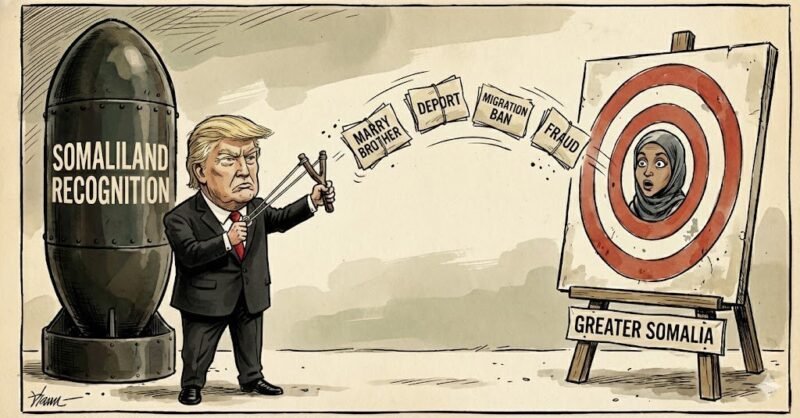
A U.S. political cartoon targeting Ilhan Omar has gone viral in Somalia and Somaliland, revealing how American domestic politics now shape perceptions and soft power in the Horn of Africa.
A single political cartoon depicting former U.S. President Donald Trump attacking Congresswoman Ilhan Omar has crossed oceans and political systems, morphing from a piece of American partisan commentary into a viral symbol across Somalia and Somaliland. Its unexpected afterlife in the Horn of Africa offers a revealing case study in how U.S. domestic politics now reverberate far beyond American borders, often in ways Washington neither anticipates nor controls.
The image—showing Trump aiming arrows at Omar—was originally intended for an American audience familiar with the former president’s rhetorical assaults on the Minnesota lawmaker. But once it entered Somali digital spaces, its meaning shifted.
In Mogadishu and Hargeisa, the cartoon is not consumed as satire or partisan critique; it is read as a visual metaphor for hostility toward Somalis themselves. Omar’s identity as the first Somali-American elected to Congress has fused her personal political battles with a broader communal narrative of representation, pride, and vulnerability.
This transformation underscores the power of diaspora politics as a two-way transmission channel. Somali communities abroad do not merely absorb Western political narratives; they export them back to the homeland, stripped of their original context and reframed through local histories of displacement, marginalization, and survival.
For many viewers in Somalia and Somaliland, the arrow imagery evokes memories of persecution and exclusion, reinforcing fears about the conditional acceptance of Muslims and Africans in Western societies.
The viral spread of the cartoon also exposes a critical vulnerability in U.S. soft power. At a time when Washington is competing with Beijing and Moscow for influence in the Horn of Africa—while relying on Somali partners for counterterrorism cooperation—perceptions matter.
Images suggesting hostility toward Somali-Americans weaken America’s moral authority and provide ready-made material for rival narratives portraying the United States as hypocritical or exclusionary. What begins as domestic political theater can quickly become strategic ammunition abroad.
The episode highlights a deeper structural reality: the collapse of the boundary between domestic and foreign messaging. In a hyperconnected world shaped by social media and diaspora networks, American political rhetoric is no longer confined to U.S. voters.
Attacks framed for domestic consumption are instantly reinterpreted in foreign contexts, where they interact with local grievances and geopolitical competition.
For U.S. policymakers, the lesson is uncomfortable but unavoidable. Cultural wars waged at home increasingly have international consequences, particularly in regions where identity, migration, and historical trauma intersect.
Whether American political leaders choose to acknowledge this reality or continue to treat domestic messaging as cost-free abroad will shape not only elections, but also America’s standing in regions where influence is quietly slipping.
The cartoon’s journey from Washington to Somalia is not an anomaly. It is a warning sign of a world in which every image, every insult, and every political performance now travels globally—often faster than diplomacy can keep up.