PLAN B TO MOSCOW: Is Iran’s Supreme Leader Preparing to Run as the Streets Boil?
As protests spread across Iran and security forces struggle to contain mounting public anger, a striking claim has emerged from London: Supreme Leader Ayatollah Ali Khamenei, now 86, allegedly has a contingency plan to flee the country if the regime begins to collapse.
According to a report by The Times of London, the plan — dubbed “Plan B” — would see Khamenei and a tightly controlled inner circle of roughly 20 people, including family members and senior aides, evacuate to Russia. Intelligence sources cited by the paper say the arrangement would also include mechanisms to transfer control of Khamenei’s vast financial empire, estimated at around $95 billion.
That wealth, much of it opaque and shielded from scrutiny, is reportedly tied to Setad, a powerful conglomerate originally created to manage confiscated property after the 1979 revolution, as well as a web of semi-state religious foundations. These entities have long functioned as the economic backbone of the supreme leader’s authority — and, potentially, his insurance policy.
The scenario echoes a recent and ominous precedent. When Syria’s Bashar al-Assad fled Damascus in late 2024 as his regime collapsed, Moscow provided sanctuary. Assad, according to Western reporting, is now living quietly in Russia under Kremlin protection. Former Israeli intelligence official Beni Sabti told The Times that Russia may be Khamenei’s only realistic destination if power slips from his grasp. “There is no other place for him,” Sabti reportedly said.
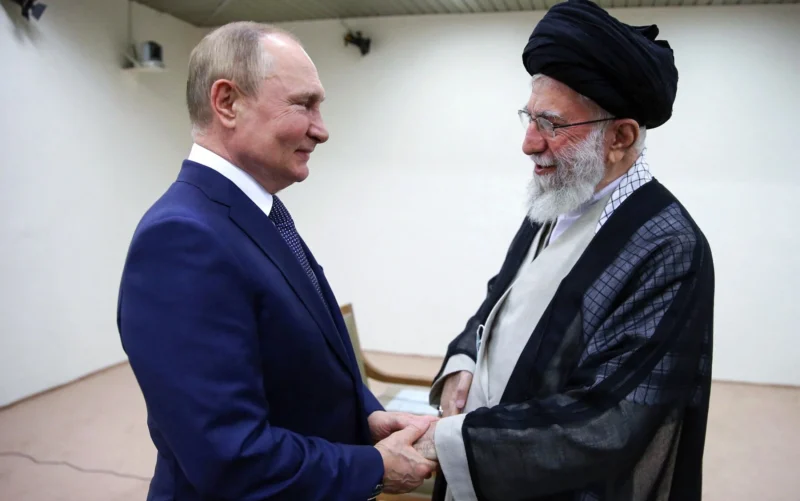
The report suggests Khamenei’s affinity for Russia is not merely tactical. He has repeatedly praised President Vladimir Putin and, according to those familiar with his thinking, views Russia as culturally closer to Iran than the West — and far more reliable in moments of existential crisis.
The timing of the report is significant. Iran is facing its most serious unrest since the 2022 protests sparked by the death of Mahsa Amini, with demonstrations now fueled by economic collapse, currency freefall, and growing defiance across multiple provinces. While the regime retains formidable coercive tools, including the Islamic Revolutionary Guard Corps, the persistence and geographic spread of the protests have rattled elites.
Adding to the pressure is an unusually blunt signal from Washington. Following the dramatic U.S. operation that captured Venezuela’s Nicolás Maduro, the Trump administration has leaned into a posture of intimidation toward Tehran. On Sunday, the U.S. State Department’s Farsi-language account posted a stark message alongside an image of President Trump: “President Trump is a man of action. If you didn’t know, now you know.”
Trump himself reinforced the warning, telling reporters aboard Air Force One that if Iranian authorities respond to protests with mass killings, “they will be hit hard by the United States.”
For now, there is no public confirmation from Tehran of any escape plan, and the regime continues to project confidence. But history suggests that authoritarian systems often prepare exit options long before admitting vulnerability.
If the report is accurate, “Plan B” is more than a logistical contingency. It is a quiet acknowledgment of a possibility the Islamic Republic has always denied: that even the supreme leader may not be immune to the force of sustained public revolt.
Whether Khamenei ever boards a plane for Moscow is uncertain. What is clear is that the mere circulation of such a plan reflects a regime increasingly aware that the ground beneath it is no longer as solid as it once was.