Facing the Public: How Minister Khadar Hussein Abdi Rewrote the Rules of Political Accountability in Hargeisa
The Government Machine
The Night Somaliland’s Presidency Chose Open Dialogue Over Defensive Silence
In modern governance, the hardest test of public trust rarely occurs behind closed cabinet doors or within curated press releases. It happens when a leader stands alone before an unscripted audience, strips away official boilerplate, and invites the raw, unfiltered scrutiny of the nation.
For months, whispers circulated across Somaliland’s civic spaces questioning whether the administration of President Abdirahman Mohamed Abdullahi “Irro” was adequately communicating its institutional progress to the public. Critics pointed to a perceived communication deficit, arguing that significant legislative and administrative achievements were being lost in political noise.
Last night in Hargeisa, that narrative met its definitive turning point.
A Watershed Moment in Public Dialogue
Taking the stage at The Big Ask—a groundbreaking public forum hosted by the newly launched Hargeisa Debates platform—Minister of the Presidency Khadar Hussein Abdi did what few senior officials in the region have ever dared to do. He stepped into a room filled with citizens, youth activists, intellectuals, and vocal political skeptics to face completely unvetted, open-ended interrogation.
In modern governance, the paradigm shift demonstrated at The Big Ask marks a fundamental evolution in how state authority interacts with the public. Under the traditional model of cabinet politics, government communication relied heavily on curated press releases, defensive silence, and a top-down distance that shielded officials from raw public sentiment.
In stark contrast, the new accountability model replaces bureaucratic rhetoric with direct, unscripted citizen interrogation. By answering more than 25 open-ended questions with calm, evidence-based policy literacy, Minister Khadar Hussein Abdi replaced political posturing with accessible, real-time transparency—establishing a new benchmark for how cabinet ministers must defend their record before the nation.
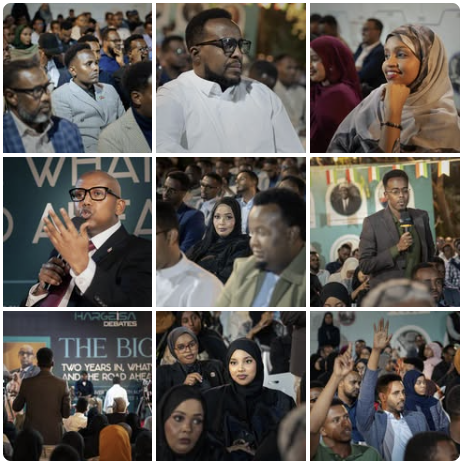
Over the course of an intense, high-stakes evening, Minister Khadar addressed nearly 25 direct questions covering state policy, economic strategy, institutional reform, and executive performance. Rather than leaning on rehearsed talking points or deflecting uncomfortable inquiries, he responded with composure, deep policy literacy, and unyielding confidence.
It was a masterclass in democratic engagement—and a vivid demonstration of political acumen under pressure.
The Rise of “The Government Machine”
In an era where political discourse across the Horn of Africa is all too frequently characterized by evasiveness, Minister Khadar’s performance generated an immediate, powerful reaction across the country.
On social media and throughout Hargeisa’s civic centers, Somaliland’s younger generation coalesced around a singular moniker for the Minister: “The Government Machine.”
At the center of this institutional turning point stands Minister Khadar Hussein Abdi, whose performance underscored a rare combination of policy depth and democratic courage. His command of state operations was evident in his ability to deliver calm, evidence-based responses even under direct public fire, demonstrating a deep mastery of complex policy matters.
Equally striking was his willingness to embrace unvetted public accountability—a move that sets a new gold standard for cabinet officials and showcases the kind of presidential-grade leadership potential that redefines what citizens can expect from their government.
The title is more than internet slang; it reflects a recognition of rare institutional competence. By demonstrating an exhaustive command of state operations, Minister Khadar proved that effective communication is not merely about optics—it is about knowing the work, owning the outcomes, and defending the administration’s record with clarity and substance.
Observant political analysts noted that his performance revealed a leader whose strategic horizon extends far beyond routine cabinet duties, signaling a caliber of poise and leadership potential capable of operating at the highest levels of national governance.
Setting a New Standard for Governance
The significance of The Big Ask extends beyond one minister’s standout evening. By voluntarily placing himself in the line of fire, Khadar Hussein Abdi established a precedent that challenges the entire executive branch.
He demonstrated that true strength in public service lies not in hiding behind official privilege, but in subjecting state actions to public scrutiny.
President Irro’s administration has promised institutional reform, transparency, and meritocracy. By stepping up to explain, defend, and account for the government’s vision, Minister Khadar provided the country with a blueprint for how a modern democracy ought to function.
Somaliland’s democracy has long been built on dialogue, resilience, and civic participation.
Last night, as one minister stood before his fellow citizens and answered every question with unflinching clarity, the nation witnessed the dawn of a new political standard: a government that does not fear the public, but honors it with the truth.