
Top stories
Hundreds Missing in North Carolina After Hurricane Helene’s Devastation

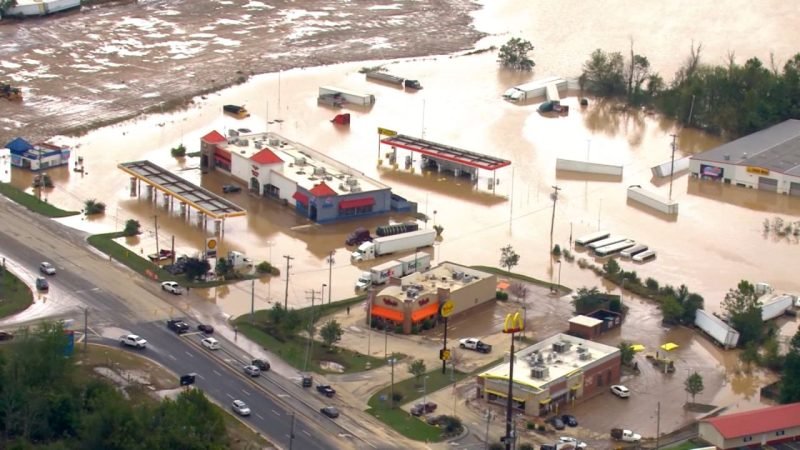
Western North Carolina has been left grappling with destruction and loss in the wake of Hurricane Helene, as hundreds remain missing and residents struggle to navigate a landscape described as “post-apocalyptic.” The storm, one of the most powerful to strike the Southeast in recent memory, has left communities isolated, roads flooded, and basic services cut off.
More than 100 deaths have been reported across six states, with Hurricane Helene making landfall in Florida’s Big Bend region late Thursday before cutting a path of destruction through Georgia and into the Carolinas. The full extent of the devastation remains uncertain as search and rescue efforts continue.
At the White House on Monday, U.S. Homeland Security adviser Liz Sherwood-Randall reported that as many as 600 people remain unaccounted for in the region, though she cautioned that the numbers are likely to fluctuate as more areas are reached by responders. Officials fear the death toll will continue to rise.
Isolation and Desperation in Western North Carolina
In North Carolina’s Buncombe County, home to the popular tourist destination of Asheville, at least 35 people have been confirmed dead, according to the county sheriff. Local authorities are preparing to distribute food and water, but efforts have been hampered by widespread flooding and mudslides that have rendered many major routes impassable. Some supplies have been airlifted into the area, where rescue operations are racing against time.
Colleen Burns, 58, a resident of nearby Yancey County, spoke of the mounting challenges facing her community. “They’re running out of gas for ATVs that are helping the rescue, they’re also running out of gas for the chainsaws,” she said. Burns’ house is near the small town of Burnsville, one of the hardest-hit areas. “We desperately need gas,” she added, underscoring the critical shortages affecting recovery efforts.
Elsewhere in Yancey County, Taylor Shelton, 44, described the devastation that has overwhelmed her neighborhood. Century-old trees around her home were snapped by the storm’s powerful winds, leaving her husband to spend two days clearing a path with a chainsaw just to get their family out. Without phone service, Shelton and her neighbors relied on a local EMT with a walkie-talkie to guide them through back roads out of the mountains.
“The devastation is unbelievable,” Shelton said. On Monday, she was attempting to return home to retrieve their pets and leave supplies for neighbors. “It looks like War of the Worlds. Very, very big trees are down everywhere. We saw houses that are just washed away.”
A Scene of Destruction Across the Region
The widespread impact of the storm was evident across the region. In Lake Lure, about 20 miles southeast of Asheville, floating debris from homes and businesses washed away by swollen mountain streams covered the lake. Charlotte City Councilman Tariq Bokhari shared images of the destruction, writing, “It’s so overwhelming. You don’t even know how to fathom what recovery looks like, let alone where to start.”
Power outages remained extensive on Monday, with 2.1 million homes and businesses across several states still in the dark, according to the monitoring website PowerOutage.us.
North Carolina Governor Roy Cooper expressed grave concern over the lack of communication and the hundreds still missing. “We know that there are people missing, and we know that there’s going to be significant fatalities at the end of this,” Cooper said in an interview with CNN. The governor, who himself had not heard from his son and daughter in 72 hours, said authorities were conducting door-to-door welfare checks in many affected communities.
In Buncombe County, officials were particularly focused on checking 150 households identified as “priority” due to their elderly or medically vulnerable residents.
A Federal Response and Long Road to Recovery
The scale of the devastation has prompted a massive response from federal, state, and local authorities. The National Guard and emergency workers from 19 states have been deployed to assist in the recovery, alongside personnel from the Federal Emergency Management Agency (FEMA). However, the rugged terrain of western North Carolina has posed significant challenges, with landslides and flooding making many areas inaccessible by ground.
“We’re depending a lot on air power, helicopters with hoist capacity to get supplies in,” Cooper said, describing the complex logistics involved in the relief efforts.
President Joe Biden announced that he would visit North Carolina later this week to assess the damage and discuss further federal assistance. Speaking from the White House, Biden said he may ask Congress to reconvene for a special session to approve supplemental disaster aid funding.
“There’s nothing like wondering, ‘Is my family alive?’” the president said. “Many more will remain without electricity, water, food, and communications, and whose homes and businesses are washed away in an instant. I want them to know we’re not leaving until the job is done.”
Vice President Kamala Harris, who had been on the campaign trail in Nevada, cut short her trip to participate in briefings on the hurricane response. She is expected to visit the region once it is clear her presence will not impede ongoing recovery efforts.
Meanwhile, former President Donald Trump traveled to Valdosta, Georgia, on Monday to survey damage at a local furniture store destroyed by the storm.
A Storm’s Devastating Toll
Hurricane Helene, which struck Florida’s Gulf Coast as a Category 4 storm, has caused an estimated $15 billion to $100 billion in damage, according to insurance analysts and weather forecasters. Among the dead are 25 people in Georgia, including a firefighter responding to emergency calls and a mother and her 1-month-old twins, all killed by a falling tree.
As the Southeast reels from the storm’s devastation, the focus remains on the immediate task of search and rescue. But for the millions affected, the path to recovery is likely to be long and fraught with challenges, as entire communities grapple with the aftermath of one of the most destructive storms in recent history.


















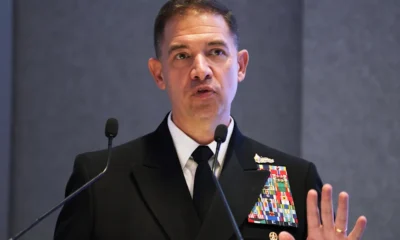


Iran Rules Out Broader Talks as Trump Signals Possible Second Carrier Deployment.
Iran said Wednesday it is willing to negotiate with the United States over its nuclear program but firmly rejected expanding talks to include its ballistic missile arsenal, drawing a clear line as diplomatic efforts intensify and military pressure mounts in the region.
President Masoud Pezeshkian, speaking in Tehran during ceremonies marking the anniversary of the 1979 Islamic Revolution, reiterated that Iran is not seeking nuclear weapons and is prepared to accept verification measures. At the same time, senior Iranian officials made clear that missile capabilities and broader defense issues remain off the table.
“We are not seeking nuclear weapons and we are ready for any kind of verification,” Pezeshkian told crowds gathered in the capital. But advisers to Supreme Leader Ayatollah Ali Khamenei emphasized that Iran’s missile program is non-negotiable, describing it as a core component of national defense.
The remarks come as President Donald Trump increases both diplomatic outreach and military signaling. The USS Abraham Lincoln aircraft carrier is already operating in the region, and Trump indicated this week that a second carrier group could be deployed if negotiations falter.
“We have an armada that is heading there and another one might be going,” Trump said in an interview, warning that time is “running out” for Tehran to reach what he described as a fair agreement.
The escalating rhetoric coincides with renewed talks between U.S. and Iranian officials, including a recent round of discussions in Oman. While Trump has said negotiations are underway, he has also warned that failure to reach a deal could result in decisive military action.
Israeli Prime Minister Benjamin Netanyahu, who met Trump in Washington, is expected to press for any agreement to address not only Iran’s nuclear activities but also its expanding ballistic missile stockpiles and support for regional proxy groups. Israeli officials view Iran’s missile arsenal as a direct and immediate threat, particularly after last year’s 12-day conflict between the two countries.
Iranian leaders, however, have rejected linking missile discussions to nuclear negotiations. Foreign Minister Abbas Araghchi said earlier this week that while nuclear talks are possible, Iran’s defense capabilities “will never be negotiated.”
Tensions have been further heightened by domestic unrest inside Iran. Nationwide protests erupted in late December over rising living costs before evolving into broader anti-government demonstrations. Human rights groups report thousands of deaths during the crackdown, though official figures released by Iranian authorities are significantly lower. Independent verification of casualty numbers remains difficult.
As the diplomatic track continues, both sides are balancing pressure and positioning. Washington has expanded its military presence in the Middle East, while Tehran has warned that any attack would trigger a regional confrontation. Iranian military leaders say forces are on high alert.
Despite the hardened rhetoric, officials in both capitals have signaled that negotiations remain possible. The coming weeks are likely to determine whether talks yield a limited nuclear understanding or whether escalating military deployments push the crisis toward a more dangerous phase.

Puntland President Said Abdullahi Deni and Jubaland President Ahmed Mohamed Islam arrived in Mogadishu on Tuesday, marking a rare joint return to the capital after a prolonged political standoff with the federal government.
President Deni landed at Aden Adde International Airport accompanied by a delegation that included security officials. He was received by members of parliament, senators, opposition figures and representatives of civil society before being escorted to his residence at the Halane camp.
His arrival followed that of President Ahmed Madobe, who reached Mogadishu earlier in the day after an absence of roughly 18 months. Madobe was similarly welcomed by senior officials and community representatives at the airport.
Both leaders are attending a conference convened by Somali President Hassan Sheikh Mohamud, bringing together Villa Somalia and members of the Future Council. The talks are expected to focus on national priorities, including elections, constitutional disputes, unity, security, the fight against Al-Shabaab and the broader governance crisis.
Deni and Madobe have largely stayed away from Mogadishu in recent years due to escalating tensions with the federal government, which at times led to a breakdown in cooperation between the centre and key federal member states.
The conference, scheduled to begin imminently, is being closely watched as a potential turning point in strained federal-state relations. Both presidents are expected to address the media and outline their positions as discussions get under way.
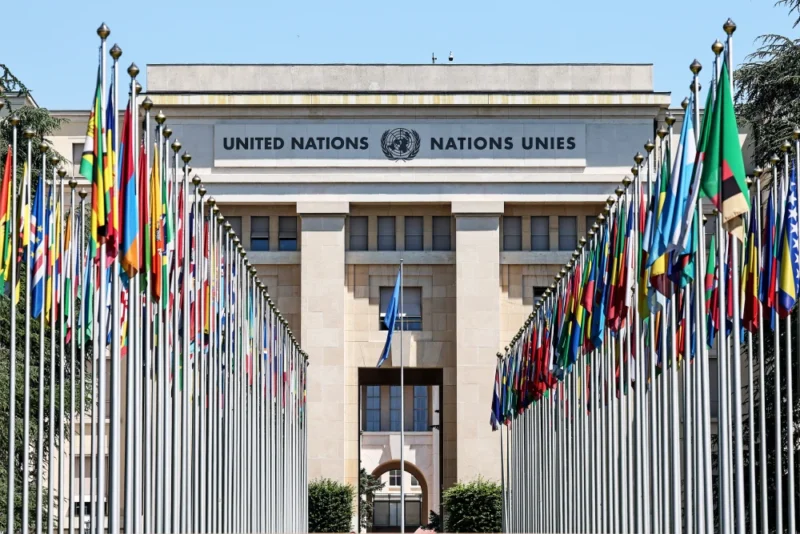
The United Nations said Monday it is waiting to learn how much of the nearly $4 billion owed by the United States the Trump administration intends to pay, and when the funds will be delivered, as the world body warns of a looming financial crisis.
UN Secretary-General Antonio Guterres cautioned last week that the organization faces an “imminent financial collapse” unless its funding rules are reformed or all 193 member states meet their financial obligations—a warning widely seen as aimed at Washington.
According to UN officials, the United States owes about $2.2 billion to the UN’s regular operating budget, including roughly $767 million for the current year, as well as an additional $1.8 billion for peacekeeping operations. Those arrears are expected to grow if payments are further delayed.
The United Nations confirmed that U.S. Ambassador Mike Waltz told officials the administration plans to make a significant initial payment within weeks, though the final amount has not yet been decided.
UN spokesman Stephane Dujarric said Secretary-General Guterres and senior UN financial officials have been in ongoing contact with U.S. counterparts, but stressed that the organization is still awaiting clarity. In a recent letter to member states, Guterres warned that funds for the UN’s core budget could be exhausted by July, potentially disrupting operations worldwide.
President Donald Trump has repeatedly criticized the UN, arguing it has failed to live up to its mission. His administration made no payments to the UN in 2025 and has withdrawn from several UN bodies, including the World Health Organization and UNESCO, while cutting funding to dozens of others.
UN officials say the United States accounts for roughly 95% of unpaid contributions to the organization’s regular budget. Venezuela is the second-largest debtor, owing about $38 million, and has lost its General Assembly voting rights after falling more than two years behind on payments.
Nearly 60 countries paid their annual UN dues by the February deadline, but officials warn that without U.S. action, the financial strain could soon become critical.

South Korean police on Tuesday raided the country’s intelligence services as part of an expanding investigation into suspected government involvement in drone flights into North Korea earlier this year.
Investigators from a joint military–police task force searched 18 locations, including the Defense Intelligence Command and the National Intelligence Service, authorities said. The raids are linked to a drone that North Korea claims was flown into its territory and shot down over Kaesong in January.
Pyongyang accused Seoul of sending the drone to drop propaganda leaflets and released images it said showed debris from the downed aircraft. The South Korean government initially denied any official role, with President Lee Jae Myung warning at the time that such an act would amount to a dangerous provocation.
Authorities now say they are investigating three active-duty soldiers and one intelligence agency employee in connection with the incident. Three civilians have already been charged. One has publicly claimed responsibility, saying the flight was intended to measure radiation levels near North Korea’s Pyongsan uranium facility.
The investigation also casts renewed scrutiny on former president Yoon Suk Yeol, who is on trial over allegations he illegally ordered drone flights into North Korea to help justify a declaration of martial law in late 2024. Prosecutors say the actions were designed to provoke a response from Pyongyang and create conditions for emergency rule. Yoon was impeached and removed from office last year after the plan collapsed.
Since taking office, Lee has sought to reduce tensions with the North, including ordering the removal of propaganda loudspeakers along the border. He has previously suggested an apology might be warranted for his predecessor’s alleged actions, though he cautioned against fueling domestic political divisions.
North Korea, meanwhile, has showcased new attack drones and accused the South of repeated provocations, as cross-border tensions continue despite intermittent efforts at de-escalation.

Russia has warned that Cuba’s worsening fuel shortage has reached a critical stage, accusing the United States of imposing “suffocating measures” aimed at crippling the island’s economy and political will.
Kremlin spokesman Dmitry Peskov said Monday that Moscow is discussing “possible solutions” to support Havana and stands ready to provide assistance. His remarks come as Cuba reels from severe energy shortages after Washington cut off oil flows from Venezuela and threatened tariffs against countries supplying fuel to the island.
“The situation is really critical in Cuba,” Peskov told reporters, blaming US sanctions for deepening the crisis.
Russian Foreign Minister Sergey Lavrov echoed that stance, expressing solidarity with Cuba and Venezuela and insisting both nations have the right to determine their own futures without external pressure.
Cuba’s fuel shortage has forced emergency measures across the country. Authorities have introduced a four-day work week for state firms, limited fuel sales, shut universities, shortened school hours and warned airlines that jet fuel supplies are running out. Air Canada announced Monday it would suspend flights to Cuba due to the lack of aviation fuel.
Cuban Foreign Minister Bruno Rodríguez condemned what he called Washington’s “cruel aggression,” saying the goal was to “break the political will of the Cuban people.” President Miguel Díaz-Canel said Havana remains open to dialogue with the United States, but not under coercion.
The crisis has drawn international concern. UN Secretary-General António Guterres has warned of a potential humanitarian collapse if Cuba’s energy needs are not met. Mexico’s President Claudia Sheinbaum also criticized US sanctions, vowing to continue diplomatic efforts to restore oil shipments despite the risk of American tariffs.
Washington, meanwhile, has defended its hard line. President Donald Trump has labeled Cuba an “extraordinary threat” to US national security and warned of further penalties against countries supplying the island with fuel, signaling that pressure on Havana is set to intensify.
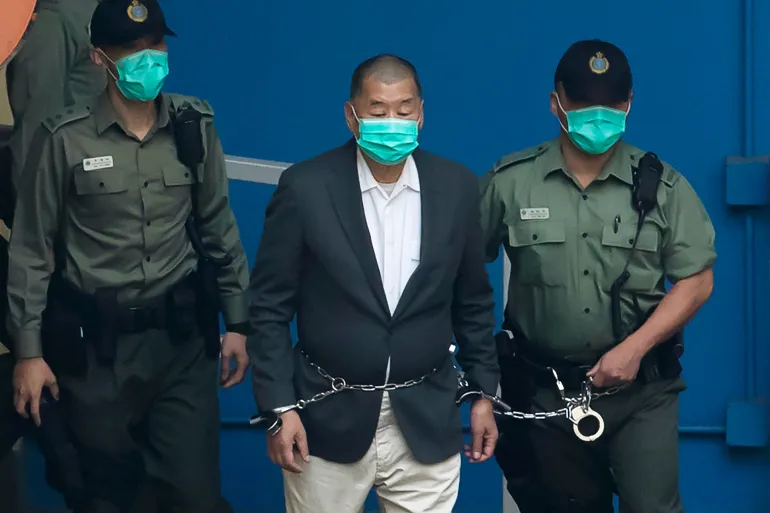
Hong Kong’s most prominent pro-democracy media figure, Jimmy Lai, was sentenced on Monday to 20 years in prison under the city’s Beijing-imposed national security law, drawing sharp international condemnation and warnings that the punishment amounts to a life sentence.
The 78-year-old founder of the now-defunct Apple Daily was convicted of foreign collusion and sedition, the harshest penalty yet imposed under the law. Lai has been in detention since 2020. His family said the sentence is cruel and life-threatening given his age and deteriorating health, warning that he could die behind bars if the ruling stands.
Hong Kong leader John Lee defended the verdict, calling Lai’s actions “heinous” and saying the sentence upheld the rule of law. Beijing echoed that position, insisting the case was lawful and beyond dispute.
Western governments and rights groups reacted with alarm. Britain described the sentence as tantamount to a life term and urged Lai’s release on humanitarian grounds. The European Union said it deplored the ruling and called for an end to the prosecution of journalists. Australia and Taiwan warned the case would deepen the chilling effect on freedoms in Hong Kong and beyond.
Press freedom advocates said the verdict symbolized the collapse of independent journalism in the city. Human Rights Watch called the 20-year term “effectively a death sentence,” while legal scholars said the punishment appeared unusually severe and that an appeal should be considered.
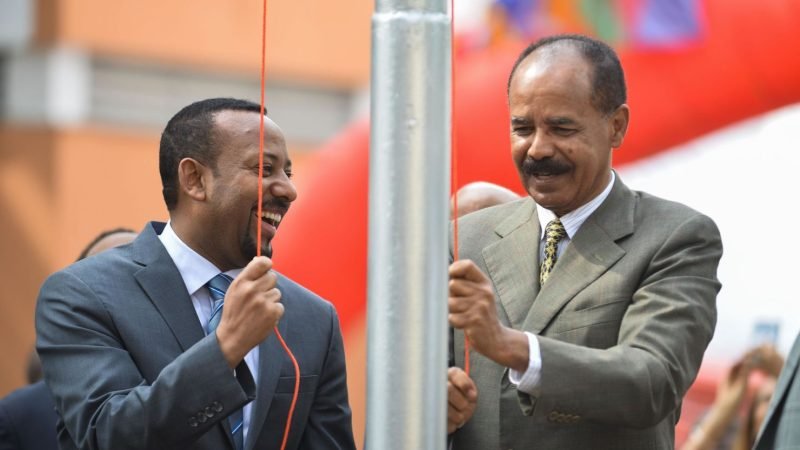
Ethiopia has formally warned Eritrea to withdraw its troops from what Addis Ababa says is Ethiopian territory, accusing Asmara of violating its sovereignty and backing armed groups along the border, while offering dialogue if the troops pull back.
In a letter sent on January 30, Ethiopian Foreign Minister Gideon Timothy told his Eritrean counterpart Osman Salah that Eritrean forces have occupied Ethiopia’s northeastern territory “for a long time,” undermining Ethiopia’s territorial integrity. The letter, confirmed by Foreign Ministry spokesperson Ambassador Nebiat Getachew, calls the actions a “complete invasion” and a breach of international law.
Ethiopia accused Eritrea of providing direct support to unnamed armed groups operating along the border, allegations that in the past have included links to the TPLF and Fano militias. It also warned that recent military movements show Eritrea has chosen “a path of destruction,” including joint operations with rebel groups on Ethiopia’s northwest frontier.
Addis Ababa said it is ready to enter sincere negotiations — including talks on maritime services and access to the port of Assab — if Eritrea immediately withdraws its troops and ends cooperation with rebel forces. The letter stressed that while Ethiopia is committed to peaceful dialogue after decades of conflict, Eritrea’s current actions are “unacceptable under any circumstances.”
So far, Eritrea has not officially responded. Ethiopia has also raised the issue with the United Nations, warning that Eritrean troop deployments along the border continue to fuel instability and serious human rights concerns.

U.S. President Donald Trump said the American economy now belongs to him, declaring he is “very proud of it,” as he seeks to take full ownership of economic performance ahead of the November midterm elections.
Speaking in an interview with NBC Nightly News anchor Tom Llamas that aired Sunday during the Super Bowl, Trump said the transition from the Biden-era economy is complete. Asked when the country entered the “Trump economy,” he replied: “I’d say we’re there now.”
Trump’s comments come despite widespread public dissatisfaction. An NPR/Marist/PBS News poll released last week found that just 36% of Americans approve of Trump’s handling of the economy, while 59% disapprove. Democrats have capitalized on economic anxiety, particularly around affordability, in recent off-year election victories in states including Virginia, New Jersey and New York.
In the Oval Office interview, recorded Wednesday, Trump argued that Democrats have quietly dropped their affordability message because of recent economic performance. He blamed former President Joe Biden for high prices, saying he inherited “a mess in every way.”
“In the last four days, the Democrats have not uttered the word ‘affordability,’” Trump said, without offering evidence.
Trump claimed the economy has grown by 5.6% since he took office, a figure not supported by official government data. According to the Labor Department, the economy grew at an annualized rate of 4.4% in the third quarter of 2025 and has not exceeded 5% growth in any quarter since 2021.
Economic output also contracted in the first quarter of 2025, partly due to uncertainty surrounding trade and tariff policies later announced by the administration. Fourth-quarter data has not yet been released because of a government shutdown.
A White House official said Trump was referencing projections from the Atlanta Federal Reserve, which at times estimated growth as high as 5.4%.
Trump also claimed that $18 trillion is being invested in the United States, citing new factories, plants and businesses. However, the White House’s own website lists $9.6 trillion in announced investments, and independent reviews have said even that figure is likely inflated.
Asked whether those projects would materialize before his term ends in January 2029, Trump said many would open within the next year or two.
In a previous NBC interview in May, Trump had drawn a sharper line, saying the economy’s “good parts” were his, while the “bad parts” belonged to Biden.

Turkey’s Expanding Military Role in Somalia Raises Strategic Questions for Somaliland

From Negotiation to Escalation: Why the Iran File Is Sliding Toward Force

Australia Charges Two Chinese Nationals With Foreign Interference


-
 Interagency Assessment2 months ago
TOP SECRET SHIFT: U.S. MILITARY ORDERED INTO SOMALILAND BY LAW
-

 Somaliland4 months ago
Somaliland Recognition: US, UK, Israel, and Gulf Bloc Poised for Historic Shift
-
 Minnesota1 month ago
Fraud Allegations Close In on Somalia’s Top Diplomats
-

 Middle East2 months ago
Saudi Arabia vs. UAE: How The Gulf Rivalry is Heating Up
-

 American Somali3 months ago
Why Frey Won a Significant Share of the Somali Vote Against a Somali Opponent
-
 Middle East2 months ago
Turkey’s Syria Radar Plan Triggers Israeli Red Lines
-
 Editor's Pick1 month ago
Why India Is Poised to Become the Next Major Power to Recognize Somaliland
-

 The Million-Follower Exile2 months ago
Why America Deported Its Most Famous Somali TikTok Star And Who Paid The Price