Connect with us

Editor's Pick

From Germany, ‘War Influencers’ Incite Violence in Somalia

Published

on

Somali influencers used social media to spread radical content, urge violence, raise cash for arms and glorify war in Somalia — all from Germany, a joint investigation by DW and German public broadcaster ARD found.

Esther Felden | Mariel Müller

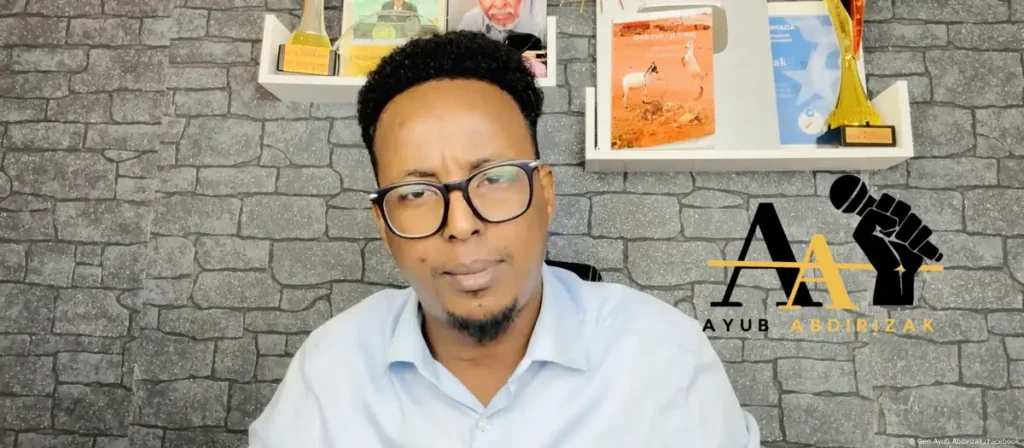
Ayub Abdirizak can be found in many video clips online, including this one, uploaded to Facebook in June 2024Image: Gen.Ayub Abdirizak/Facebook

And he built his social media career in Germany, where he arrived in 2017 and remained for about seven years, operating under the radar of authorities while encouraging bloodshed back home.

“Take the guns and fight,” Ayub urges his followers in a video he posted in late 2022. Offering what he calls practical advice from personal experience, he tells fighters to climb tall buildings to spot enemies at a distance. “Shoot any person on the highway once you see they are wearing a military uniform,” he says. And it’s not just the military who is the enemy in this scenario, Ayub tells his audience: People who refuse to let them enter buildings to take their rooftop positions should be “shot on the forehead” and left with a “bullet mark on his face.”

As now uncovered by DW’s investigative team in collaboration with the German public broadcaster ARD, German authorities eventually took notice of Ayub’s efforts at incitement. We set out to trace his path — and study the destructive influence he wields. The investigation also examined the reach of another war influencer who continues to use Germany as a haven to call for violence back in Somalia.

A violent path

Somalia has grappled with armed conflict and volatile politics for decades. With the federal government constantly fighting the militant Al-Shabab group for more than a decade, longer-running deep-rooted conflicts between the clans that dominate Somali society have complicated efforts to build national unity and institute effective governance. Amid such instability, several Somali regions have forged their own political paths.

Ayub’s story is closely tied to the often-violent rivalry between two regions in northern Somalia. Puntland is governed by President Said Abdullahi Deni of the Majerteen clan, whom Ayub supports in his videos. Neighboring Somaliland declared independence in 1991, although the self-proclaimed republic failed to gain international recognition. Violence frequently erupts on the border between Puntland and Somaliland.
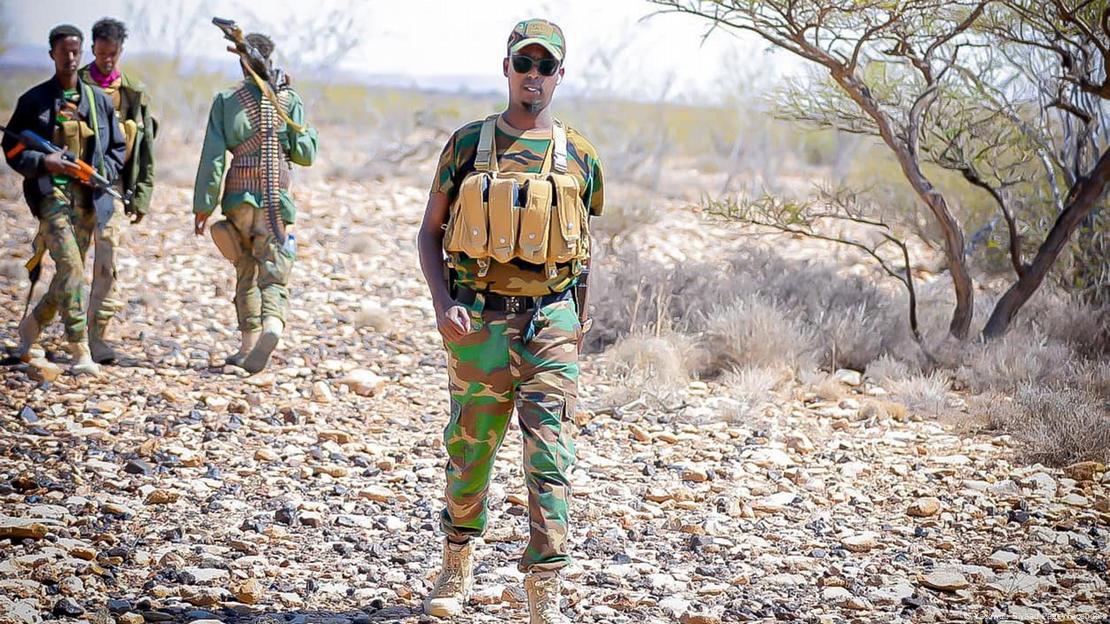
Ayub Abdirizak with armed fighters in Somalia
Ayub Abdirizak was independently confirmed to be in Somalia in early 2025 by DW; this picture was posted on one of his Facebook accounts in January Image: Yacqwub Siyaad Page/Facebook

Ayub seems to take pride in detailing the violence of his youth in Somalia for his online followers. “I left my family when I was 13 years old and took a gun,” Ayub, who is now in his late 30s, says in a YouTube video. He tells viewers that he fought in more than 30 battles when he “used to be a clan militant.”

Several sources, including a contact close to the current Puntland administration, told DW and ARD that Ayub was among the hijackers who held ships and hostages for ransom during the peak years of piracy off the Horn of Africa. Two seamen on a ship that was under the control of pirates from March 2010 through December 2012 told us their captors included a man called Ayub, who was tall and slim and spoke with a deep, resonant voice.

Life in Germany

As DW and ARD were able to confirm, Ayub first entered Germany in 2017.

He applied for asylum, but his application was rejected in 2020. However, he was allowed to stay as a “tolerated” refugee, a status that comes with fewer rights than recognized asylum.

According to his Facebook page, Ayub lived in Hamburg. Several short TikTok clips posted in 2022 show him in the city and elsewhere in northern Germany with friends.

But events would soon draw him back to Somalia.

On February 6, 2023, violence erupted in Las Anod, the capital of the Sool region. The dominant Dhulbahante clan, which has long sought to separate from Somaliland, seems to have the backing of the Puntland regional administration in its efforts.

Hundreds of people were killed in the initial clashes; hundreds of thousands more were displaced.
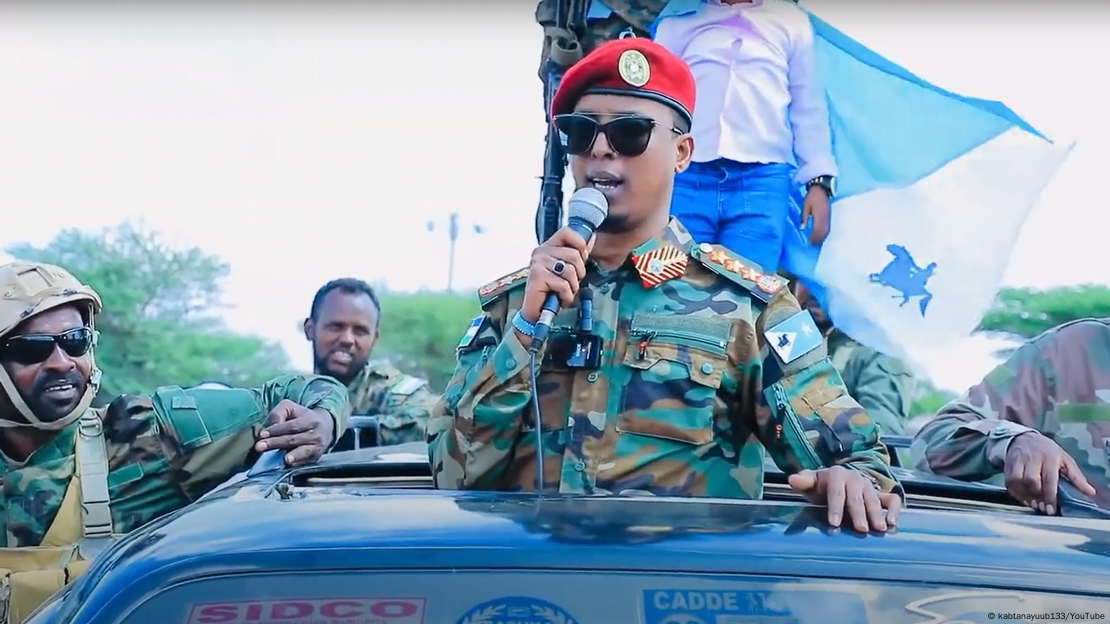
Ayub Abdirizak in a car's moonroof, wearing sunglasses and a microphone and talking to supporters
Ayub Abdirizak speaking to supporters when he visited his home country in November 2023 in a video uploaded to his YouTube channel Image: kabtanayuub133/YouTube

As a tolerated foreign national, Ayub was not officially permitted to travel freely. However, in November 2023, he posted a clip of a trip to Somalia, where he was greeted and cheered by supporters. One video, published on November 10, 2023, features Ayub alongside a group of fighters, sitting on a military vehicle and firing a Russian-developed anti-aircraft cannon.

In fact, research by ARD and DW found that Ayub made at least one round trip to Somalia while residing in Germany. The last video showing him in Germany was uploaded to his TikTok in July 2024. He is seen walking in fatigues past the town hall of Neubrandenburg in the northeasternmost state of Mecklenburg-Vorpommern.

In late 2024, Ayub left Germany and returned to Somalia. DW and ARD were able to confirm that he has since joined the Puntland Defense Force.

Another voice of hate from Germany

At least one other Somali war influencer continues to incite hatred from within Germany. Yacqwub Siyaad preaches violence to more than half a million followers on Facebook and about 230,000 on TikTok.

In several videos posted in 2023, Yacqwub, who shares Ayub’s cause, encourages his followers to attack their opponents: “Shell them day and night and then at last overrun their camp, cut off their heads.”

In another, he says: “These pigs are mine. I will drive them out of their holes and dance on their corpses.” He calls on viewers to “go to war” and “slaughter the enemy.” Being wounded or even killed, he claims, “is happiness.”

Yacqwub openly expresses his homophobia: “Kill those creatures. Remove them from society. Flog them.”

Confirmed by DW and ARD’s research, Yacqwub resides near Düsseldorf. He openly expresses hostility toward Germany. In a TikTok video, he says he lives “among infidels in the country of infidels.”

Yacqwub Siyadd in uniform and with an AK-47 in his hand
This photo of Yacqwub Siyaad holding an AK-47 was posted to Facebook in August 2023Image: Yacqwub Siyaad Page/Facebook

Like Ayub, Yacqwub has traveled to Somalia since moving to Germany. In the summer of 2023, a few months into the Las Anod conflict, he shared a picture of himself wearing a uniform alongside armed fighters. Another image shows him holding an AK-47. And, in a video clip, he is meeting a group of combatants, likely in one of the region’s desert areas.

Currently, he is back in Germany. Returning to Somalia does not appear to be a viable option for Yacqwub — he would risk being arrested upon arrival. In January 2025, a Puntland military court sentenced him in absentia to 10 years in prison on charges of using his YouTube channel to spread disinformation. The circumstances that led to this verdict are unclear.

Influencers’ ‘information warfare’

Influencers from abroad play a “very destructive role” in Somalia and have a “major impact” on the situation, said Moustafa Ahmad, a security analyst based in Somaliland. He describes their online activity as “information warfare.”

Yacquub Siyaad in front of a wall which displays his name
Yacqwub in a post on YouTube in June 2025Image: youtube.com | Yacquub Siyaad

In addition to spreading hate messages, Yacqwub uses his social media platforms to raise money within the Somali diaspora. He calls on his female followers to “sell your gold and donate the money.”

Jamal Osman, a Somali journalist working for international media, said war influencers had sometimes raised tens of thousands of euros within an hour — money that “is often used to buy weapons.”

Osman describes Ayub as charismatic: “He knows what buttons to press to provoke people into action.”

Well-connected in Germany

The influencers are known in the Somali community in Germany. DW and ARD talked to one Somali who has been living in Germany for several years and has been monitoring Ayub’s and Yacqwub’s social media activities for a long time. He said there was a simple reason why they can post virtually anything they want without fear of the authorities: “They speak Somali — and hardly anyone understands it.” He said anyone who did would still be unlikely to report the influencers. “Most people are afraid of them”.

Their fame has even made Ayub and Yacqwub sought-after interlocutors within the Somali diaspora, where they are seen by some as effective at attracting attention to causes and mobilizing support.

During his time in Germany, Ayub appears to have maintained a good relationship with Mohamed Abdulahi, the chairman of the nonprofit Somali-European Cooperation e.V. (SEKO). In a video, Abdulahi expresses his deep appreciation for Ayub’s contributions to the organization’s success. “I salute you, Kaptan Ayub,” Abdulahi says. “Thank you so very much.” In another clip, published in 2022, Abdulahi is talking to both Ayub and Yacqwub, sitting right between them. When introducing Ayub, Abdulahi refers to him as a “role model who plays a major role to assist the Somali people.”
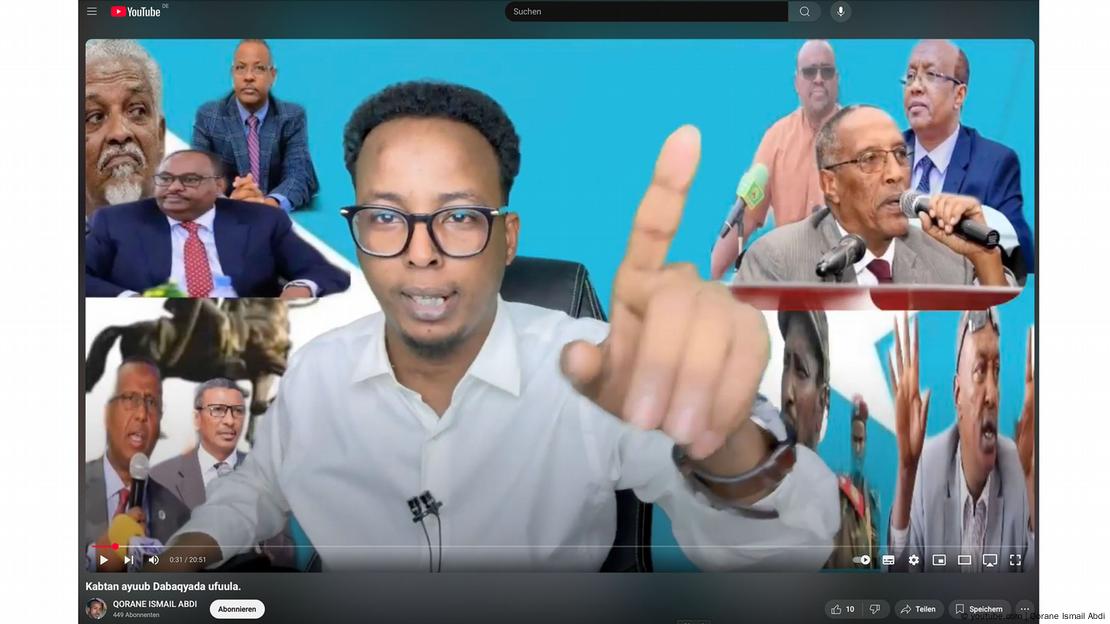
Ayub Abdirizak sitting in front of a picture wall with a raised finger
In this video, posted on on YouTube in December 2023, Ayub calls on his followers to “take the guns and fight”Image: youtube.com | Qorane Ismail Abdi

ARD and DW presented Abdulahi with several examples of the influencers’ efforts at incitement. He admitted the content was “brutal” and “not good,” and that this needed to be investigated and condemned. He said, however, that he was “not the one to judge” and that one must also take into account that these statements were made in the context of war, where there are always different sides and perspectives. He said repeatedly that he had not seen those videos before.

Abdulahi called his relationship with Ayub “friendship” and said, “You can just work really well with him.” He said SEKO had approached Ayub and Yacqwub in the past to “ask them for support in reaching people so they can make an announcement for us.”

When asked whether he could imagine asking for their support in the future, Abdulahi was evasive. After repeated questioning, he acknowledged that, having watched the videos, it “is not good to keep receiving support from them.”

Source; Esther Felden | Mariel Müller

By DW and German public broadcaster ARD found.

Editor's Pick

China Tests Hypersonic Jet Aiming to Circle the Globe in Seven Hours

Published

on

China Tests Hypersonic Jet Aiming to Circle the Globe in Seven Hours.

China’s aviation ambitions are accelerating at extraordinary speed. The country is developing a hypersonic jet capable of flying at Mach 16 — fast enough to circle the planet in just seven hours — in what could become one of the most dramatic leaps in commercial air travel since the dawn of the jet age.

The aircraft, designed by Beijing-based Lingkong Tianxing, is moving from concept toward reality. The company has already completed successful test flights of its Yunxing prototype at Mach 4, roughly 3,070 mph. Engineers are now conducting advanced trials on a new-generation engine designed to push the aircraft into true hypersonic territory.

If the program advances as planned, long-haul routes would be transformed. A journey such as London to New York — currently an eight-hour transatlantic flight — could be reduced to about 90 minutes, surpassing even the Concorde’s fastest record of under three hours.

Lingkong Tianxing confirmed that its Yunxing demonstrator flew successfully in October, with additional propulsion tests scheduled throughout November. Each step marks incremental progress toward a maiden hypersonic flight, which the company hopes to achieve within the next decade.

A legacy of speed: from Concorde to the hypersonic race

The promise of ultra-fast civilian travel revives a dream that captivated the world half a century ago. The Concorde, operated by British Airways and Air France, was the first and only supersonic passenger jet to enter commercial service.

Flying at Mach 2, it cut transatlantic travel times in half and embodied the pinnacle of Cold War–era aerospace engineering.

But the Concorde also revealed the limits of early supersonic travel. Operating costs were immense, its fuel burn was high, and its sonic booms sharply restricted where it could fly. A deadly crash in 2000, followed by surging fuel prices and weakened demand after 9/11, led to the aircraft’s retirement in 2003.

In the years since, the industry’s push toward supersonic and hypersonic travel has periodically faded and re-emerged. Today, advances in materials science, engine design, and computational aerodynamics have reignited optimism that the next generation of ultra-fast flight may succeed where the Concorde could not.

A global race to the next frontier

China is not alone in the race. Designers such as Oscar Viñals have proposed aircraft capable of exceeding Mach 5. NASA’s X-59 program is experimenting with technologies to dramatically reduce sonic booms.

American firms like Venus Aerospace envision jets that could complete transatlantic routes in under an hour. Meanwhile, Chinese companies like Cormac are working on supersonic aircraft quieter than a car at Mach 1.

But among the many contenders, Lingkong Tianxing’s hypersonic Yunxing project is the most audacious — and the most advanced in real-world testing.

Whether the jet ultimately reaches its proposed Mach-16 capability remains an open question. The technological and regulatory challenges are enormous. Yet the company’s rapid progress signals that a new era of extreme-speed passenger flight may no longer be a distant fantasy.

For now, the Yunxing program stands at the forefront of a high-stakes, global technological race — one that could redefine both military and civilian aviation and fundamentally reshape how the world moves.

Continue Reading

Editor's Pick

The New Dubai? Foreigners to Own Prime Saudi Real Estate

Published

on

Saudi Arabia’s decision to allow foreign nationals to purchase real estate beginning in January 2026 marks one of the most consequential shifts in the Kingdom’s economic strategy in decades, signaling a deeper turn toward global investment and the structural ambitions of Vision 2030.

The policy, which will open designated zones in Riyadh, Jeddah, NEOM and other major development corridors to expatriates and international buyers, represents a calibrated move toward economic liberalization in a country historically defined by strict ownership rules. Properties in Makkah and Madinah will remain governed by special regulations.

Under the government’s timeline, the new law is set to take effect in early 2026, with detailed regulations to be released within six months on the “Istitaa” digital platform. Officials say this window is intended to provide clarity to investors, developers, and financial institutions preparing for what is expected to become one of the world’s largest emerging real estate markets.

The policy aligns with a broader effort to reduce Saudi Arabia’s dependence on oil by drawing long-term foreign capital into the country’s infrastructure and housing sectors.

Property ownership, Saudi officials argue, encourages expatriates to transition from temporary workers to invested residents — deepening the professional class required for expanding industries such as finance, technology, and advanced manufacturing.

A central driver of the reform is the need to attract private investment into the Kingdom’s mega-projects, including NEOM, the Red Sea development, and the rapid transformation of Riyadh.

Opening real estate to foreign ownership converts a previously limited market into a globally tradable asset class, offering new revenue streams for banks, developers, and state-backed projects.

The approach parallels elements of Dubai’s economic model, which ignited a real estate boom when it opened specific zones to international buyers in 2002. Saudi Arabia’s strategy mirrors that playbook: liberalize selectively, preserve sensitive areas, and allow major urban centers to absorb and shape global demand.

The scale, however, is dramatically larger; some economists estimate the long-term potential of Saudi Arabia’s property market at more than $15 trillion.

Still, questions remain. The full impact will hinge on the specifics of the forthcoming regulations — including ownership limits, financing rules, zoning boundaries, and taxes.

The clarity and predictability of these rules will determine whether Riyadh and Jeddah emerge as major global real estate hubs or advance more cautiously as regional centers of investment.

For international executives, asset managers, and institutional investors, the new policy is a signal to begin preparing.

The Kingdom’s real estate sector is transitioning from a protected domestic market to an international investment landscape, introducing opportunities for construction firms, financial institutions, private equity, and residential developers.

Saudi Arabia’s long-term bet is clear: foreign ownership will accelerate economic diversification, draw global talent, and bind international capital to the success of Vision 2030. As the Kingdom continues its rapid transformation, the opening of the property market is poised to become one of the most influential economic reforms of the decade.

Continue Reading

Editor's Pick

Hacked, Broke, and Isolated — Somalia’s Federal Dream Turns to Dust

Published

on

The Collapse of a Mirage: Donor Fatigue Exposes Somalia’s Fake Economy.

The illusion of Mogadishu’s “economic progress” has finally cracked. Somalia’s finance minister has admitted what diplomats have long whispered: without foreign donors, the so-called federal government cannot even fund itself.

For years, Somalia’s officials sold the world a narrative of recovery — polished PowerPoints, aid conferences in Brussels, and endless speeches about “digital transformation.” But the mask is off. The 2025 growth forecast has collapsed from 4 percent to barely 1 percent, a free fall that exposes a truth Somalilanders have known all along: the federal state survives not on governance, but on grants, gimmicks, and global sympathy.

Finance Minister Bihi Iman Egeh told CNBC Arabia that the crash comes after a steep drop in donor aid. In plain words, Somalia’s economy is an empty shell built on handouts. The country’s entire budget — from roads to salaries — depends on the goodwill of foreign governments who are now turning away.

Decades after the war, Mogadishu has not learned to stand. Every ministry depends on an NGO; every project depends on another foreign grant. When donors walk, Somalia falls.

The E-Visa Scandal: A Government That Can’t Guard Its Own Data

The collapse of the federal e-visa system, hacked and humiliated before the world, was not an accident — it was a symptom of a failed state pretending to be digital.

More than 35,000 travelers’ data were leaked, including names, photos, and addresses, while Mogadishu stayed silent for days.
Washington warned citizens directly, bypassing Somalia’s own institutions — a diplomatic slap that said it all: even the U.S. doesn’t trust the system.

And yet, this is the same federal government that tried to block Somaliland’s airspace, disrupt regional travel, and impose illegal digital systems across territories it doesn’t control. The breach turned the tables. The world now sees who is capable — and who is careless.

Donor Patience Has Run Out

Global partners have shifted priorities — Ukraine, Gaza, climate crises. Somalia is no longer the emotional project it once was.

Analysts say donors have grown tired of funding corruption disguised as reform. Billions have flowed into Mogadishu, yet poverty deepens, youth flee, and infrastructure barely exists.

As the flow of dollars dries up, Mogadishu’s officials panic, hiding behind slogans of modernization. The Finance Minister himself admitted domestic tax reforms increased revenue “from a very low base.” Translation: nothing significant.

Meanwhile in Hargeisa…

Across the Gulf of Aden, a different story unfolds. Somaliland — unrecognized but self-reliant — continues to run balanced budgets, secure borders, and deliver what Mogadishu only advertises: real governance.

Its coast guards train with Western partners. Its peace endures without a cent from foreign troops. Its institutions function without begging for debt forgiveness or donor pity.

While Mogadishu blames the world, Somaliland builds.
While Somalia collapses under fake federalism, Somaliland stands on fiscal discipline, national unity, and quiet competence — the very ingredients that donors wish Mogadishu had.

The Verdict

Somalia’s looming financial crash is not just an economic headline; it’s a moral one.
A country that refuses to govern itself cannot ask others to keep paying its bills.
And a government that spies, hacks, and fails at basic administration cannot claim to represent a region that has already moved on.

As 2025 begins, the difference is now undeniable:

Continue Reading

Commentary

The Secret Route Restoring Iran’s Global Reach

Published

on

A340s, 777s and Forged Papers: Inside the Plot to Replenish Iran’s Fleet.

A fresh sanctions-evasion pathway has opened from Africa to Tehran, aviation researchers and open-source investigators warn, after Malawian front companies began re-registering wide- and narrow-body jets bound for Iran.

The transfers mirror a larger, adaptive campaign by Mahan Air — an Iranian carrier long linked to the Islamic Revolutionary Guard Corps — to rebuild long-haul capacity in the face of U.S. export controls.

A chronology of flights and registry entries reviewed by investigators shows Malawi-registered airframes appearing in Asia before small, clandestine movements toward Iran.

The pattern follows the July 2025 “Triple Seven” operation through Madagascar, in which five ex-Singapore Airlines Boeing 777-212ERs were routed through multiple countries using forged Malagasy registrations.

That scandal prompted arrests in Madagascar and the suspension of a civil-aviation official, but experts say Tehran’s logisticians quickly shifted tactics.

Between mid-2024 and mid-2025, Malawian shell operators acquired records for several aircraft types — including Boeing 737s, Airbus A320s and the four-engine Airbus A340-642 — that investigators say were refurbished in China and later prepared for clandestine transfer to Iran.

In at least three cases, jets sold for dismantling in 2022 were instead returned to service and painted with Malawian registration codes while stored at Taiyuan Wusu International Airport, according to satellite imagery and photographic evidence examined by open-source analysts.

The aircraft are valuable for reasons beyond passenger service. The A340-642, despite its age, uses Rolls-Royce Trent 556 engines whose spare-parts lines are more accessible to Iranian technicians than the primarily U.S.-made engines on more modern jets.

Investigators say that capability, combined with the A340’s range and cargo capacity, makes it an attractive platform for mixed passenger-freight missions that can support long-distance logistics — a capability Tehran has used for years.

Analysts say the Malawi shift exposes broader weaknesses in international aviation oversight. “Where one permissive registry is closed, another can appear,” said an aviation compliance expert who reviewed the materials.

Wealthier states and established registries have more robust end-user checks; smaller states with limited technical capacity and acute financing needs are often vulnerable to opaque transactions and political pressure, the expert added.

The U.S. response to the Madagascar affair — a coordinated probe by the FBI and sanctions on complicit actors — demonstrated that enforcement can work.

Washington and allies now face a fresh policy choice: replicate that model in Lilongwe and other jurisdictions, or watch Iran’s procurement networks adapt again.

The report urges Treasury’s Office of Foreign Assets Control, the State Department and international civil aviation authorities to press Malawi for transparency, suspend suspect air operator certificates and trace beneficial ownership of the shell companies involved.

If left unchecked, investigators warn, the incremental restoration of Iran’s long-range airlift would erode the effectiveness of export controls by adding capability one aircraft at a time — a slow-moving attrition of sanctions that would be difficult to reverse.

Continue Reading

Editor's Pick

Global Finance Targets Africa’s Power Banks — Here’s the Real Reason

Published

on

Africa’s development banks are entering a make-or-break moment. Behind closed doors in Washington, Paris and major investment houses, a quiet campaign is underway — one that could determine whether the continent keeps the financial tools it needs to fund its own growth, or remains trapped in a system where others set the rules and the price of money.

At the center of this dispute is preferred creditor status — a long-standing guarantee that multilateral development banks are repaid first when countries face distress.

Global institutions like the World Bank, IMF and regional lenders in Asia and Latin America rely on this protection. Their credibility, and their ability to lend cheaply during crises, depends on it.

But in recent months, powerful actors — from IMF officials to Paris Club negotiators and analysts at JP Morgan — have begun questioning whether African development banks deserve the same treatment.

Some claim the institutions are “too small.” Others argue that because they do not always offer concessional loans, their status should be reconsidered. A JP Morgan note even warned investors that African banks could lose the privilege altogether.

This is not a technical debate. It is a battle over who controls Africa’s access to affordable capital. And if the narrative goes unchallenged, it will justify the same high interest rates that have long punished African economies.

What sets African development banks apart is that their preferred creditor status is not an informal practice — it is international law. Treaties establishing Afreximbank, the African Development Bank and the Trade and Development Bank explicitly enshrine this status.

They are registered under the UN Charter and ratified domestically by member states. Ironically, the legal footing of African institutions is stronger than that of the IMF or World Bank. Yet it is Africa’s lenders that are cast as “uncertain.”

African governments must correct this perception, loudly and collectively. Finance ministers, central bank governors and the African Union should issue coordinated public affirmations making clear: the legal protections exist, they are enforceable, and they are backed by political will.

Meanwhile, Africa’s development banks — now holding more than $640 billion in assets — must speak with a unified voice.

Their success and rapid growth have sharpened resistance from rating agencies and commercial creditors. Silence allows outsiders to shape the narrative; coordinated action reclaims it.

Ultimately, this is not about protecting institutions. It is about protecting African financial sovereignty. If global perceptions dictate African creditworthiness, the continent will continue paying a penalty that other regions do not.

Reasserting preferred creditor status is therefore not technical housekeeping — it is a declaration that Africa has the right to finance its future on fair terms.

Continue Reading

Editor's Pick

Inside Iran’s Elite Meltdown: Corruption, Paranoia, and the Race to Succeed Khamenei

Published

on

A fierce political feud is tearing through Iran’s ruling elite, exposing deep fractures within a regime long defined by unity in repression and control.

Analysts in Tehran are calling it a “war of wolves” — a brutal contest for survival among insiders as Supreme Leader Ali Khamenei’s grip weakens and his eventual succession looms ever closer.

The turmoil reached a public crescendo this week when Ali Larijani, a former parliament speaker and one of Khamenei’s most trusted lieutenants, issued a rare public appeal for restraint.

Writing on X, the social media platform banned for ordinary Iranians but routinely used by officials, Larijani warned that senior figures “still fail to grasp the sensitivity and gravity of the current situation,” urging them to “move beyond differences and strengthen national unity.”

For many Iranians, that call rang hollow. Citizens mocked the appeal, noting that the Islamic Republic has lived in “sensitive circumstances” since 1979, yet has never tolerated dissent or accountability.

Behind the public bickering lies a deeper, more dangerous struggle: the competition for wealth and influence in a crumbling, corrupt system.

Since the devastating Israeli air campaign in June 2025, which destroyed key elements of Iran’s nuclear and air defense infrastructure, Khamenei has largely vanished from public view.

His frail appearance and absence from major state functions have left Iran’s elite guessing who actually runs the country.

Former President Hassan Rouhani reignited tensions in July by criticizing the Islamic Revolutionary Guard Corps (IRGC) for wasting national resources on “inefficient” military programs.

The IRGC struck back, accusing Rouhani of cutting defense budgets and undermining national security during his presidency.

Rouhani went further, warning that Russia’s alliance with Tehran was “self-serving and unreliable,” a rare challenge to the Kremlin-friendly faction now dominant in Iran.

Parliament Speaker Mohammad Bagher Ghalibaf, a former IRGC commander, lashed out at Rouhani and former Foreign Minister Mohammad Javad Zarif for their remarks.

By early November, the feud had escalated to open confrontation: parliamentary spokesman Abbas Goudarzi urged the judiciary to prosecute Zarif for “anti-Russian statements” and “disturbing national unity.”

The IRGC-aligned hardliners have crushed Rouhani’s reformist bloc since 2020, seizing control of parliament through tightly managed elections. Yet their dominance has not brought cohesion.

Instead, competing factions within the conservative camp are now fighting over who will control Iran’s political and financial machinery once Khamenei — now 86 and visibly frail — is gone.

At the heart of the struggle lies Iran’s crony capitalist economy, which rewards loyalty over competence and has bred staggering corruption.

Most members of the political elite depend entirely on state contracts, monopolies, and subsidies — systems they built and now cling to for survival. “They have no skills to thrive in a free-market economy,” one Tehran economist said. “Without the regime, they lose everything.”

That fragility was laid bare by the collapse of Bank Ayandeh in October, a scandal that revealed decades of insider theft and mismanagement.

The Central Bank’s decision to absorb the institution rather than prosecute its operators provoked outrage — even among loyal conservatives. Seyyed Yasser Jebraily, a regime insider, admitted on X that “nearly one hundred billion dollars of the nation’s capital has been plundered” since 2018.

For many Iranians, this confirmed what they already believed: that corruption, not foreign sanctions, has impoverished the country.

Decades of cronyism have gutted Iran’s productive economy and concentrated power in the hands of a few families and security networks.

As uncertainty grows over Khamenei’s successor, those networks are turning on each other — looting what remains of the state before the system they built begins to devour itself.

Continue Reading

Editor's Pick

Arise, Sir David: The Significance of David Beckham’s Knighthood

Published

on

David Beckham has been knighted by King Charles III, in what the retired British soccer star described as his “proudest moment.”

The former England soccer captain accepted the knighthood for his services to sport and charity on Tuesday at a ceremony at Windsor Castle, where Japanese-British author and screenwriter Kazuo Ishiguro, and West End and Broadway star Elaine Paige also received honors.

Beckham was named earlier this year in the King’s Birthday Honours list.

“I’ve been very obviously lucky in my career to have won what I’ve won and done what I’ve done but to receive an honor like this, of a knight, is beyond anything that I ever thought that I would receive,”

Beckham told Britain’s PA Media news agency after the ceremony. “To be honest, a young boy from the east end of London, born in Leytonstone, and here at Windsor Castle, being honored by His Majesty the King – the most important and the most respected institution in the world – it’s quite a moment,” he added.

Beckham was accompanied by his wife, Victoria, who made the suit he wore to accept the award.

The father-of-four said the King had “inspired quite a few” of his looks over the years. “I looked at old pictures of him when he was quite young in morning suits and I was like, ‘OK, that’s what I want to wear,’ so I gave it to my wife and she did it.”

The honor comes more than two decades after the 50-year-old, who represented England in 115 international games and won league titles in four different countries, was appointed an officer of the Order of the British Empire (OBE) by Queen Elizabeth II.

Beckham, who retired from professional soccer in 2013, is also a UNICEF goodwill ambassador. In 2015, he launched the “7” fund to support children at risk of dangers such as the Ebola crisis – a fund named after the number on his Manchester United shirt.

He made a notable return to soccer in 2018 when he was awarded a Major League Soccer franchise in Miami, Florida, and went on to form the football club Inter Miami.

Beckham has a good working relationship with King Charles, having exchanged “beekeeping tips” in the Cotswolds, England, last year, when he became an ambassador for The King’s Foundation.

Continue Reading

Editor's Pick

FBI Terror Raid Rekindles Old Fears in Arab America

Published

on

When flashbangs lit up a quiet Dearborn street before dawn on Halloween, residents thought they were reliving an old nightmare.

The FBI shouted commands in Arabic as agents stormed a family home, detaining several young men. Hours later, FBI Director Kash Patel declared on X that agents had “thwarted a potential terrorist attack” in Michigan.

But days have passed without charges, evidence, or answers — and the community that woke up to sirens, helicopters, and suspicion says it has seen this movie before.

Dearborn, often dubbed “the heart of Arab America,” is home to the largest Arab population in the United States — and for many residents, the government’s handling of this case feels eerily familiar.

In the absence of indictments or details, speculation has rushed to fill the void, and once again an entire city finds itself on trial by perception.

“I don’t believe it,” said Ahmed, a neighbor who described the family in question as kind and quiet. “They’re good people. They help everyone.” Another resident, Laraib Irfan, said he saw FBI agents leading the family out with their hands behind their backs as stunned neighbors looked on. “We heard two loud bangs — it felt like bombs,” he said.

The FBI insists it prevented a “potential mass-casualty event,” citing encrypted online chats referencing “pumpkin day” and a shooting range visit involving legally registered firearms.

But defense attorneys say the claims are flimsy and premature. Amir Makled, representing one of the detainees, argues the so-called plot may have been nothing more than “online gamer chat that was misinterpreted.”

“We are confident that once the facts are reviewed objectively, it will be clear there was never any planned terror attack,” Makled said. “All firearms were legally obtained. This was not a terrorist cell — it was a family.”

So far, no federal charges have been filed, a delay that experts say either suggests a cautious prosecution or a weak case. “It makes me think the plot wasn’t as mature as they led people to believe,” said Colin Clarke, executive director of The Soufan Center. “If this were a credible ISIS-directed plot, there would be more to show.”

What has emerged instead is a deepening unease. Patel’s announcement triggered a wave of online hate, with commenters calling Dearborn “a sleeper cell” or “an Islamic hub for terror.” For a city that the FBI itself ranks as one of Michigan’s safest, such comments sting.

Dearborn’s residents say they are used to being the scapegoat — from airport watchlists to surveillance operations after 9/11, Arab and Muslim Americans have lived under an unshakable shadow of suspicion.

“This community is part of the American fabric,” Makled said. “But we’re tired of being treated like we’re guilty by default.”

The Michigan branch of the Council on American–Islamic Relations (CAIR) condemned the FBI’s lack of transparency, warning that the absence of charges while publicly touting a “foiled terror plot” risks fueling Islamophobia.

“People in the community are tired of this idea of collective guilt,” said Executive Director Dawud Walid. “Muslims in Dearborn don’t owe anyone an apology for the alleged actions of others.”

FBI officials have declined to clarify whether the suspects remain in custody or what specific threats prompted the raid. For now, Dearborn is left in limbo — a city that prides itself on safety and solidarity, thrust again into the national spotlight as a backdrop for a story it didn’t write.

Makled said his client’s mother “hasn’t stopped crying.” And for many in Dearborn, the emotional toll of once again being cast under suspicion feels heavier than any legal burden.

“If the director put out a statement prematurely,” Makled said, “he should apologize. That’s how you heal this community — not by treating it like a suspect, but like a partner.”

Whether the FBI caught a real threat or a misunderstanding will eventually come out in court. But for Arab Americans in Dearborn, the verdict they care about most isn’t legal — it’s social. After decades of loyalty, they’re still waiting for their government to trust them back.

Continue Reading

Most Viewed