
Interagency Assessment
TOP SECRET SHIFT: U.S. MILITARY ORDERED INTO SOMALILAND BY LAW

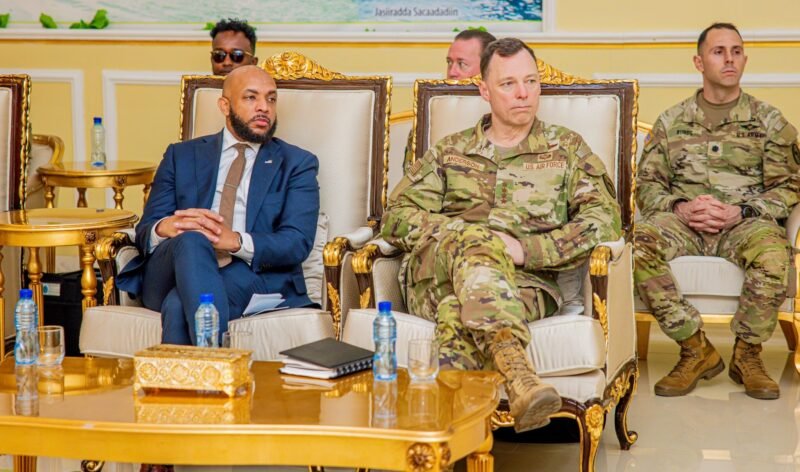
Emerging details surrounding the 2026 National Defense Authorization Act (NDAA) suggest that Washington is preparing its most consequential policy shift toward Somaliland in three decades—one that quietly dismantles the “One Somalia” framework without formally announcing recognition.
According to multiple sources speaking to WARYATV, including officials familiar with congressional language and State Department planning, President Donald Trump is expected to sign the 2026 NDAA into law with provisions that directly implicate Somaliland’s security, diplomatic status, and strategic value to the United States.
At the center of the legislation is a binding directive to the U.S. executive branch—particularly the Department of Defense and associated agencies—to pursue a formal security partnership with Somaliland.
The language reportedly authorizes U.S. military access to Berbera’s port and airport, framing Somaliland not as a subsidiary of Mogadishu, but as a distinct security interlocutor.
This is not symbolic language. Under U.S. constitutional practice, NDAA provisions carry the force of law. Once enacted, the president cannot reverse them through executive discretion; only subsequent legislation passed by Congress can alter the mandate.
In practical terms, this locks in Somaliland’s strategic relevance regardless of future political shifts in Washington.
Crucially, the framework being described stops short of full diplomatic recognition. Instead, it establishes what analysts describe as de facto recognition: a formalized security and access relationship that effectively abandons the “One Somalia policy” while avoiding the diplomatic trigger of recognition.
The model closely mirrors U.S. relations with Taiwan and, regionally, Somaliland’s current relationship with Ethiopia.
For Somaliland, this represents a structural breakthrough. For the first time, its relationship with a global superpower would be codified in U.S. law, not dependent on State Department discretion or temporary political goodwill.
That distinction matters. It transforms Somaliland from a diplomatic exception into a statutory partner.
The legislation also reportedly instructs the U.S. State Department to revise its security advisories. Specifically, sources say Washington is being ordered to separate Somalia-wide travel warnings from Somaliland, issuing a distinct advisory that reflects Somaliland’s comparatively stable security environment.
If implemented, this would be the first official U.S. acknowledgment, in policy form, that Somaliland and Somalia are not interchangeable security spaces.
Beyond security, the NDAA appears to task the State Department with conducting an urgent review on how to establish closer diplomatic engagement with Somaliland. That review reportedly includes pathways for cooperation on counterterrorism, maritime security, intelligence sharing, and long-term diplomatic presence.
An intelligence source familiar with the process told WARYATV that opening a U.S. embassy or consulate in Somaliland is being actively discussed as a next-stage option.
The same source indicated that Washington is considering the establishment of an American-administered school or institutional presence designed to safeguard U.S. interests—an approach explicitly compared to the U.S. model in Taiwan.
This would signal a strategic recalibration rather than a tactical adjustment. The Horn of Africa is no longer being viewed solely through the Mogadishu lens, but as a competitive theater shaped by Red Sea security, Chinese expansion, Iranian proxy networks, and global mineral supply chains.
In that environment, Somaliland’s long-standing stability, coastal control, and cooperative posture have become assets too valuable to ignore.
The implication is clear but conditional. Full recognition is not automatic. Sources stress that Somaliland’s trajectory will now depend heavily on how Hargeisa manages its relationship with Washington—particularly on governance discipline, security cooperation, and strategic alignment.
What is changing is the baseline. The United States appears to be moving Somaliland out of diplomatic limbo and into a legally defined partnership category. Once that line is crossed, reversal becomes politically and institutionally costly.
If the NDAA provisions are enacted as described, they will mark the most significant shift in U.S.–Somaliland relations since 1991—not through declarations, but through law. In geopolitics, that distinction is often the one that matters most.















War Enters Dangerous New Phase as Oil Surges, Alliances Strain

Beyond the Bombs: The Real War Is Radicalism vs. Stability

Ukraine’s War Expertise Becomes Gulf’s Shield


-
 Terrorism2 months ago
America Pulls Back From Somalia but Doubles Down Next Door
-
 Top stories2 months ago
Rubio Signals Preemptive Military Option as U.S. Tightens Pressure on Iran
-

 Analysis2 months ago
How Chinese Speculators Set the Stage for the Gold and Silver Crash
-
 Russia-Ukraine War1 month ago
Russian General Boasted of Torture and Killing of Ukrainian Prisoners
-
 US-Israel war on Iran1 month ago
UK Refuses Iran Strike Access, Trump Fires Back
-
 Russia-Ukraine War1 month ago
Europe’s Spies Challenge Trump’s Ukraine Peace Optimism
-
 Top stories4 weeks ago
War Expands Across Region as Iranian Militias Join Fight
-
 US-Israel war on Iran4 weeks ago
Iran Pledges ‘Never, Ever’ to Hold Bomb-Grade Material