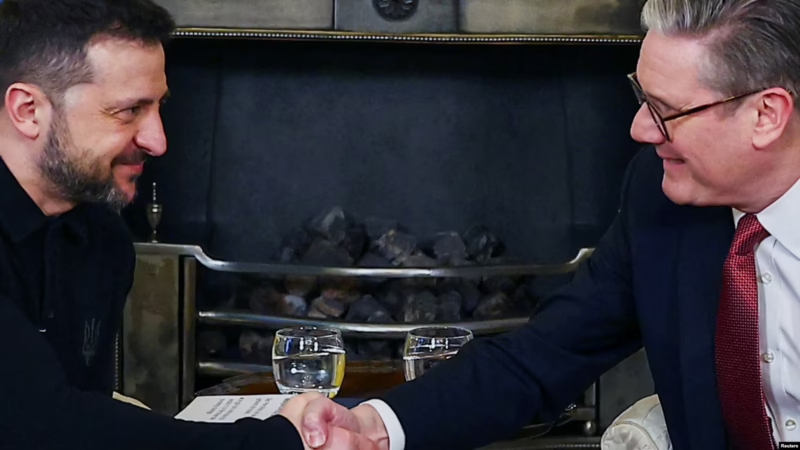
As Ukraine pushes toward what could be the most consequential phase of peace negotiations since Russia’s full-scale invasion, Volodymyr Zelenskyy is set to meet European leaders and Donald Trump amid a renewed wave of Russian strikes on Kyiv that underscored the urgency—and fragility—of the diplomatic moment.
European leaders, including European Commission President Ursula von der Leyen, were scheduled to join a call on Saturday with Zelenskyy and Trump, according to a commission spokesperson, as coordination intensifies ahead of the Ukrainian president’s trip to Florida on Sunday.
Zelenskyy has framed the meeting with Trump as pivotal, saying it would focus on the most sensitive elements of a proposed peace deal, including security guarantees, postwar reconstruction, and territorial questions surrounding the Donbas region and the Zaporizhzhia nuclear power plant.
The outlines of the deal are taking shape but remain incomplete. Zelenskyy said Friday that a proposed 20-point peace plan is “90% ready,” adding that Ukrainian and American negotiating teams have made “significant progress.” The aim of the Florida talks, he said, is to close the remaining gaps.
According to Axios, Zelenskyy has signaled a willingness to put the deal to a national referendum—if Russia agrees to a ceasefire of at least 60 days—particularly if Ukraine fails to secure what he considers a strong position on territorial integrity.
Yet even as diplomacy accelerated, the war did not pause. In the early hours of Saturday, Kyiv came under one of its most intense attacks in weeks. Ukrainian officials said Russia launched a mix of Kinzhal hypersonic missiles, Iskander ballistic missiles, Kalibr cruise missiles, and drones, striking at least seven locations across the capital.
Eleven people were injured, including two children. Fires broke out in high-rise residential buildings in multiple districts, and power outages were reported in parts of the surrounding region.
The assault rippled beyond Ukraine’s borders. Poland scrambled fighter jets, and airports in Rzeszów and Lublin were temporarily closed, highlighting how closely the conflict is watched—and felt—by NATO’s eastern flank.
The current push follows a burst of behind-the-scenes diplomacy last weekend in Miami, where Trump’s envoy Steve Witkoff held separate meetings with Russian and Ukrainian representatives, as well as with Trump’s son-in-law Jared Kushner. The emerging proposal is described as an updated version of an earlier 28-point framework developed in US–Russia contacts, a document that critics say leaned heavily toward Moscow’s demands.
Ukraine has insisted that any agreement must include robust security guarantees, ideally modeled on NATO’s Article 5 mutual defense clause. Whether Russia would accept such guarantees remains deeply uncertain.
Moscow has already pushed back. Russian Deputy Foreign Minister Sergei Ryabkov said Friday that Kyiv and its European backers were trying to “torpedo” an agreement and warned that the current proposal diverges sharply from earlier drafts discussed with US officials.
Trump, for his part, struck a characteristically transactional note. In an interview with Politico, he said he expected a “good” meeting with Zelenskyy but emphasized that no deal exists without his approval. “He doesn’t have anything until I approve it,” Trump said.
The juxtaposition is stark. As negotiators refine text and trade assurances, missiles continue to fall. Whether the Florida meeting narrows the gap between diplomacy and battlefield reality—or exposes how wide it remains—may determine not only the future of Ukraine’s war, but the credibility of the peace process itself.