Middle East
Tehran Rocked by Strikes as Iran’s War with Israel Widens
Leadership vacuum. Regional retaliation. Oil routes at risk. The Middle East conflict is entering a dangerous new phase.
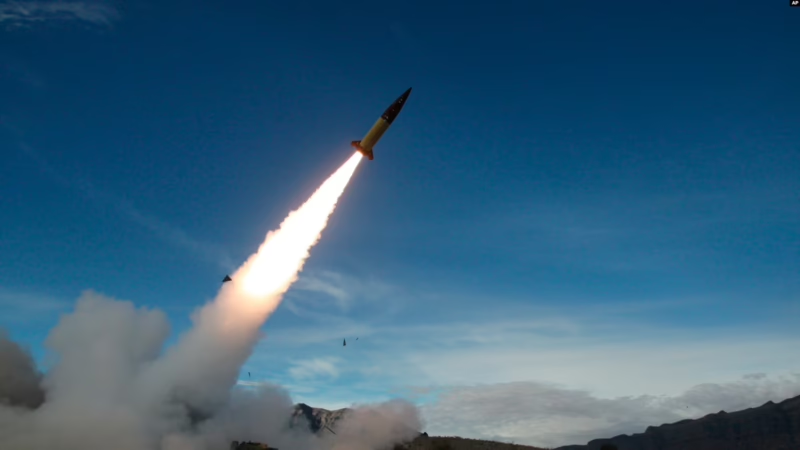
Israeli airstrikes shook Tehran on Sunday as Iran expanded its missile retaliation across Israel and several Gulf states, deepening a fast-moving regional confrontation that began with coordinated US–Israeli attacks a day earlier.
Iranian authorities say more than 200 people have been killed since the campaign began. Blasts in Tehran sent thick smoke rising over areas that include government compounds, though specific targets were not immediately confirmed.
The escalation follows widespread claims — including statements from US and Israeli officials — that Iran’s Supreme Leader Ayatollah Ali Khamenei was killed in the initial strikes. Iranian state media later announced a 40-day mourning period and said a governing council had begun work, though full independent international verification remains limited.
Iran’s President Masoud Pezeshkian confirmed in a prerecorded address that a new leadership council is operating as the country manages what would be its most significant power transition since 1989.
Missile exchanges have widened geographically. Loud detonations were heard in Tel Aviv, where Israeli rescue services reported eight deaths and dozens of injuries in Beit Shemesh, bringing the Israeli toll to at least 10.
Iranian parliamentary speaker Mohammad Bagher Qalibaf vowed retaliation, warning that Israel and the United States would face “devastating blows.” President Donald Trump responded with a stark warning against further escalation, promising overwhelming force if attacks continue.
The conflict has also spilled beyond the two countries. Saudi Arabia, the United Arab Emirates, Kuwait, Bahrain, Qatar and Jordan reported intercepting projectiles or drones. In Abu Dhabi, falling debris reportedly caused casualties and structural damage. Attacks were also reported near US facilities in Iraq.
The economic implications are mounting. Roughly 20 percent of global oil shipments pass through the Strait of Hormuz, and energy markets are bracing for volatility if maritime security deteriorates.
At the United Nations, Secretary-General António Guterres urged immediate de-escalation. Russia and China condemned the strikes, while Washington defended them as necessary to prevent Iran from acquiring nuclear weapons.
Whether this confrontation stabilizes or accelerates into a prolonged regional war may hinge on Iran’s succession process — and on how far Washington and Tel Aviv are prepared to push their campaign in the days ahead.
Middle East
Netanyahu Presses Hezbollah Offensive While Pursuing Talks
Israel Strikes While It Talks: Netanyahu’s High-Stakes Gamble in Lebanon.
Can you negotiate peace while intensifying war? Israel is trying—and the risks are rising fast.
Israeli Prime Minister Benjamin Netanyahu is pursuing a strategy that appears contradictory on its surface but deeply consistent in doctrine: escalate militarily while negotiating politically.
On Wednesday, Netanyahu confirmed that Israeli forces are continuing strikes against Hezbollah positions in southern Lebanon, with a particular focus on Bint Jbeil—long considered one of the group’s strongest operational hubs. At the same time, Israel is engaged in renewed talks with Beirut, aiming to secure what Netanyahu described as a “sustainable peace achieved through strength.”
That phrase is not rhetorical. It defines the current Israeli approach.
For Netanyahu, negotiations are not a pause in conflict—they are an extension of it. Military pressure is designed to shape the terms of any eventual agreement, forcing Hezbollah and, by extension, the Lebanese state into concessions that would otherwise be unattainable.
This mirrors the broader regional strategy unfolding across the Middle East. As the United States pressures Iran through a naval blockade and diplomacy, Israel is applying parallel pressure on Iran’s most powerful proxy.
But the risks are multiplying.
The renewed fighting in Lebanon sits outside the fragile U.S.-Iran ceasefire framework, creating a dangerous loophole. While Washington and Tehran test diplomatic openings, the battlefield in southern Lebanon is intensifying—raising the possibility that escalation there could collapse broader de-escalation efforts.
Netanyahu’s objectives are ambitious: dismantle Hezbollah’s military infrastructure and establish long-term security guarantees along Israel’s northern border. Yet those goals face structural limits. Hezbollah is not a conventional army tied to a single geographic center; it is a decentralized network embedded within Lebanon’s political and social fabric.
Even if Bint Jbeil falls, the organization’s capacity to regenerate remains.
At the same time, Netanyahu signaled close coordination with the United States on Iran, particularly on nuclear restrictions and reopening the Strait of Hormuz. This alignment underscores a broader convergence: Israel’s campaign in Lebanon is inseparable from the wider confrontation with Iran.
That linkage cuts both ways.
Success in Lebanon could strengthen Israel’s negotiating position regionally. But continued escalation risks drawing Hezbollah deeper into the conflict—and potentially triggering a wider regional war that undermines diplomatic efforts elsewhere.
The timing is especially sensitive. With talks between Washington and Tehran expected to resume, any major escalation in Lebanon could harden positions in Tehran, reduce trust, and derail fragile progress.
Netanyahu acknowledged the uncertainty himself: “It is too early to say how this will end.”
For now, Israel is betting that pressure creates opportunity—that battlefield gains can translate into diplomatic breakthroughs.
History suggests the outcome is rarely that straightforward.
What is clear is this: the Middle East is entering a phase where war and negotiation are no longer sequential—they are simultaneous. And in that environment, every strike carries consequences far beyond the battlefield.
Middle East
Clinton Sounds Alarm as Iran Crisis Deepens
Hillary Clinton Warns U.S. Has ‘Lost Leverage’ With Iran as Blockade Escalates.
When even insiders say the U.S. lost leverage, the real question isn’t what happens next—it’s who is actually in control.
Former Secretary of State Hillary Clinton has issued one of the bluntest assessments yet of Washington’s position in the Iran crisis: the United States, she argues, is no longer negotiating from strength.
Her warning comes at a pivotal moment—just days after talks in Islamabad collapsed and as the U.S. intensifies pressure through a naval blockade targeting Iranian ports around the Strait of Hormuz.
“We are in a very weak position,” Clinton said, arguing that Washington has “lost the leverage and initiative” that once defined its approach to Tehran.
That critique cuts directly against the Trump administration’s strategy, which rests on the belief that maximum pressure—military, economic, and psychological—can force Iran into concessions.
Clinton’s argument is the opposite: pressure without a clear diplomatic framework erodes leverage rather than strengthens it.
Her position reflects a deeper strategic divide in U.S. foreign policy. While she supported earlier, limited strikes on Iranian nuclear facilities, she criticized what she described as a broader, “incoherent” escalation lacking a defined end state. In her view, leverage comes not just from القوة—but from clarity, credibility, and coalition-building.
That credibility, she suggests, has been damaged.
The collapse of talks led by JD Vance—combined with unilateral actions like the blockade—has reinforced Iranian perceptions that Washington is negotiating on shifting terms. At the same time, U.S. allies have refused to join the blockade, further weakening the appearance of a united front.
This matters because leverage in diplomacy is not just about capability—it is about alignment.
If Iran believes the United States is isolated, divided from allies, or uncertain in its objectives, it has less incentive to compromise. Instead, it can wait, escalate selectively, or seek alternative backing from powers like China or Russia.
Clinton also pointed to another structural problem: the absence of experienced negotiators deeply versed in nuclear diplomacy. Her call to “bring in people who actually know something about nuclear weapons” signals concern that technical complexity is being overshadowed by political messaging.
Meanwhile, the battlefield reality is moving in the opposite direction of de-escalation. The blockade is tightening. Shipping is disrupted. Iran is threatening retaliation. And Israel’s continued operations in Lebanon complicate any ceasefire framework.
In that environment, leverage becomes fluid.
Washington may hold military dominance, but Iran retains asymmetric tools—control over chokepoints, proxy networks, and the ability to destabilize global energy markets. Each side believes it can outlast the other.
Clinton’s warning ultimately points to a larger risk: that the United States is drifting into a position where it must negotiate not from strength, but from necessity.
And in high-stakes conflicts, that shift can define the outcome.
Middle East
Trump Warns China Over Iran Arms Allegations
U.S.–China Clash Looms: Iran War Threatens to Go Global.
If China enters the Iran war—even indirectly—it won’t stay a regional conflict. It becomes something much bigger.
A new flashpoint is emerging in the already volatile Iran conflict—this time between the world’s two largest powers.
President Donald Trump has issued a stark warning to Beijing, threatening “big problems” if China moves forward with alleged plans to supply Iran with shoulder-fired anti-aircraft missiles. The systems in question—known as MANPADS—may be small, but their strategic impact is anything but.
If deployed, they could dramatically alter the battlefield.
These portable missiles are designed to target low-flying aircraft, including helicopters and drones—precisely the assets the United States and Israel have relied on heavily in their campaign against Iran. Even limited proliferation could raise the cost of air operations, constrain strike options, and extend the conflict’s timeline.
In modern warfare, asymmetry often matters more than scale.
China has firmly denied the allegations, calling the reports “fabricated” and reiterating its position of not supplying weapons to active conflict zones. Yet the mere possibility of such a transfer—whether real or perceived—has already injected a new layer of tension into the crisis.
For Washington, Chinese involvement—direct or indirect—would represent a strategic escalation. It would signal that Beijing is willing to challenge U.S. military dominance not only economically or diplomatically, but within an active conflict zone.
For China, the calculus is more nuanced. Beijing has consistently positioned itself as a stabilizing actor, calling for ceasefires and diplomacy while maintaining deep economic ties with Tehran, particularly in energy. Openly arming Iran would contradict that posture—but covert or indirect support, if it exists, would align with a broader strategy of counterbalancing U.S. influence without direct confrontation.
That ambiguity is the real battleground.
The Iran war has already expanded beyond its initial parameters—spilling into Lebanon, disrupting global shipping through the Strait of Hormuz, and straining alliances within NATO. Now, it risks evolving into a proxy theater for major powers.
Even unconfirmed intelligence can shift strategic behavior. The United States may adjust its military posture, accelerate defensive measures, or expand surveillance. Iran, in turn, could leverage the perception of external backing to harden its negotiating position.
And China—whether involved or not—finds itself pulled deeper into the equation.
The timing is especially delicate. Diplomatic efforts between Washington and Tehran are tentatively resuming, with both sides signaling openness to further talks. But any perception that Iran is gaining new military capabilities could undermine those efforts, reinforcing mistrust and narrowing the space for compromise.
This is how wars expand—not always through decisive events, but through incremental shifts that redraw the strategic map.
Trump’s warning, therefore, is not just a message to Beijing. It is a signal that the United States is prepared to widen the confrontation if it believes the balance is changing.
The question now is whether this remains a war shaped by regional dynamics—or becomes one defined by global rivalry.
Because once major powers begin testing each other inside the same conflict, the path back to containment becomes far more difficult.
Analysis
America Fought Iran — But Strengthened Its Rivals
Washington hit Iran hard. But did it accidentally help China and Russia win bigger?
Four Ways the Iran War Has Weakened the U.S. in the Global Power Struggle.
The war between the United States and Iran may have delivered battlefield gains for Washington, but its broader geopolitical consequences tell a more complicated story. As a fragile ceasefire holds, analysts increasingly argue that the conflict has exposed—and in some cases deepened—strategic vulnerabilities in America’s global position, particularly in its rivalry with China and Russia.
First, the war has reshaped influence dynamics in the Middle East. While Washington sought to reassert dominance, the perception among regional powers has shifted. Gulf states—long reliant on U.S. security guarantees—are now recalibrating, exploring deeper economic and diplomatic ties with both China and Russia.
Beijing, in particular, has quietly expanded its role as a mediator, building on earlier diplomatic successes between regional rivals. Moscow, despite setbacks such as the loss of Syria’s former leadership, has maintained relevance through selective alignment with Tehran.
Second, the conflict has diverted U.S. attention from its core strategic priorities. The Trump administration had signaled a pivot toward the Indo-Pacific and Western Hemisphere, where competition with China is most acute.
Instead, the Iran war pulled military, diplomatic, and political resources back into the Middle East. This shift has not gone unnoticed by rivals, who see an opportunity in Washington’s strategic distraction—and in growing tensions between the U.S. and its traditional allies, particularly within NATO.
Third, the economic fallout has been uneven—and, in some cases, advantageous to U.S. competitors. Iran’s disruption of the Strait of Hormuz sent global oil prices sharply higher, benefiting energy exporters like Russia, whose war-driven economy relies heavily on hydrocarbon revenues.
Meanwhile, China, despite its dependence on Gulf energy, has shown resilience through diversified supply chains and domestic energy investments. For Washington, however, rising fuel costs have translated into domestic political pressure and global market instability.
Finally, the war has eroded perceptions of U.S. global leadership. Washington’s shift from diplomacy to direct military action—combined with conflicting messaging during the conflict—has raised questions about its reliability as a negotiating partner.
In contrast, Beijing has positioned itself as a stabilizing force, supporting ceasefire efforts and advocating diplomatic solutions. That contrast has strengthened China’s claim to a larger role in shaping the international order.
None of this suggests the United States has lost its global standing. But the Iran war underscores a growing reality: in today’s multipolar world, military success does not automatically translate into strategic advantage.
Strait of Hormuz
Tankers Slip Through — Others Panic and Turn Back
Three Tankers Pass Strait of Hormuz as US Blockade Triggers Shipping Disruptions.
Three ships made it through Hormuz. The rest are backing off. That tells you everything.
Three oil and gas tankers have successfully navigated the Strait of Hormuz in the first known transits since the United States moved to impose a naval blockade—offering a fragile sign that limited shipping is still possible, even as fear grips global trade routes.
The vessels—identified as the New Future, the sanctioned Auroura, and the Vietnamese LPG carrier NV Sunshine—completed their passage through the narrow waterway, hugging routes close to Iran’s coastline before emerging into the Gulf of Oman. Their movements were closely tracked by maritime data services, with routes appearing to follow guidance previously issued by Tehran for eastbound traffic.
But their success is the exception, not the trend.
Within hours of the U.S. blockade taking effect, signs of disruption began to surface. At least two ships—the tanker Rich Starry and the China-linked bulk carrier Guan Yuan Fu Xing—abruptly altered course mid-transit, turning back rather than risk entering contested waters. The sudden reversals highlight the chilling effect the standoff is already having on commercial shipping.
The Strait of Hormuz remains the world’s most critical energy chokepoint, historically carrying about one-fifth of global oil supplies. Since the outbreak of war between the United States and Iran, traffic through the corridor has plunged, with shipowners increasingly unwilling to risk vessels amid threats of interception, attack, or seizure.
Washington’s blockade—targeting vessels linked to Iranian ports and trade—aims to strip Tehran of a vital economic lifeline while forcing a reopening of the strait. But the policy is already reshaping behavior on the water. Ship operators are now weighing not just market conditions, but real-time geopolitical risk.
Some vessels appear to be adapting. The Auroura, for instance, signaled it had an Indian crew—a tactic increasingly used by ships to signal neutral or non-Western affiliations in hopes of avoiding confrontation. Others are relying on diplomatic channels, as seen with Vietnam engaging Tehran to ensure safe passage for its vessels.
Still, uncertainty dominates. The limited number of successful crossings suggests that while passage is technically possible, confidence in safe navigation has not returned. Insurance premiums remain elevated, and many operators are choosing caution over profit.
The result is a partial paralysis of global shipping flows—enough movement to prevent total collapse, but not enough to restore normalcy.
For now, three ships have proven the route is not fully closed. But the larger picture is clear: the Strait of Hormuz is no longer a reliable artery of global trade—it is a contested frontline.
Escalating Conflict
China Warns Hormuz Blockade Threatens Global Interests
Beijing Pushes Back — Oil Lifeline Under Threat.
When China speaks on oil, the world listens—Hormuz just became a global flashpoint.
China has issued a clear warning against any blockade of the Strait of Hormuz, arguing that such a move would undermine global economic stability and run counter to the interests of the international community.
Speaking in Beijing, Foreign Minister Wang Yi said the disruption of the critical maritime corridor—through which roughly one-fifth of the world’s oil and gas supplies pass—would have far-reaching consequences beyond the immediate conflict between Washington and Tehran.
“The blockade does not serve the common interests of the international community,” Wang said during talks with a senior envoy from the United Arab Emirates, urging all sides to exercise restraint and avoid actions that could reignite hostilities.
The statement comes as the United States prepares to enforce a naval blockade targeting Iranian maritime traffic following the collapse of peace talks in Islamabad. While Washington has framed the operation as limited to Iranian ports, concerns are mounting that even a partial disruption could destabilize global energy flows.
For China, the stakes are particularly high. As the world’s largest importer of crude oil—and a major buyer of Iranian exports—Beijing is deeply exposed to any sustained interruption in Gulf shipping routes. Prior to the war, a significant share of Iran’s oil shipments flowed directly to Chinese markets, making stability in Hormuz a strategic necessity for Beijing’s economy.
Chinese officials emphasized that the only viable path forward lies in diplomacy. Foreign ministry spokesperson Guo Jiakun reiterated calls for all parties to uphold the fragile ceasefire and return to political negotiations, describing the recent talks in Pakistan as a step in the right direction despite their failure to produce a deal.
At the same time, Beijing sought to distance itself from rising geopolitical tensions, rejecting allegations that it plans to supply weapons to Iran. Officials described such claims as “groundless,” underscoring China’s effort to maintain a position of cautious neutrality while protecting its economic interests.
China’s messaging reflects a broader strategic calculation. It aims to position itself as a stabilizing force—supporting de-escalation while avoiding direct confrontation with the United States. Yet its warning also signals a deeper concern: that the crisis in the Gulf is no longer a regional conflict but a global economic threat.
The risk is not theoretical. Even limited disruptions in Hormuz have already driven sharp volatility in oil prices, with ripple effects across supply chains, inflation, and energy security worldwide.
As tensions rise, Beijing’s stance highlights a widening divide in how major powers view the crisis. While Washington is escalating pressure to force concessions from Tehran, China is emphasizing stability, continuity of trade, and negotiated outcomes.
The underlying message is unmistakable: if Hormuz becomes a battlefield, the consequences will not be confined to the Middle East—they will be felt across the global economy.
Red Sea
Iran Threatens Bab el-Mandeb Disruption
If Hormuz closes, Bab el-Mandeb could follow—and the world economy won’t survive it unchanged.
As tensions escalate in the Middle East, a new and dangerous front is emerging—one that could push the global economy into uncharted territory. Iran is signaling that if the United States proceeds with its blockade of the Strait of Hormuz, it may retaliate not just in the Gulf, but across another critical artery of global trade: the Bab el-Mandeb.
The warning marks a potential turning point in the conflict. While the Strait of Hormuz has long been the focal point of energy security—handling roughly 20% of global oil flows—the Bab el-Mandeb carries an additional 12%, linking the Red Sea to the Gulf of Aden and serving as a lifeline between Asia and Europe.
Together, these two chokepoints form the backbone of global maritime trade. Disruption in both would not simply raise prices—it could fracture supply chains worldwide.
The threat hinges on Iran’s ability to act indirectly. Analysts warn that Tehran could leverage its regional network, particularly Houthis in Yemen, to target shipping in the Red Sea. The Houthis have already demonstrated their capacity to strike vessels using drones, missiles, and explosive boats, forcing shipping companies to reroute in previous crises.
Senior Iranian figures have made the linkage explicit. Ali Akbar Velayati recently suggested that Iran views Bab el-Mandeb in the same strategic terms as Hormuz—implying that escalation in one theater could trigger retaliation in the other.
This emerging doctrine reflects a broader shift in the conflict. What began as a direct military confrontation is rapidly evolving into a multi-layered economic war, where control over trade routes becomes as decisive as battlefield victories.
For Washington, the blockade announced by U.S. Central Command is intended to pressure Iran by cutting off its oil exports and forcing concessions at the negotiating table. But such a move carries cascading risks. By targeting Hormuz, the United States may unintentionally open the door to a wider maritime confrontation stretching from the Gulf to the Red Sea.
The consequences could be immediate. Shipping insurers may withdraw coverage, freight costs could surge, and energy markets—already strained—could face a prolonged shock. Countries heavily dependent on these routes, particularly in Asia and Europe, would bear the brunt.
The deeper danger, however, lies in the precedent. If chokepoints become tools of escalation, global trade itself becomes a battlefield.
The phrase “Gate of Tears,” long associated with the Bab el-Mandeb, may soon take on a more literal meaning. The world is no longer watching a single crisis unfold—it is watching the possible convergence of two.
And if both close, even partially, the economic impact will not be regional. It will be global.
U.S.–Iran Talks
Most Americans Think Iran Ceasefire Won’t Last
Americans ‘Relieved’ but Doubtful as Polls Reveal Skepticism Over Trump’s Iran Ceasefire.
A majority of Americans are breathing easier after the temporary ceasefire between the United States and Iran—but few believe it will hold.
New polling data shows that the dominant public reaction to the two-week truce announced by Donald Trump is simple: relief. Yet beneath that initial reaction lies a deeper sense of doubt about the durability of the agreement and the direction of U.S. policy.
A YouGov survey of nearly 3,000 U.S. adults found broad support for the ceasefire. Around 41% strongly approved of the deal, with another 25% expressing moderate approval. Only a small minority opposed it, while nearly a quarter remained uncertain—reflecting a public still trying to process rapidly shifting developments.
But a separate poll by Daily Mail in partnership with JL Partners reveals a more cautious mood. While “relieved” was the most common word used by respondents, 54% believe the ceasefire will likely collapse. Just one in four Americans expect it to hold, and only 7% expressed full confidence in the agreement.
That gap—between emotional relief and strategic skepticism—captures the fragile political reality facing Washington.
The ceasefire was announced just 90 minutes before a deadline set by Trump, who had warned of catastrophic consequences if Iran did not reopen the Strait of Hormuz. The last-minute diplomatic breakthrough helped ease immediate fears of escalation, but it did little to resolve the underlying issues driving the conflict.
Public opinion also reflects uncertainty over the economic trade-offs embedded in the deal. About 43% of Americans support allowing Iran to charge fees on ships passing through the Strait of Hormuz if it helps maintain the truce, while 32% oppose the idea. The debate highlights growing concern over global energy disruptions, which have already pushed inflation higher and strained supply chains.
Meanwhile, the political stakes are rising. JD Vance now leads high-level negotiations aimed at turning the temporary pause into a longer-term settlement—an effort complicated by Iranian demands for sanctions relief and disagreements over whether the ceasefire extends to Lebanon.
Despite administration claims that strong U.S. pressure forced Tehran to negotiate, the public appears unconvinced that a lasting solution is within reach.
For many Americans, the ceasefire offers a momentary pause—not peace.
-
Red Sea1 week agoHouthis Threaten to Shut Red Sea if War Widens
-
Terrorism2 weeks agoEgypt Uncovers Alleged Plan to Down Presidential Plane
-
Top stories2 weeks agoIRGC Moves to Control Iran’s Future
-
Top stories1 week agoKremlin Claims EU Is Working Against Orbán
-
Top stories3 weeks agoSaudi Arabia Deepens Defense Ties with Ukraine
-
Middle East1 week agoIsrael’s War Goals Unmet as U.S.-Iran Ceasefire Shifts Conflict Dynamics
-
Top stories3 weeks agoFrance Leads Talks With 35 Nations to Secure Strait of Hormuz
-
Analysis3 weeks agoRed Sea Emerges as Next Global Flashpoint