Connect with us

Somaliland

Heroes of the Nation: VP + General: One Nation, One Army — Somaliland Stands United

Published

on

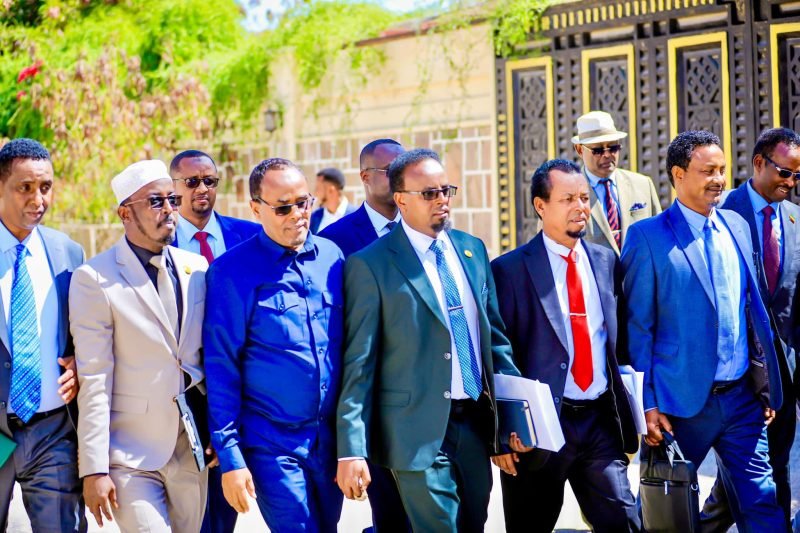
Vice President Mohamed Ali Aw Abdi and General Nimcaan Yusuf Osman conclude the most successful operation of Somaliland’s new government: uniting the nation’s armed forces and ending internal divisions.

In the annals of Somaliland’s history, few moments stand out as boldly as the recent achievements of Vice President Mohamed Ali Aw Abdi and Brigadier General Nimcaan Yusuf Osman. Their unwavering commitment to national unity and security has not only reshaped the future of Somaliland but has also solidified their places as heroes in the eyes of the Somaliland people.

Their joint efforts culminated in the stunning success of the civilian disarmament initiative—a landmark program aimed at integrating militias into the national military framework. This essential operation began in February 2025 and concluded with remarkable efficiency, with the final handover of armed civilian forces and their vehicles taking place in Qori-lugud District. Their leadership stands as a testament to what can be accomplished through vision, courage, and steadfast resolve.

Unification Through Leadership

From Conflict to Control: Civilian Disarmament Completed in the East

Advertisement

As violence erupted earlier this year in regions like Erigavo, tensions between Somaliland forces and Khaatumo terrorist posed a significant threat to national stability. Many feared that internal divisions would spiral out of control. However, the timely interventions led by Vice President Aw Abdi and Brigadier General Nimcaan have effectively neutralized these tensions, laying the ground for a new era within Somaliland.

In his address during the military ceremony, Vice President Aw Abdi affirmed: “The national armed forces have taken control of the country’s defense. Somaliland’s unity is not negotiable—and today, our shield is stronger than ever.” This strong stance resonated deeply within the community, reinforcing the idea that every citizen must stand united under one flag—one army.

A Commitment to Peace

Somaliland Vice President Leads Historic Nationalization of Civilian Forces

Advertisement

The recent actions taken by both leaders reflect a broader commitment to ensuring peace and stability in Somaliland. Through the brave decision to disarm civilian militias and integrate them into the Somaliland National Army, VP and General Nimcaan demonstrated a risk-taking leadership approach designed to eradicate the era of private wars and clan-based loyalties. By establishing uniformity across the ranks, they have cultivated a sense of pride among the citizens who now recognize that their security is in the hands of a unified force.

The integration process has not been without skepticism, but the clear messaging from both leaders has resonated across the nation. Their emphasis on control and discipline has helped dismantle distrust and fear, reinforcing the notion that all arms now serve one purpose: the preservation and protection of Somaliland’s sovereign identity.

Achievements in 100 Days

Erigavo: Somaliland’s Peace Initiative

Advertisement

In just over 100 days, this administration has solidified its legacy with the strongest gains for national unity since Somaliland’s reassertion of independence in 1991. The work of Vice President Mohamed Ali Aw Abdi alongside the strategic military guidance of Brigadier General Nimcaan Yusuf Osman has garnered admiration and support from every corner of Somaliland. This partnership is not just about military might; it’s about fostering a sense of responsibility and dedication to the nation as one.

Somaliland has successfully neutralized internal threats, regained control over local security dynamics, and is now poised for greater international recognition—a fundamental step for a nation often stuck in diplomatic limbo due to its historical claims.

Preparing for the Next Chapter

VP Mohamed Ali Aw Abdi Champions Vocational Revival

Advertisement

With the groundwork laid for national unity and security, Vice President Aw Abdi and Brigadier General Nimcaan now face the dual task of continuing to solidify their achievements while preparing Somaliland for the international diplomatic stage. The challenges ahead remain, but the leaders have demonstrated a clear understanding of the strategic landscape, prioritizing stability over divisive politics.

Their collaboration with international partners, particularly in defense and security sectors, will further strengthen Somaliland’s position. As the world increasingly looks toward recognizing Somaliland’s sovereignty, the time is ripe for this administration to leverage its military successes as a platform for diplomatic negotiations.

A Nation United

Somaliland Cracks Down on Unauthorized Flags Ahead of May 18

Advertisement

As we reflect on the monumental strides taken by Vice President Mohamed Ali Aw Abdi and Brigadier General Nimcaan Yusuf Osman, it is clear that their destinies are linked to that of Somaliland. They represent a future marked by strength, unity, and resilience. As their actions continue to inspire and galvanize the Somaliland populace, we stand at the precipice of a new dawn.

Together under the leadership of these great figures, Somaliland emerges not only as a self-governing entity but as a symbol of hope and tenacity. They remind us that through cooperation, discipline, and unwavering resolve, we can forge a dynamic future where our narrative is one of strength, stability, and national pride.

Let us rally behind our heroes, celebrate their achievements, and march forward into a new chapter of Somaliland’s rich and promising history.

Advertisement

BALCAD’S BIG LIE

Mogadishu’s Narrative of Engagement With Somaliland Seen as Political Incitement

Published

on

FGS Claims of “Direct Talks” With Somaliland Exposed as Strategic Deception.

Mogadishu’s newest diplomatic claim—that it maintains “direct and regular contact” with Somaliland—marks a familiar return to political theater disguised as dialogue.

Somali Minister of State for Foreign Affairs Ali Omar Balcad delivered the assertion to Qatari media this week, framing it as evidence of active engagement between the Federal Government of Somalia (FGS) and the Republic of Somaliland.

Advertisement

In reality, the statement reflects an information campaign designed not to foster negotiation but to fabricate the appearance of one.

Somaliland’s position is unequivocal: all communication with Mogadishu has been suspended, Somaliland has repeatedly stated that no talks, formal or informal, are underway.

The insistence by Mogadishu that dialogue continues—despite clear evidence to the contrary—reveals less about Somaliland’s diplomacy and far more about the political fragility of the FGS.

Advertisement

Balcad’s narrative serves three strategic purposes for a government that finds itself increasingly isolated. First, it allows Mogadishu to project the illusion of diplomatic relevance at a time when it holds no leverage over Somaliland’s decision-making.

Portraying Somaliland as engaged in a political settlement process helps the FGS save face before regional and international partners who expect progress on national reconciliation.

Second, the disinformation is engineered to undermine public trust in Somaliland’s elected leadership. By suggesting that the government is secretly negotiating with Somalia, Mogadishu hopes to sow suspicion at a moment when localized issues—such as grievances in Borama—offer fertile ground for exploitation.

Advertisement

This tactic mirrors a longstanding pattern: a weak central government attempting to destabilize a stronger, more cohesive neighbor by manufacturing internal tension.

Third, Balcad uses the interview to redirect attention toward Somalia’s geographic position along the Gulf of Aden and the Red Sea, portraying Mogadishu as the indispensable guardian of regional security.

It is an attempt to pressure international stakeholders into viewing the FGS—not Somaliland—as the central actor in maritime stability, despite Somalia’s limited capacity to manage its own coastal environment.

Advertisement

Talk of “unity” serves as a thin political veil. The underlying strategy is clear: to reassert authority over the 1960 borders through messaging and intimidation rather than through governance, consensus, or legitimacy.

Somaliland, for its part, has remained firm. The Presidency’s refusal to engage in any discussion that presupposes reunification underscores Hargeisa’s political maturity and its commitment to sovereign decision-making.

Mogadishu’s current approach is not diplomacy; it is an exercise in incitement and psychological pressure, aimed at weakening Somaliland’s internal cohesion rather than resolving any dispute.

Advertisement

For Somaliland, the strategic response remains unchanged: strengthen institutions, preserve internal unity, and pursue recognition based on its proven track record of stability.

The FGS’s fabricated dialogue cannot alter the reality that Somaliland’s future will be determined in Hargeisa—not in Mogadishu.

Advertisement
Continue Reading

Somaliland

Ugaas Calls for National Council to Protect Somaliland Borders After Saylac Dispute

Published

on

BORAMA, AWDAL — Tension in Borama eased sharply on Saturday after two days of unrest, as a forceful address by Awdal’s paramount chief, Ugaas Abdirashid Ugaas Rooble, restored a sense of order and reaffirmed Somaliland’s territorial red lines.

His message blended condolences with a blunt warning: peace would be preserved, but the region’s borders would not be surrendered “under any disguise.”

Opening with a tribute to those killed during the disturbances, the Ugaas urged an immediate return to stability and unity. But his remarks quickly turned to the source of the recent friction—the planned unveiling of the “Xeer Ise” book in Saylac, an event he described not as a cultural initiative but as a political maneuver aimed at territorial encroachment.

Advertisement

He praised President Abdirahman Mohamed Abdullahi Irro for halting the gathering before it took place, calling the decision a necessary step to prevent a manufactured crisis.

“The book Xeer Ise was an excuse,” he said. “Seeking land through culture will not happen. Taking a piece of our land will not happen.”

The statement crystallized the prevailing view among Awdal leaders that the Presidency’s intervention was protective, not prohibitive.

Advertisement

Local officials have since confirmed that stopping the event helped defuse broader tensions between the Gadabuursi and Ise communities, which had threatened to spill into a wider regional confrontation.

Yet the Ugaas’s speech carried a darker undercurrent. He warned that efforts to ignite conflict were being organized across the border in Dire Dawa, Ethiopia, and called on the Gadabuursi people to prepare to defend their land if necessary. Without naming specific actors, his message made clear that the threat was external—and intentional.

To guide the region forward, the Ugaas outlined a three-part initiative: a national funeral for the young people killed in the unrest; the rapid formation of a broad-based Gadabuursi “national council” of clerics, thinkers, and lawmakers; and a mandate for that council to safeguard internal peace while defending Somaliland’s territorial integrity.

Advertisement

The gathering in Borama included key members of Somaliland’s Parliament from Awdal, among them MP Mohamed Abiib, who addressed the youth directly and urged restraint—an indication that national and regional authorities are moving in tandem to prevent further escalation.

Together, the Ugaas’s defiant stance and the President’s swift action send a clear signal: attempts to exploit local grievances for political land claims will be met with organized resistance and unified leadership.

For now, Borama is calm—but its message to those attempting to destabilize it is unmistakable.

Advertisement
Continue Reading

Somaliland

Four Suspected Snipers Arrested in Borama as Somaliland Investigates Deadly Shootings

Published

on

Four Suspected Snipers Arrested in Borama as Deadly Unrest Deepens.

Somaliland security forces have detained four suspected snipers in Borama amid an intensifying investigation into a string of mysterious shootings that have unsettled the city and deepened public anxiety, WARYATV has learned.

Multiple independent sources in Borama confirmed that security units are actively hunting a network of armed men believed to be responsible for targeted killings in recent days.

Advertisement

Residents reported seeing individuals positioned on rooftops and tall buildings overlooking the city’s central district, including structures adjacent to Borama Hospital.

Images circulating widely on social media show figures perched on high-rise buildings with what appear to be long-range rifles.

Eyewitnesses who spoke to WARYATV described the men as “highly trained” and “deliberately positioned.”

Advertisement

Security sources say at least ten suspected snipers are being pursued.

The threat became more pronounced Friday, when three people were fatally shot near Borama Hospital.

According to witnesses, the bullets were “silent,” suggesting the use of suppressors — an unusual escalation in a city unaccustomed to such tactics. The origin of the fire has not yet been publicly determined.

Advertisement

One Borama resident, Fardus Ahmed Hassan, posted on social media shortly after the shooting, pointing to a tall building near the hospital as the likely firing point.

A member of the Somaliland security forces, who requested anonymity because he was not authorized to speak publicly, told WARYATV that the four men currently in custody are not residents of Somaliland. He declined to provide further details, citing an active investigation.

Security personnel say the arrest operation remains ongoing, with additional suspects believed to be operating inside Borama’s urban center.

Advertisement

Authorities are now examining whether the sniper attacks are tied to external actors seeking to inflame the unrest that has rocked Awdal in recent days.

As of Saturday, the Somaliland government has not issued any official statement regarding the arrests or the broader investigation.

Advertisement
Continue Reading

Irro Clean-Up Begins

INFO MINISTER OUT! Ahmed Yasin Resigns Before Irro Could Fire Him

Published

on

Sources: Somaliland Minister Resigned Before Planned Removal in President Irro’s Reshuffle.

Somaliland’s Minister of Information, Ahmed Yasin Sheikh Ali Ayanle, announced his resignation on Saturday evening, a sudden move that comes at a moment of heightened national tension and just weeks before a major cabinet reshuffle expected from President Abdirahman Mohamed Abdullahi Irro.

Speaking to local media, the outgoing minister said the decision was mutual and conducted respectfully. “I thank the President of Somaliland for the position he appointed me. Today I went to him, we forgave one another, and he accepted my resignation,” he stated.

Advertisement

In an emotional appeal to his community, Ahmed Yasin urged restraint following the deadly unrest in Awdal. “Oh my tribe, I do not advise you to fight or spill blood. Do not open fire on both sides,” he said, signaling concern that the regional crisis may escalate without responsible leadership.

But independent reporting obtained by WARYATV suggests a deeper political undercurrent behind the resignation. According to sources with direct knowledge of the matter, Ahmed Yasin was informed that he would be among several ministers removed in the President’s upcoming reshuffle.

Faced with dismissal, he reportedly chose to step down early—leveraging the Awdal situation as a political shield while seeking to exit on his own terms.

Advertisement

The minister’s tenure has been widely criticized inside government circles and among the public. Despite leading the ministry for a full year, he consistently struggled to manage or influence the fast-moving Somaliland media landscape, which independent analysts say has become a major driver of social unrest, factionalism, and misinformation.

Officials familiar with the ministry’s internal operations describe a leadership deficit: Ahmed Yasin lacked media expertise, strategic communication skills, and the ability to build a coherent national narrative. As a result, the government spent much of the past year reacting to online crises rather than shaping public discourse.

Some senior advisers argue that this vacuum contributed directly to the escalation of recent tensions—including those in Awdal.

Advertisement

The administration was also forced to dedicate substantial resources to combating online incitement, a burden compounded by the minister’s inability to establish regulatory clarity or modern communication strategies.

President Irro, aware of mounting frustration, had already included Ahmed Yasin on his list of ministries to be reshuffled. The resignation preempted his formal removal but does not change the political calculus: the Information Ministry is expected to undergo significant restructuring to restore narrative control, public trust, and national stability.

WARYATV attempted to contact the former minister for clarification regarding the circumstances of his departure but was unable to reach him.

Advertisement
Continue Reading

Somaliland

Qatar Meeting EXPOSED: Mogadishu Uses Borama Chaos to Crush Recognition Bid

Published

on

Inside the Doha Deal: How Mogadishu Turned Awdal Instability Into Diplomatic Ammo.

Somali President Hassan Sheikh Mohamud’s sudden trip to Doha — timed precisely at the height of the Borama unrest — was not a diplomatic coincidence.

It was a targeted geopolitical maneuver, designed to exploit Somaliland’s moment of instability and reinforce Mogadishu’s long-term strategy: to block, delay, and ultimately dismantle Somaliland’s path to recognition.

Advertisement

The choreography of the visit, the messaging, and the regional alignments reveal a multi-layered mission calibrated to use the Awdal crisis as political ammunition.

The most telling indicator is timing. The visit came during the peak of the security breakdown in Borama, when the confusion surrounding the Xeer Iise exhibition had escalated into deadly protests.

For Mogadishu, the crisis provided a rare opportunity: a real-time illustration of Somaliland’s vulnerability, precisely the kind of instability it has long argued invalidates Hargeisa’s claim to sovereign capacity.

Advertisement

Although neither side publicly mentioned Borama, the official phrase “the situation in the region” offered ample diplomatic cover. In diplomacy, silence can speak louder than specificity.

Inside the meeting, President Mohamud had a clear strategic narrative to deliver: Somaliland’s famed stability — the foundation of every recognition argument — had cracked.

By briefing Emir Tamim on the unrest, Mohamud positioned himself as the guardian of regional order and framed Somaliland as a fragile, unreliable entity whose internal governance cannot sustain peace.

Advertisement

It is a narrative Qatar has historically accepted, and Mogadishu capitalized on the moment to reinforce it.

Securing financial support was not separate from this agenda; it was strengthened by it.

Qatar is one of Mogadishu’s most critical economic patrons, underwriting development budgets, political initiatives, and the broader state-building effort.

Advertisement

In moments of instability, donors listen more attentively. The Emir’s promise of continued support fits a long-standing pattern: Doha finances, Mogadishu consolidates, and Somaliland is squeezed out of regional diplomatic space.

This financial pillar is intertwined with a second, more muscular dimension: Turkey’s expanding security footprint in Somalia. Qatar and Turkey rarely act in isolation.

Their partnership has become an axis of influence in the Horn, enabling Mogadishu to train thousands of troops, expand military capacity, and elevate its external posture.

Advertisement

Shay Gal’s warning regarding Turkey’s use of Somalia as a testing ground for advanced missile systems underscores the broader reality: the Somali government is being armed, trained, and politically shielded by a coalition of states that view Somaliland as an unacceptable precedent.

Within that strategic ecosystem, the Borama crisis was a golden opportunity. President Mohamud arrived in Doha not merely to seek money or discuss development; he came to frame the unrest as proof that Somaliland’s recognition bid is premature, destabilizing, and dangerous.

He also came to ensure that Qatar — with its influence in the Arab League and among Western partners — maintains a unified diplomatic line: no recognition, no deviation, no ambiguity.

Advertisement

By the time President Irro cancelled the Xeer Iise event in a bid to defuse the crisis, Mogadishu had already spent its political capital in Doha.

The mission had achieved its purpose: reinforcing Somalia’s narrative at a critical juncture and tightening the regional consensus against Somaliland’s aspirations.

In essence, Hassan Sheikh’s visit was not reactive diplomacy; it was a synchronized strike.

Advertisement

It leveraged internal turmoil in Somaliland to secure external backing for Mogadishu, reinforced strategic alliances with Qatar and Turkey, and weaponized the Awdal crisis in the international narrative war.

For Somaliland, it is a stark reminder that internal instability is never contained — it becomes foreign policy ammunition for adversaries who are prepared to act the moment the cracks appear.

Advertisement
Continue Reading

Analysis

IRRO SLAMS THE BRAKES: Xeer Ise CANCELLED to Save Somaliland Stability

Published

on

CRISIS AVERTED: Somaliland Crisis De-escalates as President Irro Prioritizes Peace Over Politics.

President Abdirahman Mohamed Abdullahi Irro’s abrupt cancellation of the Xeer Ise event marks one of the most consequential decisions of his presidency—an intervention that shifts Somaliland away from an accelerating internal crisis and back toward strategic stability.

His declaration that he acted “for the interests of my nation,” in response to “the feelings of our people,” and because “the lives of my people are more important than anything else,” reframes the government’s posture from defensive confusion to controlled, deliberate leadership.

Advertisement

This move directly cuts off the internal pressure point that external actors were rapidly exploiting. In the past 48 hours, Borama and the wider Awdal region had become fertile ground for destabilization, amplified by Mogadishu’s diplomatic allies and regional backers.

What began as a dispute over a cultural exhibition was on the verge of becoming a politically engineered fracture point.

By cancelling the event outright, Irro has removed the catalyst that external forces were using to challenge Somaliland’s cohesion at a moment when its recognition campaign is most vulnerable.

Advertisement

The decision signals executive maturity, not retreat. Somaliland’s political identity and diplomatic leverage have always rested on stability—its only uncontested national export.

Irro’s pivot recognizes that without domestic calm, there is no viable foreign policy, no recognition pathway, and no moral authority in the Horn of Africa’s increasingly crowded geopolitical arena.

Now the burden shifts to implementation. The President’s order for security forces to strengthen protections and prevent further loss of life must translate into immediate, disciplined action.

Advertisement

Communities in Awdal and Salel need visible reassurance that the state is prioritizing de-escalation, not confrontation.

Traditional leaders calling for peace must be empowered, not sidelined, so that reconciliation can move from televised statements to genuine community restoration.

If executed swiftly and coherently, Irro’s decision could become a turning point. It denies Mogadishu and its regional partners the internal instability they needed to challenge Somaliland’s international credibility.

Advertisement

It re-centers the narrative around responsible leadership at a moment when global observers are watching closely. And it reiterates a message foundational to the Somaliland project: peace is not merely a political choice, but a national doctrine.

The cancellation is not the end of the crisis, but it is the most decisive step yet toward containing it. Somaliland’s next 72 hours will determine whether Irro’s strategic pivot becomes a diplomatic victory.

President Irro Addresses Borama Crisis, Vows Justice for Victims

Advertisement

Borama: Police Call for Calm After Fatal Protests Over Xeer Ciise Event

Two Killed, Eleven Injured in Borama Clashes Over Xeer Ise Decision

Somaliland Interior Ministry Halts Xeer Ise Event in Zeylac

Advertisement

Xeer Ciise earns UNESCO Heritage status: A victory for Somali-Issa cultural legacy

Continue Reading

Analysis

Turkey’s Military Presence in Somalia Compounds Somaliland’s Internal Turmoil

Published

on

The deadly unrest in Borama has crossed the threshold from an internal security failure to a strategic crisis with international consequences. What began as a local dispute over the “Xeer Iise” exhibition has evolved into a geopolitical opening that Somalia, backed by Turkey and Qatar, is now exploiting to undermine Somaliland’s hard-won reputation for peace and stability.

Somali President Hassan Sheikh Mohamud’s high-visibility presence at the Doha Forum signals deepening political and financial dependence on Qatar, a state whose foreign policy priorities have consistently aligned against Somaliland’s ambitions for statehood.

Qatar provides diplomatic legitimacy—but it is Turkey that supplies the military muscle.

Advertisement

Here lies the true escalation. The warning issued by Israeli senior adviser Shay Gal about Turkish military activity in Somalia should reverberate sharply in Hargeisa.

According to Israeli assessments, Turkey has used Somali territory as a launch platform for testing its long-range Tayfun missile, a weapon system previously deployed to intimidate regional rivals.

Such a test is not merely symbolic—it represents a major expansion of Ankara’s military footprint in the Horn of Africa.

Advertisement

Combined with Turkey’s extensive training of Somali forces at multiple bases, Somalia’s once-limited military capacity is being rapidly transformed into a power projection tool for external patrons.

This buildup takes place at a moment of deteriorating Turkey-Israel relations, inserting Somaliland into the fault line of a broader geopolitical confrontation it cannot afford.

Qatar supplies the political cover and financial leverage; Turkey supplies the hardware, the training, and the operational reach.

Advertisement

Their shared strategic interest is clear: prevent Somaliland from ever achieving international recognition by ensuring it is perceived as unstable, divided, and incapable of governing itself.

This is why the unfolding crisis in Borama is so perilous. Every day of unrest, every casualty, every sign of public disorder strengthens Mogadishu’s narrative that Somaliland cannot manage its internal tensions.

For external observers—states, diplomats, multilateral bodies—the contrast between Somaliland’s claim to exceptional stability and the images emerging from Awdal presents a direct challenge to the recognition argument.

Advertisement

President Irro cannot treat these events as isolated unrest. The restoration of stability in Awdal is indistinguishable from the defense of Somaliland’s foreign policy agenda.

The country is at a decisive juncture: it must calm the streets, pursue genuine dialogue with aggrieved communities, and rebuild public trust.

Failure to do so will hand Somalia and its powerful allies the ultimate political weapon—the argument that Somaliland’s long-standing claim to recognition collapses the moment it is tested.

Advertisement

The stakes are no longer local. They are existential.

Continue Reading

Somaliland

President Irro Addresses Borama Crisis, Vows Justice for Victims

Published

on

Somaliland Announces Investigation, Pulls Armed Forces Back Following Borama Violence.

Somaliland President Abdirahman Mohamed Abdillahi (Irro) delivered a grave and measured statement on Friday following the deadly unrest in Borama, offering condolences to the families of those killed and outlining immediate steps to restore calm in the region.

“In this solemn hour, I extend my deepest condolences to the families who have lost their loved ones, and pray for the swift recovery of all those injured,” President Irro said, describing the moment as one that demands unity and restraint from all sides.

Advertisement

“The State stands with you — in grief, in healing, and in unwavering solidarity.”

Addressing public outrage over the fatal clashes between security forces and protesters, the president announced that he had ordered the National Armed Forces stationed in Borama to return immediately to their barracks.

He said this decision was intended to reduce tensions and “ensure that the situation does not escalate further.”

Advertisement

President Irro also confirmed the launch of a “comprehensive and independent investigation” into the events that triggered the unrest, promising that its findings will be handled with “the full rigor of the law” and guided by “transparency, justice, and accountability.”

“There is no duty more sacred than safeguarding our people, and no value higher than the sanctity of their blood,” he said. “It must never be shed.”

The remarks mark the administration’s strongest effort so far to address the crisis, which has strained public confidence and ignited calls for clearer communication between local leaders, the central government, and affected communities.

Advertisement

Tensions in Borama remained high Friday as residents demanded accountability over the deaths and clarity from authorities on the sequence of events surrounding the protest.

President Irro’s directive to withdraw military units is expected to be closely watched as both a test of the government’s control of the situation and a measure of its commitment to preventing further violence.

Advertisement
Continue Reading

Most Viewed