Mogadishu Paralysis: How Somaliland’s Icebreaker Strategy Is Stripping Somalia of Its Diplomatic Leverage.
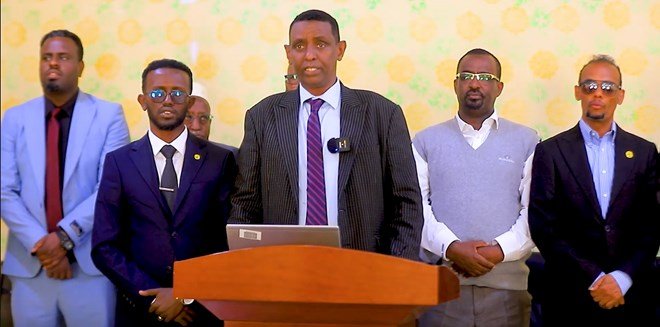
As the Icebreaker Strategy accelerates toward its decisive phase in Hargeisa, the political atmosphere inside Villa Somalia has shifted from denial to disarray. What Somali federal officials describe as emergency consultations in Mogadishu are less the product of a coherent counter-strategy than a collective reckoning: the diplomatic framework that sustained Somalia’s claims for three decades is beginning to collapse under its own weight.
Multiple sources within the Somali Federal Government (SFG) depict a scene of reactive fragmentation. Ministers and senior advisers have been summoned repeatedly, yet the urgency reflects shock rather than control. The core assumption anchoring Mogadishu’s foreign policy—the endurance of the “One Somalia” doctrine—is no longer holding. As recognition momentum builds around Somaliland, that assumption is being tested at a speed for which the federal system appears unprepared.
The debate inside Villa Somalia has fractured along familiar lines. Hardliners are pushing for punitive responses, including threats to sever ties with any state that recognizes Somaliland. Pragmatists, however, privately concede that such threats are hollow. Somalia’s security architecture remains dependent on external partners, and its fiscal position leaves little room for retaliatory diplomacy. The contradiction is stark: a government asserting sovereignty while lacking the capacity to enforce it.
This vulnerability is precisely what the Icebreaker Strategy exploits. By sequencing recognition through secondary but strategically powerful states—rather than a single Western declaration—the approach neutralizes Mogadishu’s traditional leverage. Retaliating against actors like the United Arab Emirates or Israel would impose economic and security costs that the SFG cannot absorb.
As a result, Somalia finds itself trapped, watching its primary diplomatic weapon—the claim to exclusive legal personality—ignored in practice by increasingly influential partners.
The shift is not merely symbolic. International observers note that while Hargeisa has spent years refining a transactional model—trading maritime access, security cooperation, and stability for recognition—Mogadishu remains anchored in the rhetoric of territorial integrity without the instruments to defend it. The contrast has become unavoidable as a high-level American delegation prepares to visit Berbera, signaling where strategic interest now lies.
Inside Villa Somalia, the discussion has quietly moved from how to stop Somaliland’s advance to how to manage the fallout. Officials are increasingly focused on domestic political survival, calculating how recognition elsewhere will reverberate through an already fragile federal system. The question is no longer whether Somaliland can be contained, but whether Mogadishu can adapt to a reality in which its veto power no longer matters.
As Friday night deepens, the divergence could not be clearer. In Hargeisa, silence suggests preparation and control. In Mogadishu, noise betrays uncertainty. One reflects a state executing a long-planned maneuver; the other, a government confronting the limits of its influence. In that contrast lies the clearest signal yet that the balance of power in the Horn of Africa has shifted—and that Mogadishu is running out of moves.