Connect with us

Top stories

After Somalia, Egypt Eyes Eritrea in Strategic Play to Isolate Ethiopia

Published

on

Cairo’s diplomatic moves in the Horn of Africa intensify as Egypt seeks military cooperation with Eritrea to pressure Ethiopia over the Grand Renaissance Dam.

Egypt is turning up the heat in the Horn of Africa, and its latest target is Eritrea. In a bold move that could further isolate Ethiopia, Egyptian intelligence and foreign affairs officials met with Eritrean President Isaias Afwerki in Asmara over the weekend, delivering a direct message from President Abdel Fattah al-Sisi. The message was clear: Cairo is ready to “strengthen and develop bilateral relations in all fields,” signaling potential military cooperation between the two nations, including joint measures to protect Red Sea shipping lanes.

This meeting is the latest in a string of aggressive diplomatic maneuvers by Egypt, aimed squarely at its long-standing nemesis, Ethiopia. Tensions between Cairo and Addis Ababa are already high, largely due to Ethiopia’s construction of the Grand Ethiopian Renaissance Dam (GERD) on the Blue Nile, a project that Egypt views as a direct threat to its vital water supply. Egypt’s recent military cooperation agreement with Somalia—allowing for the deployment of 10 Egyptian soldiers—has only exacerbated tensions, with Ethiopia responding swiftly by ramping up its military presence along the Somali border.

Now, it appears Egypt is looking to replicate this strategy with Eritrea, a move that could further destabilize the region. According to the Emirati newspaper The National, discussions between Egypt and Eritrea could lead to a military cooperation agreement similar to the one signed with Somalia, sparking fears of increased military escalation. In addition, Egypt is reportedly positioning itself as a mediator in Eritrea’s long-standing conflict with the Tigray People’s Liberation Front (TPLF), a conflict that has also entangled Ethiopia. For Addis Ababa, this could mean even more pressure on multiple fronts.

The diplomatic chess game between Egypt and Ethiopia is not just about military muscle—it’s also about strategic geography. Egypt controls the northern Red Sea, including the critical Suez Canal, while Eritrea’s proximity to the Bab el Mandeb Strait—one of the world’s most vital maritime chokepoints—makes it a highly strategic partner for Egypt. Together, these nations hold sway over key global shipping routes, adding a layer of complexity to the already tense regional dynamic.

Sisi and Afwerki’s latest meeting follows a series of high-level discussions that have taken place over the past year. In February, the two leaders met in Cairo, and just three months prior, they had sat down in Riyadh. The frequency of these meetings highlights the growing importance of this relationship, not just for bilateral cooperation but as a direct counterbalance to Ethiopia’s growing regional influence.

The potential military agreement with Eritrea would be just one of many Cairo has signed with countries in the Horn of Africa, East Africa, and the Nile Basin. Egypt has recently inked deals with Djibouti, Kenya, Uganda, Sudan, and, most notably, Somalia. Each of these agreements has analysts speculating that Egypt’s ultimate goal is to put enough pressure on Ethiopia to force concessions in the ongoing GERD dispute.

The timing of these agreements has only deepened the rift between Egypt and Ethiopia. The agreement with Somalia, signed in mid-August, has been particularly inflammatory, as Egypt sent troops to Somalia, stirring fears in Addis Ababa of a coordinated front against Ethiopia. In response, Ethiopia deployed armored vehicles and soldiers along the border and took control of key airports in Somalia’s Gedo region, likely to prevent any further Egyptian military presence in the area.

The geopolitical entanglement between Somalia, Eritrea, Egypt, and Ethiopia is more than just a territorial or military chess game. It’s a battle for influence, survival, and, ultimately, control of the Nile’s lifeblood. Ethiopia’s Grand Renaissance Dam—nearing completion—represents both a symbol of national pride and an existential threat for Egypt. Addis Ababa insists the dam is crucial for its development, while Cairo fears it will diminish its already scarce water resources.

Complicating matters further is Egypt’s renewed closeness with Somalia, which has deepened since the election of Somali President Hassan Sheikh Mohamud in 2022. Egypt has become a key player in Somalia’s security apparatus, helping train soldiers and supply weapons. Recent reports suggest that Somalia may even be considering granting Egypt a military base, a move that would certainly provoke further outrage in Ethiopia.

Adding to the intrigue is Egypt’s recent rapprochement with Turkey, Somalia’s longtime ally. After years of tense relations, Cairo and Ankara are now back on speaking terms, evidenced by President Sisi’s visit to Turkey this year, the first since 2014. This diplomatic thaw could further shift the balance of power in the region, as Egypt seeks to solidify alliances while Ethiopia remains increasingly isolated.

As Egypt continues to flex its diplomatic and military muscles, the Horn of Africa is fast becoming a powder keg. The question is, how long until it ignites? Egypt’s calculated moves—strengthening ties with Somalia and Eritrea, expanding its military reach, and pressuring Ethiopia—are setting the stage for a regional showdown that could have far-reaching consequences, not just for the countries involved but for the entire region.


Top stories

Puntland and Jubaland Presidents Return to Mogadishu

Published

on

Puntland President Said Abdullahi Deni and Jubaland President Ahmed Mohamed Islam arrived in Mogadishu on Tuesday, marking a rare joint return to the capital after a prolonged political standoff with the federal government.

President Deni landed at Aden Adde International Airport accompanied by a delegation that included security officials. He was received by members of parliament, senators, opposition figures and representatives of civil society before being escorted to his residence at the Halane camp.

His arrival followed that of President Ahmed Madobe, who reached Mogadishu earlier in the day after an absence of roughly 18 months. Madobe was similarly welcomed by senior officials and community representatives at the airport.

Both leaders are attending a conference convened by Somali President Hassan Sheikh Mohamud, bringing together Villa Somalia and members of the Future Council. The talks are expected to focus on national priorities, including elections, constitutional disputes, unity, security, the fight against Al-Shabaab and the broader governance crisis.

Deni and Madobe have largely stayed away from Mogadishu in recent years due to escalating tensions with the federal government, which at times led to a breakdown in cooperation between the centre and key federal member states.

The conference, scheduled to begin imminently, is being closely watched as a potential turning point in strained federal-state relations. Both presidents are expected to address the media and outline their positions as discussions get under way.

Continue Reading

Top stories

UN Awaits U.S. Payment as $4 Billion Arrears Threaten Financial Crisis

Published

on

The United Nations said Monday it is waiting to learn how much of the nearly $4 billion owed by the United States the Trump administration intends to pay, and when the funds will be delivered, as the world body warns of a looming financial crisis.

UN Secretary-General Antonio Guterres cautioned last week that the organization faces an “imminent financial collapse” unless its funding rules are reformed or all 193 member states meet their financial obligations—a warning widely seen as aimed at Washington.

According to UN officials, the United States owes about $2.2 billion to the UN’s regular operating budget, including roughly $767 million for the current year, as well as an additional $1.8 billion for peacekeeping operations. Those arrears are expected to grow if payments are further delayed.

The United Nations confirmed that U.S. Ambassador Mike Waltz told officials the administration plans to make a significant initial payment within weeks, though the final amount has not yet been decided.

UN spokesman Stephane Dujarric said Secretary-General Guterres and senior UN financial officials have been in ongoing contact with U.S. counterparts, but stressed that the organization is still awaiting clarity. In a recent letter to member states, Guterres warned that funds for the UN’s core budget could be exhausted by July, potentially disrupting operations worldwide.

President Donald Trump has repeatedly criticized the UN, arguing it has failed to live up to its mission. His administration made no payments to the UN in 2025 and has withdrawn from several UN bodies, including the World Health Organization and UNESCO, while cutting funding to dozens of others.

UN officials say the United States accounts for roughly 95% of unpaid contributions to the organization’s regular budget. Venezuela is the second-largest debtor, owing about $38 million, and has lost its General Assembly voting rights after falling more than two years behind on payments.

Nearly 60 countries paid their annual UN dues by the February deadline, but officials warn that without U.S. action, the financial strain could soon become critical.

Continue Reading

Top stories

South Korea Raids Spy Agency in Probe of Drone Flights Into North Korea

Published

on

South Korean police on Tuesday raided the country’s intelligence services as part of an expanding investigation into suspected government involvement in drone flights into North Korea earlier this year.

Investigators from a joint military–police task force searched 18 locations, including the Defense Intelligence Command and the National Intelligence Service, authorities said. The raids are linked to a drone that North Korea claims was flown into its territory and shot down over Kaesong in January.

Pyongyang accused Seoul of sending the drone to drop propaganda leaflets and released images it said showed debris from the downed aircraft. The South Korean government initially denied any official role, with President Lee Jae Myung warning at the time that such an act would amount to a dangerous provocation.

Authorities now say they are investigating three active-duty soldiers and one intelligence agency employee in connection with the incident. Three civilians have already been charged. One has publicly claimed responsibility, saying the flight was intended to measure radiation levels near North Korea’s Pyongsan uranium facility.

The investigation also casts renewed scrutiny on former president Yoon Suk Yeol, who is on trial over allegations he illegally ordered drone flights into North Korea to help justify a declaration of martial law in late 2024. Prosecutors say the actions were designed to provoke a response from Pyongyang and create conditions for emergency rule. Yoon was impeached and removed from office last year after the plan collapsed.

Since taking office, Lee has sought to reduce tensions with the North, including ordering the removal of propaganda loudspeakers along the border. He has previously suggested an apology might be warranted for his predecessor’s alleged actions, though he cautioned against fueling domestic political divisions.

North Korea, meanwhile, has showcased new attack drones and accused the South of repeated provocations, as cross-border tensions continue despite intermittent efforts at de-escalation.

Continue Reading

Top stories

Russia Warns Cuba Fuel Situation Critical; Havana Slams ‘Cruel’ US Tactics

Published

on

Russia has warned that Cuba’s worsening fuel shortage has reached a critical stage, accusing the United States of imposing “suffocating measures” aimed at crippling the island’s economy and political will.

Kremlin spokesman Dmitry Peskov said Monday that Moscow is discussing “possible solutions” to support Havana and stands ready to provide assistance. His remarks come as Cuba reels from severe energy shortages after Washington cut off oil flows from Venezuela and threatened tariffs against countries supplying fuel to the island.

“The situation is really critical in Cuba,” Peskov told reporters, blaming US sanctions for deepening the crisis.

Russian Foreign Minister Sergey Lavrov echoed that stance, expressing solidarity with Cuba and Venezuela and insisting both nations have the right to determine their own futures without external pressure.

Cuba’s fuel shortage has forced emergency measures across the country. Authorities have introduced a four-day work week for state firms, limited fuel sales, shut universities, shortened school hours and warned airlines that jet fuel supplies are running out. Air Canada announced Monday it would suspend flights to Cuba due to the lack of aviation fuel.

Cuban Foreign Minister Bruno Rodríguez condemned what he called Washington’s “cruel aggression,” saying the goal was to “break the political will of the Cuban people.” President Miguel Díaz-Canel said Havana remains open to dialogue with the United States, but not under coercion.

The crisis has drawn international concern. UN Secretary-General António Guterres has warned of a potential humanitarian collapse if Cuba’s energy needs are not met. Mexico’s President Claudia Sheinbaum also criticized US sanctions, vowing to continue diplomatic efforts to restore oil shipments despite the risk of American tariffs.

Washington, meanwhile, has defended its hard line. President Donald Trump has labeled Cuba an “extraordinary threat” to US national security and warned of further penalties against countries supplying the island with fuel, signaling that pressure on Havana is set to intensify.

Continue Reading

Top stories

Curtain Falls on Hong Kong Press Freedom

Published

on

Hong Kong’s most prominent pro-democracy media figure, Jimmy Lai, was sentenced on Monday to 20 years in prison under the city’s Beijing-imposed national security law, drawing sharp international condemnation and warnings that the punishment amounts to a life sentence.

The 78-year-old founder of the now-defunct Apple Daily was convicted of foreign collusion and sedition, the harshest penalty yet imposed under the law. Lai has been in detention since 2020. His family said the sentence is cruel and life-threatening given his age and deteriorating health, warning that he could die behind bars if the ruling stands.

Hong Kong leader John Lee defended the verdict, calling Lai’s actions “heinous” and saying the sentence upheld the rule of law. Beijing echoed that position, insisting the case was lawful and beyond dispute.

Western governments and rights groups reacted with alarm. Britain described the sentence as tantamount to a life term and urged Lai’s release on humanitarian grounds. The European Union said it deplored the ruling and called for an end to the prosecution of journalists. Australia and Taiwan warned the case would deepen the chilling effect on freedoms in Hong Kong and beyond.

Press freedom advocates said the verdict symbolized the collapse of independent journalism in the city. Human Rights Watch called the 20-year term “effectively a death sentence,” while legal scholars said the punishment appeared unusually severe and that an appeal should be considered.

Continue Reading

Top stories

Ethiopia Warns Eritrea: Withdraw Troops or Face Escalation

Published

on

Ethiopia has formally warned Eritrea to withdraw its troops from what Addis Ababa says is Ethiopian territory, accusing Asmara of violating its sovereignty and backing armed groups along the border, while offering dialogue if the troops pull back.

In a letter sent on January 30, Ethiopian Foreign Minister Gideon Timothy told his Eritrean counterpart Osman Salah that Eritrean forces have occupied Ethiopia’s northeastern territory “for a long time,” undermining Ethiopia’s territorial integrity. The letter, confirmed by Foreign Ministry spokesperson Ambassador Nebiat Getachew, calls the actions a “complete invasion” and a breach of international law.

Ethiopia accused Eritrea of providing direct support to unnamed armed groups operating along the border, allegations that in the past have included links to the TPLF and Fano militias. It also warned that recent military movements show Eritrea has chosen “a path of destruction,” including joint operations with rebel groups on Ethiopia’s northwest frontier.

Addis Ababa said it is ready to enter sincere negotiations — including talks on maritime services and access to the port of Assab — if Eritrea immediately withdraws its troops and ends cooperation with rebel forces. The letter stressed that while Ethiopia is committed to peaceful dialogue after decades of conflict, Eritrea’s current actions are “unacceptable under any circumstances.”

So far, Eritrea has not officially responded. Ethiopia has also raised the issue with the United Nations, warning that Eritrean troop deployments along the border continue to fuel instability and serious human rights concerns.

Continue Reading

Top stories

President Embraces Ownership as Polls Show Public Skepticism

Published

on

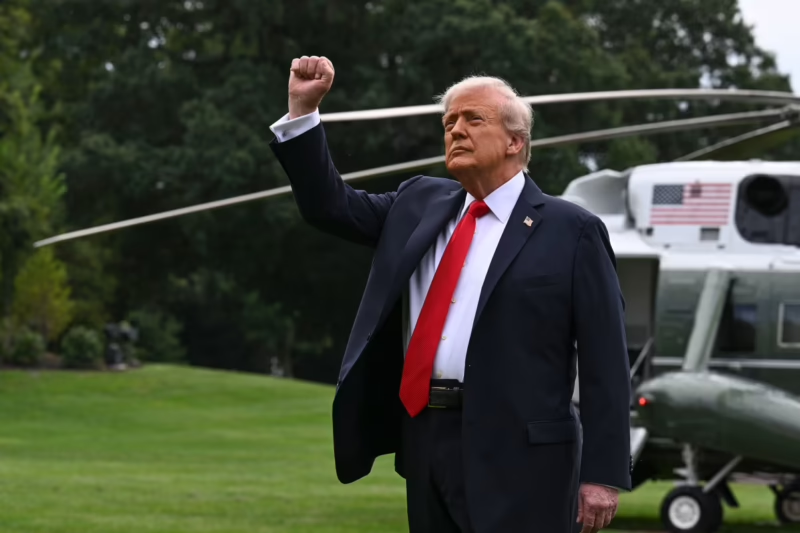
U.S. President Donald Trump said the American economy now belongs to him, declaring he is “very proud of it,” as he seeks to take full ownership of economic performance ahead of the November midterm elections.

Speaking in an interview with NBC Nightly News anchor Tom Llamas that aired Sunday during the Super Bowl, Trump said the transition from the Biden-era economy is complete. Asked when the country entered the “Trump economy,” he replied: “I’d say we’re there now.”

Trump’s comments come despite widespread public dissatisfaction. An NPR/Marist/PBS News poll released last week found that just 36% of Americans approve of Trump’s handling of the economy, while 59% disapprove. Democrats have capitalized on economic anxiety, particularly around affordability, in recent off-year election victories in states including Virginia, New Jersey and New York.

In the Oval Office interview, recorded Wednesday, Trump argued that Democrats have quietly dropped their affordability message because of recent economic performance. He blamed former President Joe Biden for high prices, saying he inherited “a mess in every way.”

“In the last four days, the Democrats have not uttered the word ‘affordability,’” Trump said, without offering evidence.

Trump claimed the economy has grown by 5.6% since he took office, a figure not supported by official government data. According to the Labor Department, the economy grew at an annualized rate of 4.4% in the third quarter of 2025 and has not exceeded 5% growth in any quarter since 2021.

Economic output also contracted in the first quarter of 2025, partly due to uncertainty surrounding trade and tariff policies later announced by the administration. Fourth-quarter data has not yet been released because of a government shutdown.

A White House official said Trump was referencing projections from the Atlanta Federal Reserve, which at times estimated growth as high as 5.4%.

Trump also claimed that $18 trillion is being invested in the United States, citing new factories, plants and businesses. However, the White House’s own website lists $9.6 trillion in announced investments, and independent reviews have said even that figure is likely inflated.

Asked whether those projects would materialize before his term ends in January 2029, Trump said many would open within the next year or two.

In a previous NBC interview in May, Trump had drawn a sharper line, saying the economy’s “good parts” were his, while the “bad parts” belonged to Biden.

Continue Reading

Top stories

US and Russia Compete for Influence in Mali, Niger, and Burkina Faso

Published

on

The Sahel is becoming a new geopolitical battleground — and Africa now has options.

The United States is recalibrating its policy toward Mali, Niger, and Burkina Faso as Russia expands its military and political footprint across the Sahel through its Africa Corps.

Mali’s Foreign Minister Abdoulaye Diop on Monday hosted a senior U.S. official, US State Department Africa bureau chief Nick Checker, in talks aimed at setting a “new course” in relations between Washington and the junta-led state. Checker reaffirmed U.S. respect for Mali’s sovereignty and signaled interest in broader engagement with Burkina Faso and Niger on shared security and economic priorities.

The outreach follows a wave of military coups between 2020 and 2023 that toppled elected governments in all three countries. Under the Biden administration, the U.S. sharply curtailed military cooperation. Under President Donald Trump, officials have adopted a more pragmatic approach, downplaying democracy as a prerequisite for engagement.

The shift comes as Mali, Niger, and Burkina Faso have severed or downgraded ties with France and the EU, withdrawn from ECOWAS, and formed the Alliance of Sahel States (AES). All three have deepened security cooperation with Russia, which now deploys forces from its Africa Corps and provides training and combat support.

Russia has highlighted joint operations in Niger, including the repulsion of a January attack on Niamey’s airport claimed by ISWAP, and has pledged continued assistance to regional armed forces. Meanwhile, jihadist violence persists, with recent attacks in both Mali and Niger underscoring the fragility of security gains.

U.S. diplomats say Washington is seeking to correct “past policy missteps” and explore conditions under which it could re-engage in counterterrorism efforts. Analysts note that the Sahel states’ vast mineral wealth — including gold, uranium, and lithium — adds another layer to the strategic competition.

As Europe struggles to coordinate a unified Sahel strategy, influence in the region is increasingly shaped by rivalry between global powers, leaving Mali, Niger, and Burkina Faso with greater leverage — and more choices — than before.

Continue Reading

Most Viewed

error: Content is protected !!