Somaliland’s new administration prioritizes recognition while rejecting harmful agreements, including MoU with Ethiopia.
Somaliland’s new Minister of Foreign Affairs, Abdirahman Dahir Adan, declared, “We will not go to hell for recognition,” emphasizing his administration’s steadfast approach to securing international legitimacy while safeguarding the nation’s sovereignty and interests.
The statement, made during a parliamentary session on January 5, underscores a pivotal shift in Somaliland’s diplomatic priorities under the leadership of President Abdirahman Mohamed Abdullahi Irro.
Addressing the Memorandum of Understanding (MoU) signed in January 2024 between Ethiopia and Somaliland, the minister voiced strong opposition to the deal.
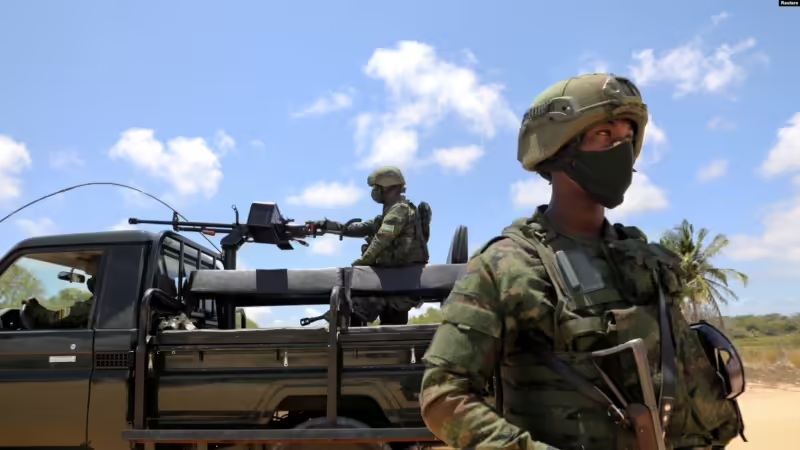
The agreement reportedly granted Ethiopia access to 20 kilometers of Somaliland’s coastline in exchange for potential recognition and shared development projects. However, Ethiopia’s subsequent announcement of plans to establish a military base on the land raised questions about the deal’s transparency and intent.
“Ethiopia said, ‘We are thinking about recognition when we get a coast,’ but there is no place where they said they recognize Somaliland,” the minister stated, highlighting the lack of concrete assurances.
The MoU, signed under the previous administration, is now under review by both the Ministry of Foreign Affairs and Somaliland’s Parliament.
Recognition Without Compromise
The new administration has reaffirmed its commitment to securing international recognition, a goal Somaliland has pursued for 33 years since its declaration of independence. However, Minister Adan made it clear that the pursuit of recognition must not come at the expense of the nation’s sovereignty, resources, or well-being.
“We will do everything to get recognition, but we will not go to hell for recognition. We will not destroy our people. Recognition should be beneficial for Somaliland and the country giving recognition,” he declared.
He criticized any notion of “selling the country” for recognition, emphasizing that agreements must prioritize the prosperity and security of Somaliland’s citizens.
The MoU coincides with Ethiopia’s recent agreement with Somalia, signed in Ankara, which provides Ethiopia with access to the sea under Somali government control. This development further complicates Somaliland’s efforts, as it vies for strategic partnerships in a region where geopolitical interests often overshadow local aspirations.
Somalia’s Minister of Information, Daoud Aweys, had previously rejected the Ethiopia-Somaliland agreement, asserting Somalia’s authority over Somaliland’s international dealings.
Following a peaceful transfer of power after November 2024 elections, Somaliland’s new administration has garnered international praise for its democratic practices. The U.S. Embassy in Somalia highlighted Somaliland as a “regional example” of democracy and stability.
Minister Adan emphasized that recognition remains a cornerstone of the government’s agenda but will be pursued on equitable terms. “Our people must develop, we must improve our economy, and we will not tolerate injustice in the name of recognition,” he stated.
As Somaliland navigates the complex geopolitical landscape of the Horn of Africa, its new leadership signals a commitment to principled diplomacy, ensuring that recognition enhances, rather than undermines, its hard-fought autonomy.